Institute for Lung Health, NIHR Respiratory Biomedical Research Unit, Department of Infection, Immunity & Inflammation, University of Leicester, Leicester, UK.
BMC Pulm Med. 2014 Jul 9;14:112. doi: 10.1186/1471-2466-14-112.
Eosinophilic airway inflammation is observed in 10-30% of COPD subjects. Whether increased eosinophils or impairment in their clearance by macrophages is associated with the severity and frequency of exacerbations is unknown.
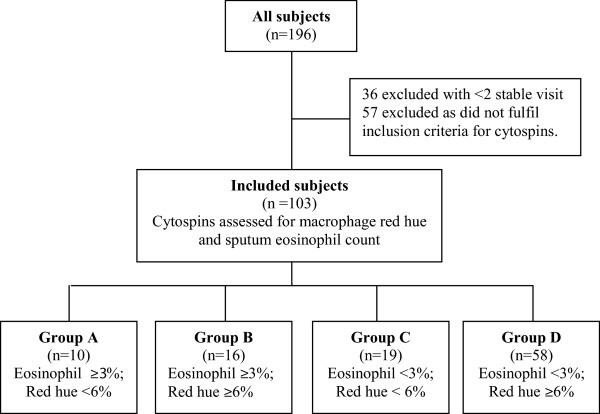
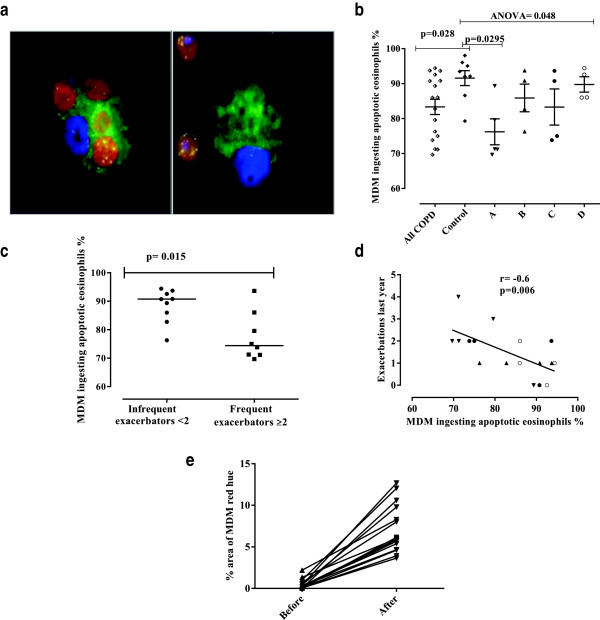
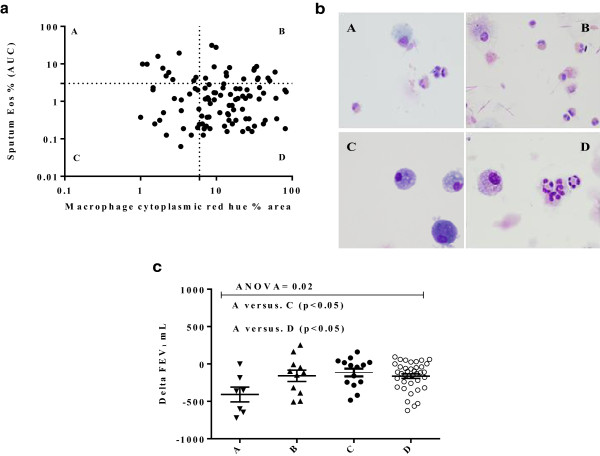
We categorised 103 COPD subjects into 4 groups determined by the upper limit of normal for their cytoplasmic macrophage red hue (<6%), an indirect measure of macrophage efferocytosis of eosinophils, and area under the curve sputum eosinophil count (≥ 3%/year). Eosinophil efferocytosis by monocyte-derived macrophages was studied in 17 COPD subjects and 8 normal controls.
There were no differences in baseline lung function, health status or exacerbation frequency between the groups: A-low red hue, high sputum eosinophils (n=10), B-high red hue, high sputum eosinophils (n=16), C-low red hue, low sputum eosinophils (n=19) and D- high red hue, low sputum eosinophils (n=58). Positive bacterial culture was lower in groups A (10%) and B (6%) compared to C (44%) and D (21%) (p=0.01). The fall in FEV1 from stable to exacerbation was greatest in group A (ΔFEV1 [95 % CI] -0.41 L [-0.65 to -0.17]) versus group B (-0.16 L [-0.32 to -0.011]), C (-0.11 L [-0.23 to -0.002]) and D (-0.16 L [-0.22 to -0.10]; p=0.02). Macrophage efferocytosis of eosinophils was impaired in COPD versus controls (86 [75 to 92]% versus 93 [88 to 96]%; p=0.028); was most marked in group A (71 [70 to 84]%; p=0.0295) and was inversely correlated with exacerbation frequency (r=-0.63; p=0.006).
Macrophage efferocytosis of eosinophils is impaired in COPD and is related to the severity and frequency of COPD exacerbations.
嗜酸性气道炎症在 10-30%的 COPD 患者中观察到。增加的嗜酸性粒细胞或巨噬细胞清除它们的能力受损是否与加重的严重程度和频率有关尚不清楚。
我们将 103 名 COPD 患者分为 4 组,根据细胞质巨噬细胞红色调(<6%)的正常上限来确定,这是巨噬细胞吞噬嗜酸性粒细胞的间接衡量标准,以及痰中嗜酸性粒细胞计数的曲线下面积(≥3%/年)。在 17 名 COPD 患者和 8 名正常对照者中研究了单核细胞衍生的巨噬细胞对嗜酸性粒细胞的吞噬作用。
各组间的基础肺功能、健康状况或加重频率无差异:A-低红色调、高痰嗜酸性粒细胞(n=10)、B-高红色调、高痰嗜酸性粒细胞(n=16)、C-低红色调、低痰嗜酸性粒细胞(n=19)和 D-高红色调、低痰嗜酸性粒细胞(n=58)。与 C 组(44%)和 D 组(21%)相比,A 组(10%)和 B 组(6%)的阳性细菌培养率较低(p=0.01)。从稳定期到加重期,FEV1 的下降幅度在 A 组最大(ΔFEV1[95%CI]-0.41L[-0.65 至-0.17]),而 B 组为-0.16L[-0.32 至-0.011])、C 组为-0.11L[-0.23 至-0.002])和 D 组为-0.16L[-0.22 至-0.10];p=0.02)。与对照组相比,COPD 患者的巨噬细胞吞噬嗜酸性粒细胞的能力受损(86[75 至 92]%对 93[88 至 96]%;p=0.028);在 A 组最为明显(71[70 至 84]%;p=0.0295),与加重频率呈负相关(r=-0.63;p=0.006)。
COPD 患者的巨噬细胞吞噬嗜酸性粒细胞的能力受损,与 COPD 加重的严重程度和频率有关。