Fraticelli Paolo, Gabrielli Barbara, Pomponio Giovanni, Valentini Gabriele, Bosello Silvia, Riboldi Piersandro, Gerosa Maria, Faggioli Paola, Giacomelli Roberto, Del Papa Nicoletta, Gerli Roberto, Lunardi Claudio, Bombardieri Stefano, Malorni Walter, Corvetta Angelo, Moroncini Gianluca, Gabrielli Armando
Arthritis Res Ther. 2014 Jul 8;16(4):R144. doi: 10.1186/ar4606.
Pulmonary involvement represents a major cause of death of systemic sclerosis (SSc) patients. Recent data suggest that tyrosine kinase inhibitors, such as imatinib, may be a therapeutic option for SSc patients. However, preliminary published clinical trials were inconclusive about imatinib efficacy and showed side effects. The purpose of this study was to verify efficacy and tolerability of low-dose imatinib on interstitial lung disease in a cohort of SSc patients unresponsive to cyclophosphamide therapy.
Thirty consecutive SSc patients with active pulmonary involvement, unresponsive to cyclophosphamide, were treated with imatinib 200 mg/day for 6 months followed by a 6-month follow-up. A "good response" was defined as an increase of forced vital capacity (FVC) by more of 15% and/or increase of diffusing capacity of carbon monoxide (DLCO) >15% and PaO2 > 90% of initial value and high-resolution computed tomography (HRCT)-scan pattern unchanged or improved.
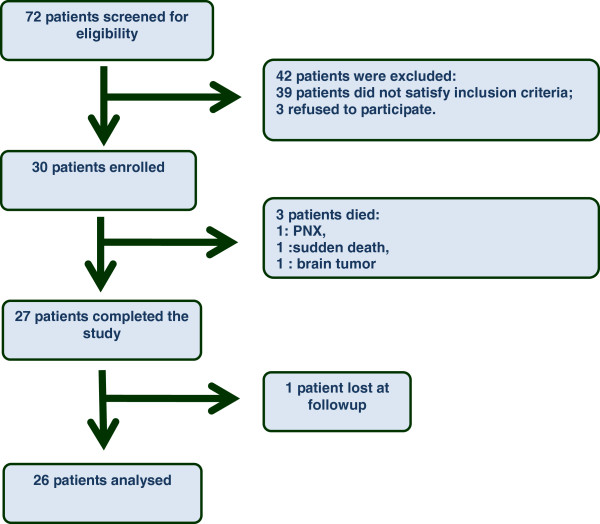
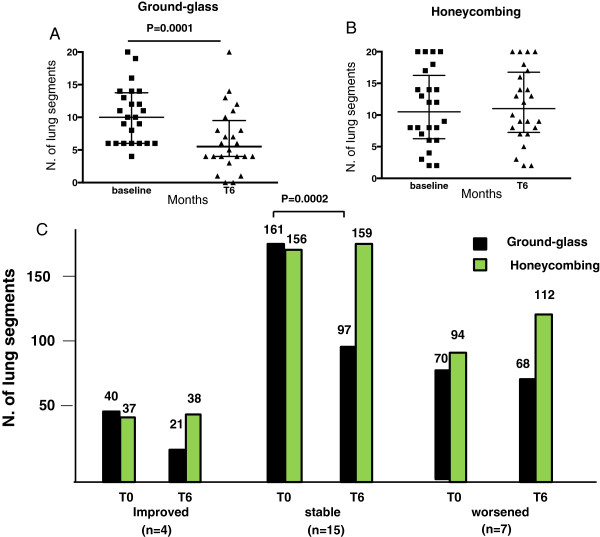
Twenty-six patients completed the study. Three patients died and one patient was lost to follow-up. Four patients (15.32%) had a good response, 7 worsened and 15 had a stabilized lung disease. Overall, 19 (73.07%) patients had an improved or stabilized lung disease. After a 6-month follow-up, 12 (54.5%) of the 22 patients showed an improved or stabilized lung disease.
Lung function was stabilized in a large proportion of patients unresponsive to cyclophosphamide therapy and a beneficial outcome emerged from the analysis of HRCT lung scans. There was no significant improvement of skin involvement, and the low dose was well tolerated. These data provide useful suggestions to design future randomized clinical trials for SSc therapeutics.
ClinicalTrials.gov NCT00573326. Registered 13 December 2007.
肺部受累是系统性硬化症(SSc)患者的主要死亡原因。近期数据表明,酪氨酸激酶抑制剂,如伊马替尼,可能是SSc患者的一种治疗选择。然而,已发表的初步临床试验对于伊马替尼的疗效尚无定论,且显示出副作用。本研究的目的是验证低剂量伊马替尼对一组对环磷酰胺治疗无反应的SSc患者间质性肺病的疗效和耐受性。
连续纳入30例有活动性肺部受累且对环磷酰胺无反应的SSc患者,给予伊马替尼200mg/天治疗6个月,随后进行6个月的随访。“良好反应”定义为用力肺活量(FVC)增加超过15%和/或一氧化碳弥散量(DLCO)增加>15%且动脉血氧分压(PaO2)>初始值的90%,同时高分辨率计算机断层扫描(HRCT)扫描模式未改变或有所改善。
26例患者完成了研究。3例患者死亡,1例患者失访。4例患者(15.32%)有良好反应,7例病情恶化,15例病情稳定。总体而言,19例(73.07%)患者的肺部疾病有所改善或稳定。经过6个月的随访,22例患者中有12例(54.5%)肺部疾病有所改善或稳定。
在很大一部分对环磷酰胺治疗无反应的患者中,肺功能得以稳定,HRCT肺部扫描分析显示出有益的结果。皮肤受累情况无显著改善,低剂量耐受性良好。这些数据为设计未来SSc治疗的随机临床试验提供了有用的建议。
ClinicalTrials.gov NCT00573326。于2007年12月13日注册。