Schwartz Jacob C, Podell Elaine R, Han Steve S W, Berry James D, Eggan Kevin C, Cech Thomas R
Howard Hughes Medical Institute, Department of Chemistry and Biochemistry and BioFrontiers Institute, University of Colorado, Boulder, CO 80309.
Department of Neurology, Massachusetts General Hospital, Boston, MA 02114 Howard Hughes Medical Institute, Harvard Stem Cell Institute and Department of Stem Cell and Regenerative Biology, Harvard University, Cambridge, MA 02138.
Mol Biol Cell. 2014 Sep 1;25(17):2571-8. doi: 10.1091/mbc.E14-05-1007. Epub 2014 Jul 9.
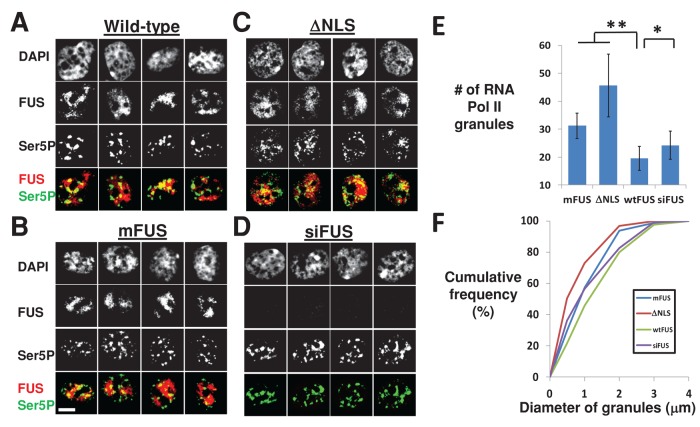
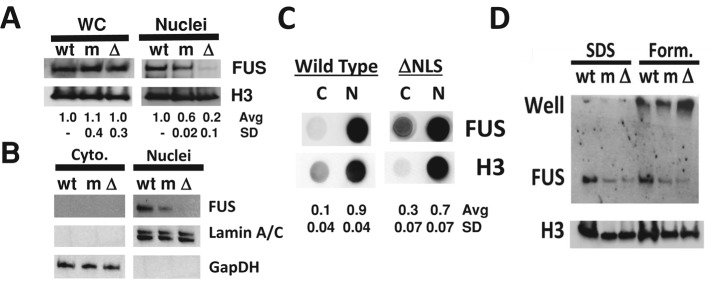
Mutations in the RNA-binding protein FUS have been shown to cause the neurodegenerative disease amyotrophic lateral sclerosis (ALS). We investigate whether mutant FUS protein in ALS patient-derived fibroblasts affects normal FUS functions in the nucleus. We investigated fibroblasts from two ALS patients possessing different FUS mutations and a normal control. Fibroblasts from these patients have their nuclear FUS protein trapped in SDS-resistant aggregates. Genome-wide analysis reveals an inappropriate accumulation of Ser-2 phosphorylation on RNA polymerase II (RNA Pol II) near the transcription start sites of 625 genes for ALS patient cells and after small interfering RNA (siRNA) knockdown of FUS in normal fibroblasts. Furthermore, both the presence of mutant FUS protein and siRNA knockdown of wild-type FUS correlate with altered distribution of RNA Pol II within fibroblast nuclei. A loss of FUS function in orchestrating Ser-2 phosphorylation of the CTD of RNA Pol II is detectable in ALS patient-derived fibroblasts expressing mutant FUS protein, even when the FUS protein remains largely nuclear. A likely explanation for this loss of function is the aggregation of FUS protein in nuclei. Thus our results suggest a specific mechanism by which mutant FUS can have biological consequences other than by the formation of cytoplasmic aggregates.
RNA 结合蛋白 FUS 的突变已被证明会导致神经退行性疾病肌萎缩侧索硬化症(ALS)。我们研究了 ALS 患者来源的成纤维细胞中的突变 FUS 蛋白是否会影响细胞核中正常 FUS 的功能。我们研究了来自两名具有不同 FUS 突变的 ALS 患者以及一名正常对照的成纤维细胞。这些患者的成纤维细胞核 FUS 蛋白被困在抗 SDS 的聚集体中。全基因组分析显示,在 ALS 患者细胞中以及正常成纤维细胞中 FUS 被小干扰 RNA(siRNA)敲低后,RNA 聚合酶 II(RNA Pol II)在 625 个基因转录起始位点附近的 Ser-2 磷酸化出现不适当的积累。此外,突变 FUS 蛋白的存在以及野生型 FUS 的 siRNA 敲低都与 RNA Pol II 在成纤维细胞核内分布的改变相关。在表达突变 FUS 蛋白的 ALS 患者来源的成纤维细胞中,即使 FUS 蛋白大部分仍位于细胞核内,也可检测到 FUS 在协调 RNA Pol II CTD 的 Ser-2 磷酸化方面的功能丧失。这种功能丧失的一个可能解释是 FUS 蛋白在细胞核内聚集。因此,我们的结果提示了一种特定机制,通过该机制突变 FUS 除了通过形成细胞质聚集体之外还能产生生物学后果。