Department of Psychiatry, Institute of Psychiatric Research, Indiana University School of Medicine Indianapolis, IN, USA.
Titus Family Department of Clinical Pharmacy and Pharmaceutical Economics and Policy, School of Pharmacy, University of Southern California Los Angeles, CA, USA.
Front Neurosci. 2014 Jun 24;8:176. doi: 10.3389/fnins.2014.00176. eCollection 2014.
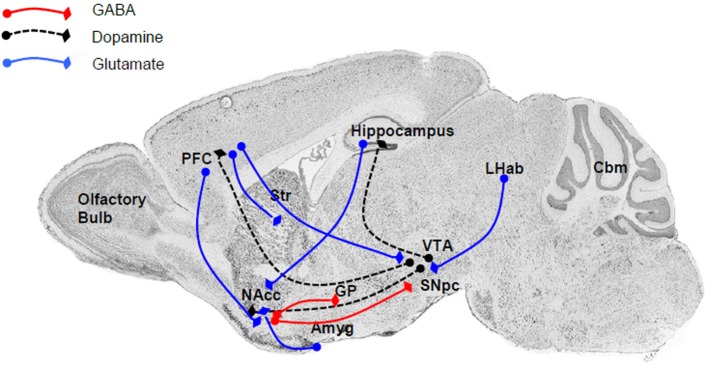
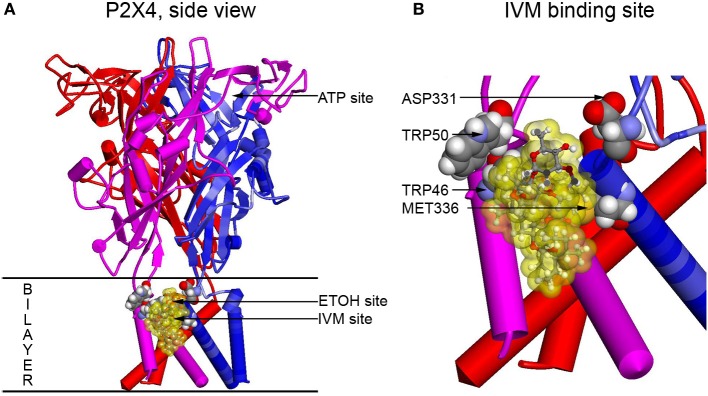
Alcohol use disorders (AUDs) have a staggering socioeconomic impact. Few therapeutic options are available, and they are largely inadequate. These shortcomings highlight the urgent need to develop effective medications to prevent and/or treat AUDs. A critical barrier is the lack of information regarding the molecular target(s) by which ethanol (EtOH) exerts its pharmacological activity. This review highlights findings implicating P2X4 receptors (P2X4Rs) as a target for the development of therapeutics to treat AUDs and discusses the use of ivermectin (IVM) as a potential clinical tool for treatment of AUDs. P2XRs are a family of ligand-gated ion channels (LGICs) activated by extracellular ATP. Of the P2XR subtypes, P2X4Rs are expressed the most abundantly in the CNS. Converging evidence suggests that P2X4Rs are involved in the development and progression of AUDs. First, in vitro studies report that pharmacologically relevant EtOH concentrations can negatively modulate ATP-activated currents. Second, P2X4Rs in the mesocorticolimbic dopamine system are thought to play a role in synaptic plasticity and are located ideally to modulate brain reward systems. Third, alcohol-preferring (P) rats have lower functional expression of the p2rx4 gene than alcohol-non-preferring (NP) rats suggesting an inverse relationship between alcohol intake and P2X4R expression. Similarly, whole brain p2rx4 expression has been shown to relate inversely to innate 24 h alcohol preference across 28 strains of rats. Fourth, mice lacking the p2rx4 gene drink more EtOH than wildtype controls. Fifth, IVM, a positive modulator of P2X4Rs, antagonizes EtOH-mediated inhibition of P2X4Rs in vitro and reduces EtOH intake and preference in vivo. These findings suggest that P2X4Rs contribute to EtOH intake. The present review summarizes recent findings focusing on the P2X4R as a molecular target of EtOH action, its role in EtOH drinking behavior and modulation of its activity by IVM as a potential therapy for AUDs.
酒精使用障碍 (AUDs) 对社会经济有巨大影响。目前可用的治疗选择很少,而且往往不够充分。这些不足突显了开发有效药物来预防和/或治疗 AUDs 的迫切需要。一个关键的障碍是缺乏关于乙醇 (EtOH) 发挥其药理活性的分子靶标 (s) 的信息。本综述强调了 P2X4 受体 (P2X4Rs) 作为开发治疗 AUDs 的治疗药物的靶标的发现,并讨论了伊维菌素 (IVM) 作为治疗 AUDs 的潜在临床工具的使用。P2XR 是一组由细胞外 ATP 激活的配体门控离子通道 (LGIC)。在 P2XR 亚型中,P2X4Rs 在中枢神经系统中表达最为丰富。越来越多的证据表明,P2X4Rs 参与了 AUDs 的发展和进展。首先,体外研究报告称,药理学相关的 EtOH 浓度可以负调节 ATP 激活的电流。其次,认为中皮质边缘多巴胺系统中的 P2X4Rs 在突触可塑性中起作用,并且位于理想的位置以调节大脑奖励系统。第三,与酒精非偏好 (NP) 大鼠相比,酒精偏好 (P) 大鼠的 p2rx4 基因的功能表达较低,这表明酒精摄入与 P2X4R 表达之间存在反比关系。同样,整个大脑 p2rx4 表达已被证明与 28 种大鼠的 24 小时内对酒精的先天偏好呈反比关系。第四,缺乏 p2rx4 基因的小鼠比野生型对照喝更多的 EtOH。第五,IVM,P2X4Rs 的正调节剂,在体外拮抗 EtOH 对 P2X4Rs 的抑制作用,并减少体内 EtOH 的摄入和偏好。这些发现表明 P2X4Rs 有助于 EtOH 的摄入。本综述总结了最近的发现,重点是 P2X4R 作为 EtOH 作用的分子靶标,其在 EtOH 饮酒行为中的作用以及 IVM 对其活性的调节作为 AUDs 的潜在治疗方法。