
使用生物反应器和富血小板血浆构建组织工程骨
Construction of tissue-engineered bone using a bioreactor and platelet-rich plasma.
作者信息
Wang Dong, Jiang Honglei, Wang Shuzhen, Li Huibo, Zhang Huawu, Zhao Lei, Peng Tao, Cao Zhong, Sun Shui
机构信息
Department of Orthopaedics, Provincial Hospital Affiliated to Shandong University, Jinan, Shandong 250022, P.R. China.
Department of Cardiology, Provincial Hospital Affiliated to Shandong University, Jinan, Shandong 250022, P.R. China.
出版信息
Exp Ther Med. 2014 Aug;8(2):413-418. doi: 10.3892/etm.2014.1774. Epub 2014 Jun 11.
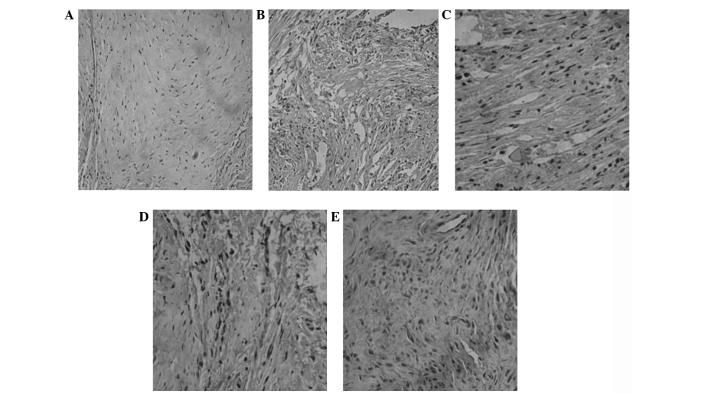
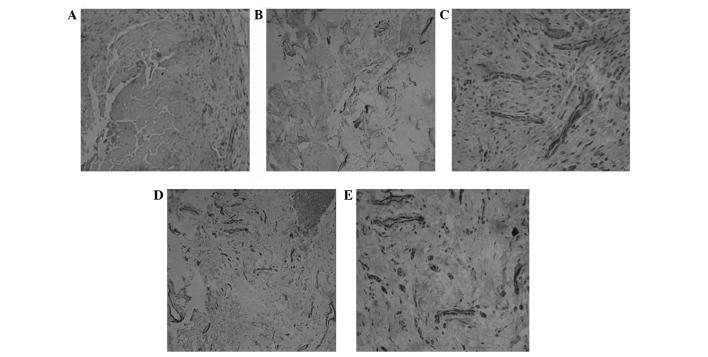
The aim of the present study was to construct tissue-engineered bone using a bioreactor and platelet-rich plasma (PRP). Bone marrow mesenchymal stem cells (BMSCs) and β-tricalcium phosphate (β-TCP) were cultured in a perfusion bioreactor with PRP-containing medium for 21 days to form a BMSC-TCP composite. Rabbits were then implanted with the BMSC-TCP composite. The morphology of the implanted BMSC-TCP composite was observed three months after surgery by scanning electron microscopy and hematoxylin and eosin (H&E) staining. In addition, the expression of cluster of differentiation (CD)31 and von Willebrand factor (WF) in the implanted BMSC-TCP composite was detected using immunohistochemistry. Bone formation was determined by comprehensive testing Following culture in a perfusion bioreactor and PRP, the BMSCs adhered to the β-TCP scaffold and the secretion of extracellular matrix was observed. The spreading and proliferation of cells was found to be enhanced on the scaffold. Furthermore, the vascular endothelial cell markers CD31 and VEF, were positively expressed. Therefore, these results suggest that tissue-engineered bone may be constructed using a bioreactor and PRP. PRP, which contains multiple growth factors, may promote vascularization of tissue-engineered bone.
本研究的目的是使用生物反应器和富血小板血浆(PRP)构建组织工程骨。将骨髓间充质干细胞(BMSCs)和β-磷酸三钙(β-TCP)在含有PRP的培养基的灌注生物反应器中培养21天,以形成BMSC-TCP复合物。然后将BMSC-TCP复合物植入兔子体内。术后三个月通过扫描电子显微镜和苏木精-伊红(H&E)染色观察植入的BMSC-TCP复合物的形态。此外,使用免疫组织化学检测植入的BMSC-TCP复合物中分化簇(CD)31和血管性血友病因子(WF)的表达。通过综合测试确定骨形成。在灌注生物反应器和PRP中培养后,BMSCs附着于β-TCP支架,并观察到细胞外基质的分泌。发现细胞在支架上的铺展和增殖增强。此外,血管内皮细胞标志物CD31和VEF呈阳性表达。因此,这些结果表明可以使用生物反应器和PRP构建组织工程骨。含有多种生长因子的PRP可能促进组织工程骨的血管化。

 Zotero 插件