Huang Yong, Li LE-Ping
Department of Gastrointestinal Surgery, Provincial Hospital Affiliated to Shandong University, Jinan, Shandong 250021, P.R. China ; Department of General Surgery, Zao Zhuang Municipal Hospital, Zaozhuang, Shandong 277101, P.R. China.
Department of Gastrointestinal Surgery, Provincial Hospital Affiliated to Shandong University, Jinan, Shandong 250021, P.R. China.
Oncol Lett. 2014 Aug;8(2):493-501. doi: 10.3892/ol.2014.2231. Epub 2014 Jun 5.
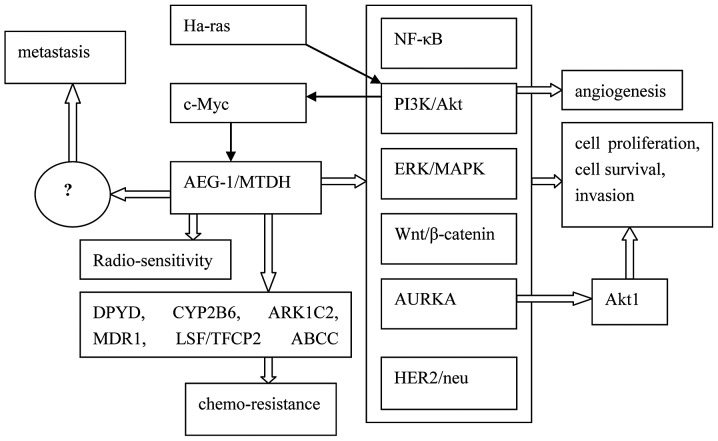
Tumor development is initiated by an accumulation of numerous genetic and epigenetic alterations that promote tumor initiation, invasion and metastasis. Astrocyte elevated gene-1 [AEG-1; also known as Metadherin (MTDH) and Lysine-rich CEACAM1 co-isolated (LYRIC)] has emerged in recent years as a potentially crucial mediator of tumor malignancy, and a key converging point of a complex network of oncogenic signaling pathways. AEG-1/MTDH has a multifunctional role in tumor development that has been found to be involved in the following signaling cascades: i) The Ha-Ras and PI3K/Akt pathways; ii) the nuclear factor-κB signaling pathway; iii) the ERK/mitogen-activated protein kinase and Wnt/β-catenin pathways; and iv) the Aurora-A kinase signaling pathway. Studies have established that AEG-1/MTDH is crucial in tumor progression, including transformation, the evasion of apoptosis, invasion, angiogenesis and metastasis. In addition, recent clinical studies have convincingly associated AEG-1/MTDH with tumor progression and poor prognosis in a number of cancer types, including hepatocellular, esophageal squamous cell, gallbladder and renal cell carcinomas, breast, non-small cell lung, prostate, gastric and colorectal cancers, and glioma, melanoma, neuroblastoma and osteosarcoma. AEG-1/MTDH may be used as a biomarker to identify subgroups of patients who require more intensive treatments and who are likely to benefit from AEG-1/MTDH-targeted therapies. The therapeutic targeting of AEG-1/MTDH may simultaneously block metastasis, suppress tumor growth and enhance the efficacy of chemotherapeutic treatments.
肿瘤的发生是由众多促进肿瘤起始、侵袭和转移的基因和表观遗传改变的积累所引发的。近年来,星形胶质细胞上调基因1 [AEG-1;也称为黏附素(MTDH)和富含赖氨酸的癌胚抗原相关细胞黏附分子1共分离蛋白(LYRIC)] 已成为肿瘤恶性程度的潜在关键调节因子,以及致癌信号通路复杂网络的关键汇聚点。AEG-1/MTDH在肿瘤发生发展中具有多功能作用,已发现其参与以下信号级联反应:i)Ha-Ras和PI3K/Akt信号通路;ii)核因子-κB信号通路;iii)ERK/丝裂原活化蛋白激酶和Wnt/β-连环蛋白信号通路;以及iv)Aurora-A激酶信号通路。研究表明,AEG-1/MTDH在肿瘤进展中至关重要,包括细胞转化、凋亡逃避、侵袭、血管生成和转移。此外,最近的临床研究令人信服地表明,AEG-1/MTDH与多种癌症类型的肿瘤进展和不良预后相关,包括肝细胞癌、食管鳞状细胞癌、胆囊癌和肾细胞癌、乳腺癌、非小细胞肺癌、前列腺癌、胃癌和结直肠癌以及神经胶质瘤、黑色素瘤、神经母细胞瘤和骨肉瘤。AEG-1/MTDH可作为一种生物标志物,用于识别需要更强化治疗且可能从AEG-1/MTDH靶向治疗中获益的患者亚组。对AEG-1/MTDH进行治疗性靶向可能同时阻断转移、抑制肿瘤生长并提高化疗疗效。