College of Pharmacy, Chungbuk National University, Cheongju 361-763.
School of Equine industries, Cheju Halla University, Jeju 690-708.
Biomol Ther (Seoul). 2014 May;22(3):232-8. doi: 10.4062/biomolther.2014.030.
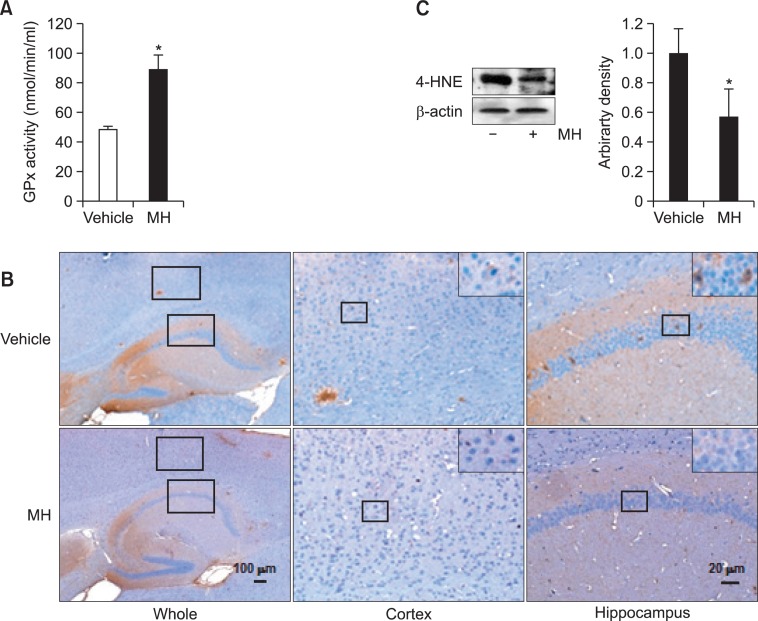
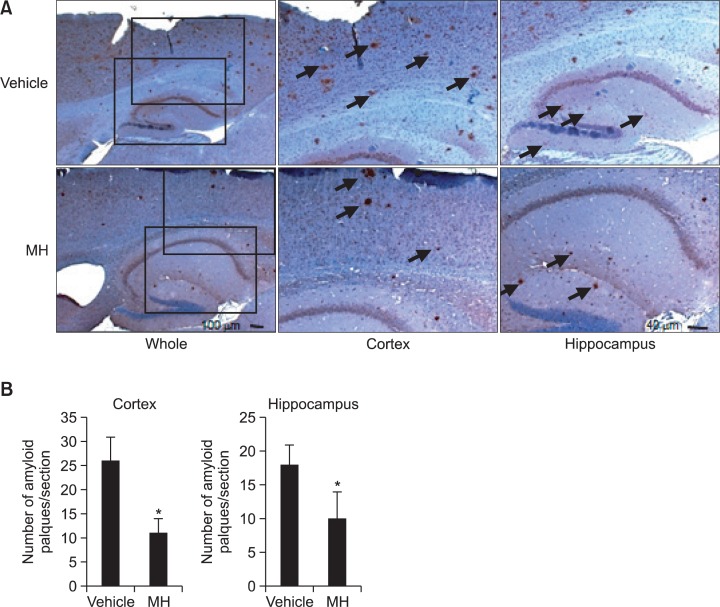
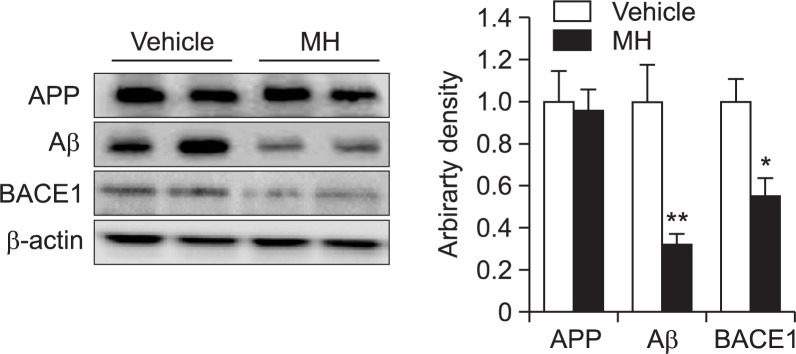
Alzheimer's disease (AD) is the most common neurodegenerative disease without known ways to cure. A key neuropathologic manifestation of the disease is extracellular deposition of beta-amyloid peptide (Aβ). Specific mechanisms underlying the development of the disease have not yet been fully understood. In this study, we investigated effects of 4-O-methylhonokiol on memory dysfunction in APP/PS1 double transgenic mice. 4-O-methylhonokiol (1 mg/kg for 3 month) significantly reduced deficit in learning and memory of the transgenic mice, as determined by the Morris water maze test and step-through passive avoidance test. Our biochemical analysis suggested that 4-O-methylhonokiol ameliorated Aβ accumulation in the cortex and hippocampus via reduction in beta-site APP-cleaving enzyme 1 expression. In addition, 4-O-methylhonokiol attenuated lipid peroxidation and elevated glutathione peroxidase activity in the double transgenic mice brains. Thus, suppressive effects of 4-O-methylhonokiol on Aβ generation and oxidative stress in the brains of transgenic mice may be responsible for the enhancement in cognitive function. These results suggest that the natural compound has potential to intervene memory deficit and progressive neurodegeneration in AD patients.
阿尔茨海默病(AD)是最常见的神经退行性疾病,目前尚无治愈方法。该疾病的一个关键神经病理学表现是β-淀粉样肽(Aβ)的细胞外沉积。疾病发展的确切机制尚未完全阐明。在这项研究中,我们研究了 4-O-甲基厚朴酚对 APP/PS1 双转基因小鼠记忆功能障碍的影响。4-O-甲基厚朴酚(3 个月 1mg/kg)通过 Morris 水迷宫测试和穿梭被动回避测试显著减少了转基因小鼠的学习和记忆缺陷。我们的生化分析表明,4-O-甲基厚朴酚通过降低β-位点 APP 切割酶 1 的表达来改善皮质和海马中的 Aβ 积累。此外,4-O-甲基厚朴酚还能减轻双转基因小鼠大脑中的脂质过氧化并提高谷胱甘肽过氧化物酶的活性。因此,4-O-甲基厚朴酚抑制转基因小鼠大脑中 Aβ 生成和氧化应激的作用可能是其增强认知功能的原因。这些结果表明,这种天然化合物具有干预 AD 患者记忆缺陷和进行性神经退行性变的潜力。