Huang Ming-Xiong, Nichols Sharon, Baker Dewleen G, Robb Ashley, Angeles Annemarie, Yurgil Kate A, Drake Angela, Levy Michael, Song Tao, McLay Robert, Theilmann Rebecca J, Diwakar Mithun, Risbrough Victoria B, Ji Zhengwei, Huang Charles W, Chang Douglas G, Harrington Deborah L, Muzzatti Laura, Canive Jose M, Christopher Edgar J, Chen Yu-Han, Lee Roland R
Radiology, Research, and Psychiatry Services, VA San Diego Healthcare System, San Diego, CA, USA ; Department of Radiology, University of California, San Diego, CA, USA.
Department of Neuroscience, University of California, San Diego, CA, USA.
Neuroimage Clin. 2014 Jun 16;5:109-19. doi: 10.1016/j.nicl.2014.06.004. eCollection 2014.
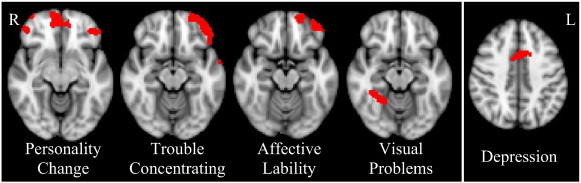
Traumatic brain injury (TBI) is a leading cause of sustained impairment in military and civilian populations. However, mild TBI (mTBI) can be difficult to detect using conventional MRI or CT. Injured brain tissues in mTBI patients generate abnormal slow-waves (1-4 Hz) that can be measured and localized by resting-state magnetoencephalography (MEG). In this study, we develop a voxel-based whole-brain MEG slow-wave imaging approach for detecting abnormality in patients with mTBI on a single-subject basis. A normative database of resting-state MEG source magnitude images (1-4 Hz) from 79 healthy control subjects was established for all brain voxels. The high-resolution MEG source magnitude images were obtained by our recent Fast-VESTAL method. In 84 mTBI patients with persistent post-concussive symptoms (36 from blasts, and 48 from non-blast causes), our method detected abnormalities at the positive detection rates of 84.5%, 86.1%, and 83.3% for the combined (blast-induced plus with non-blast causes), blast, and non-blast mTBI groups, respectively. We found that prefrontal, posterior parietal, inferior temporal, hippocampus, and cerebella areas were particularly vulnerable to head trauma. The result also showed that MEG slow-wave generation in prefrontal areas positively correlated with personality change, trouble concentrating, affective lability, and depression symptoms. Discussion is provided regarding the neuronal mechanisms of MEG slow-wave generation due to deafferentation caused by axonal injury and/or blockages/limitations of cholinergic transmission in TBI. This study provides an effective way for using MEG slow-wave source imaging to localize affected areas and supports MEG as a tool for assisting the diagnosis of mTBI.
创伤性脑损伤(TBI)是导致军人和 civilian populations 持续受损的主要原因。然而,使用传统的MRI或CT很难检测出轻度TBI(mTBI)。mTBI患者受损的脑组织会产生异常慢波(1-4Hz),可通过静息态脑磁图(MEG)进行测量和定位。在本研究中,我们开发了一种基于体素的全脑MEG慢波成像方法,用于在单个体素基础上检测mTBI患者的异常情况。为所有脑体素建立了一个由79名健康对照受试者的静息态MEG源强度图像(1-4Hz)组成的标准数据库。高分辨率MEG源强度图像通过我们最近的Fast-VESTAL方法获得。在84名有持续脑震荡后症状的mTBI患者中(36名由爆炸引起,48名由非爆炸原因引起),我们的方法在联合组(爆炸引起加非爆炸原因)、爆炸组和非爆炸mTBI组中的阳性检测率分别为84.5%、86.1%和83.3%。我们发现前额叶、顶叶后部、颞下叶、海马体和小脑区域特别容易受到头部创伤。结果还表明,前额叶区域的MEG慢波产生与人格改变、注意力不集中、情感不稳定和抑郁症状呈正相关。讨论了TBI中由于轴突损伤和/或胆碱能传递受阻/受限导致的去传入作用而产生MEG慢波的神经元机制。本研究为使用MEG慢波源成像定位受影响区域提供了一种有效方法,并支持将MEG作为辅助诊断mTBI的工具。