Maloney Sean R, Almarines David, Goolkasian Paula
Navy Mobilization Processing Site, Deployment Processing Command-East, Camp Lejeune, North Carolina, United States of America; W.G. (Bill) Hefner VA Medical Center, Salisbury, North Carolina, United States of America.
Navy Mobilization Processing Site, Deployment Processing Command-East, Camp Lejeune, North Carolina, United States of America.
PLoS One. 2014 Jul 10;9(7):e101180. doi: 10.1371/journal.pone.0101180. eCollection 2014.
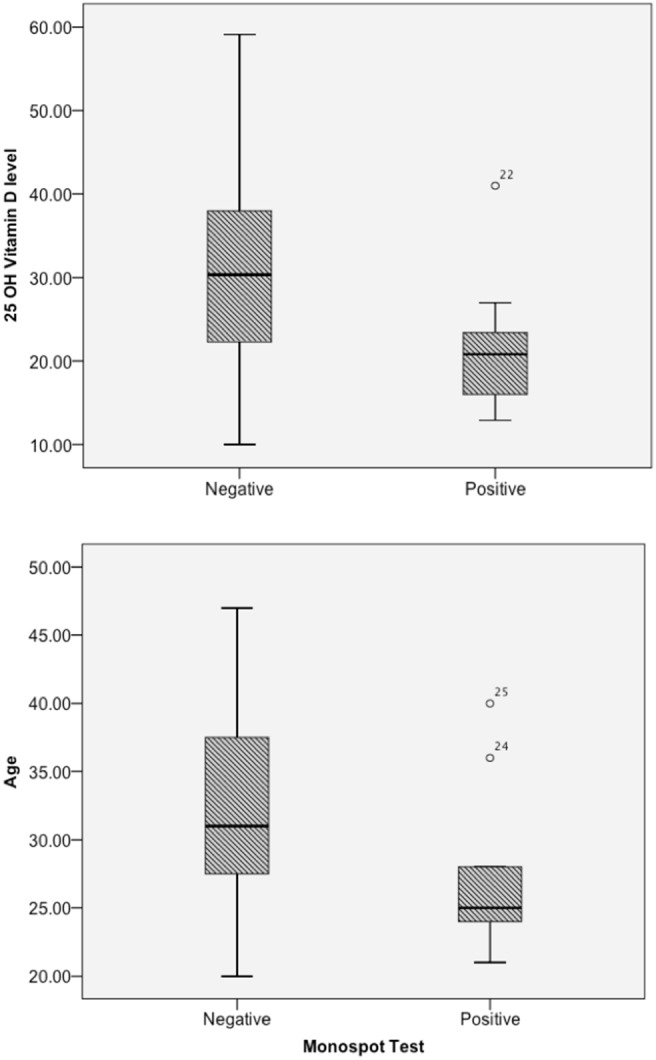
Some recent studies have proposed an important role for vitamin D in reducing the risk of infection by assisting in the suppression of viruses and by controlling the inflammatory response. A low vitamin D state may have a detrimental effect on the immune system's ability to produce activated CD8+ T cells, and it may increase the inflammatory reaction to Epstein Barr virus. The aim of this chart review was to see if serum 25 OH vitamin D3 levels in service members with acute pharyngitis were lower in those who had positive rather than negative monospot tests. A retrospective chart review was conducted on the medical records of service members who presented to sick call at Camp Lejeune, NC with acute pharyngitis from October 8, 2010 until June 30, 2011. Serum 25 OH vitamin D3 levels were compared between those with positive and negative monospot test results. Of the 25 records that were reviewed, there were 9 (36%) service members with positive results, and they were found to have lower vitamin D levels (Median = 20.80 ng/ml, Interquartile range = 10.15) than those with negative test results (Median = 30.35 ng/ml, Interquartile range = 17.05), Mann-Whitney U = 41, p = .039. Only 1 of the 9 with positive test results had a normal serum 25 OH vitamin D3 level (30 ng/ml or greater) compared with 9 of the 16 with negative test results. Optimal vitamin D stores may play a significant role in reducing the risk of developing acute mononucleosis but larger, prospective studies will be needed to verify these findings.
最近的一些研究表明,维生素D在降低感染风险方面发挥着重要作用,它有助于抑制病毒并控制炎症反应。维生素D水平低可能会对免疫系统产生活化CD8+T细胞的能力产生不利影响,并可能增加对爱泼斯坦-巴尔病毒的炎症反应。本图表回顾的目的是观察急性咽炎现役军人中,单核细胞增多症检测呈阳性者的血清25-羟基维生素D3水平是否低于检测呈阴性者。对2010年10月8日至2011年6月30日在北卡罗来纳州勒琼营医务室就诊的急性咽炎现役军人的病历进行了回顾性图表分析。比较了单核细胞增多症检测结果为阳性和阴性者的血清25-羟基维生素D3水平。在审查的25份记录中,有9名(36%)军人检测结果为阳性,发现他们的维生素D水平(中位数=20.80纳克/毫升,四分位间距=10.15)低于检测结果为阴性者(中位数=30.35纳克/毫升,四分位间距=17.05),曼-惠特尼U检验=41,p=0.039。检测结果为阳性的9人中只有1人的血清25-羟基维生素D3水平正常(30纳克/毫升或更高),而检测结果为阴性的16人中有9人正常。最佳的维生素D储备可能在降低患急性单核细胞增多症的风险中起重要作用,但需要更大规模的前瞻性研究来验证这些发现。