Hill Kathryn T, Warren Megan, Roth Tania L
Department of Psychological and Brain Sciences, University of Delaware, Newark, DE 19716, United States.
Department of Psychological and Brain Sciences, University of Delaware, Newark, DE 19716, United States.
Behav Brain Res. 2014 Oct 1;272:175-80. doi: 10.1016/j.bbr.2014.07.001. Epub 2014 Jul 8.
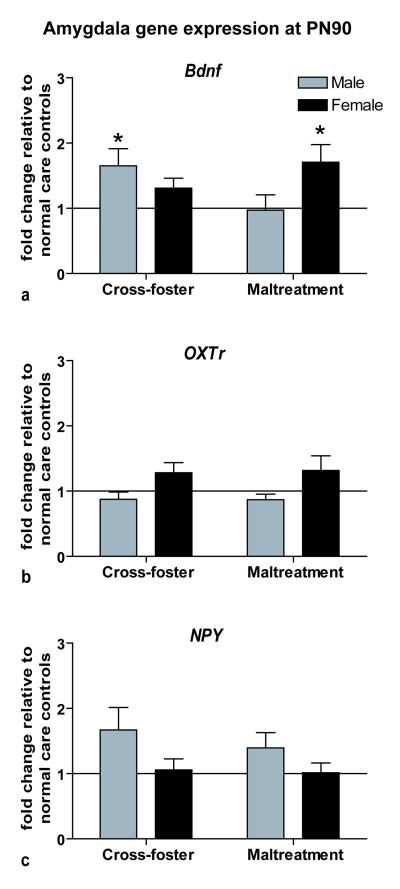
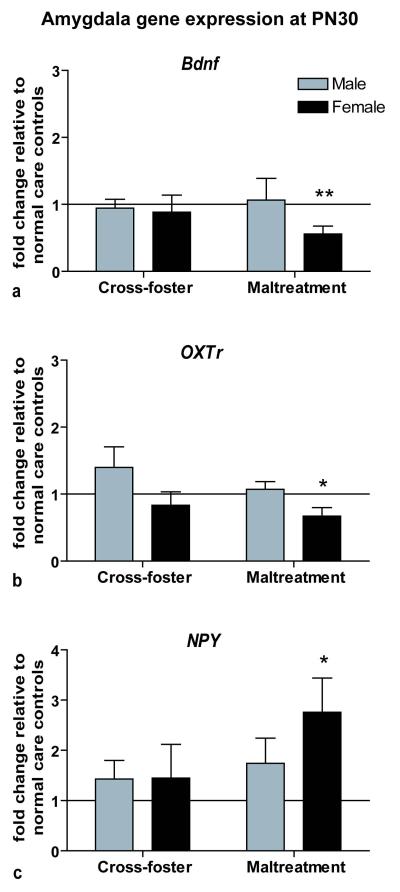
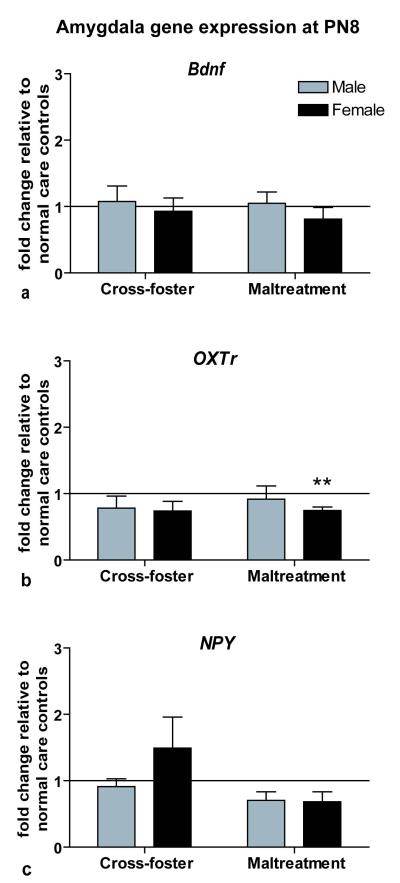
Previous work with various animal models has demonstrated that alterations in the caregiving environment produce long-term changes in anxiety-related and social behaviors, as well as amygdala gene expression. We previously introduced a rodent model in which the timing and duration of exposure to maltreatment or nurturing care outside the home cage can be controlled to assess neurobiological outcomes. Here we sought to determine whether our brief experimental conditions produce changes in gene expression within the developing and adult amygdala. Using a candidate gene approach, we examined fold mRNA changes for the Brain-derived neurotrophic factor (Bdnf), Oxytocin receptor (OXTr), and Neuropeptide Y (NPY) genes, which are all highly expressed in the amygdala and play important roles in anxiety-related and social behaviors. In adults, significant group differences were detected for only Bdnf, with higher levels of Bdnf mRNA for females that had been exposed to maltreatment and males exposed to nurturing care outside the home cage relative to littermate controls. For pups, significant group differences were detected for only OXTr, with lower levels of OXTr mRNA in females exposed to maltreatment. Finally, for adolescents, maltreated-females showed significant changes in Bdnf (decreased), OXTr (decreased), and NPY (increased) mRNA relative to controls. These data illustrate the ability of brief, but repeated exposure to different caregiving environments during the first postnatal week to have long-term effects on gene expression within the developing and adult amygdala, especially for females.
先前对各种动物模型的研究表明,照料环境的改变会导致焦虑相关行为、社交行为以及杏仁核基因表达产生长期变化。我们之前引入了一种啮齿动物模型,通过该模型可以控制在笼外遭受虐待或接受悉心照料的时间和时长,以此来评估神经生物学结果。在此,我们试图确定我们的简短实验条件是否会引起发育中和成年杏仁核内基因表达的变化。我们采用候选基因法,检测了脑源性神经营养因子(Bdnf)、催产素受体(OXTr)和神经肽Y(NPY)基因的mRNA变化倍数,这些基因在杏仁核中均高度表达,且在焦虑相关行为和社交行为中发挥重要作用。在成年动物中,仅检测到Bdnf存在显著的组间差异,与同窝对照相比,遭受虐待的雌性和在笼外接受悉心照料的雄性动物的Bdnf mRNA水平更高。对于幼崽而言,仅检测到OXTr存在显著的组间差异,遭受虐待的雌性幼崽的OXTr mRNA水平较低。最后,对于青少年动物,与对照组相比,遭受虐待的雌性动物的Bdnf(降低)、OXTr(降低)和NPY(升高)mRNA均出现显著变化。这些数据表明,在出生后的第一周内,短暂但反复地暴露于不同的照料环境会对发育中和成年杏仁核内的基因表达产生长期影响,尤其是对雌性动物。