Gottlieb Katrin, Albermann Christoph, Sprenger Georg A
Microb Cell Fact. 2014 Jul 11;13(1):96. doi: 10.1186/s12934-014-0096-1.
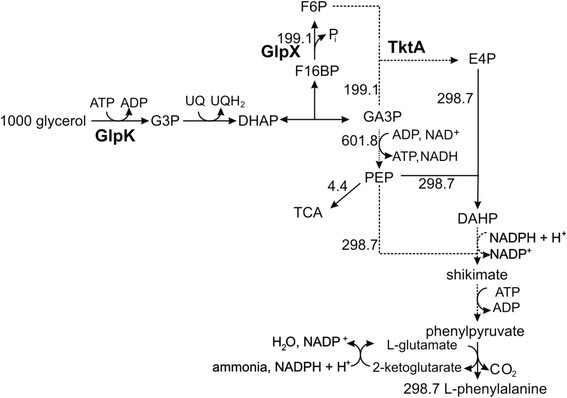
For the production of L-phenylalanine (L-Phe), two molecules of phosphoenolpyruvate (PEP) and one molecule erythrose-4-phosphate (E4P) are necessary. PEP stems from glycolysis whereas E4P is formed in the pentose phosphate pathway (PPP). Glucose, commonly used for L-Phe production with recombinant E. coli, is taken up via the PEP-dependent phosphotransferase system which delivers glucose-6-phosphate (G6P). G6P enters either glycolysis or the PPP. In contrast, glycerol is phosphorylated by an ATP-dependent glycerol kinase (GlpK) thus saving one PEP. However, two gluconeogenic reactions (fructose-1,6-bisphosphate aldolase, fructose-1,6-bisphosphatase, FBPase) are necessary for growth and provision of E4P. Glycerol has become an important carbon source for biotechnology and reports on production of L-Phe from glycerol are available. However, the influence of FBPase and transketolase reactions on L-Phe production has not been reported.
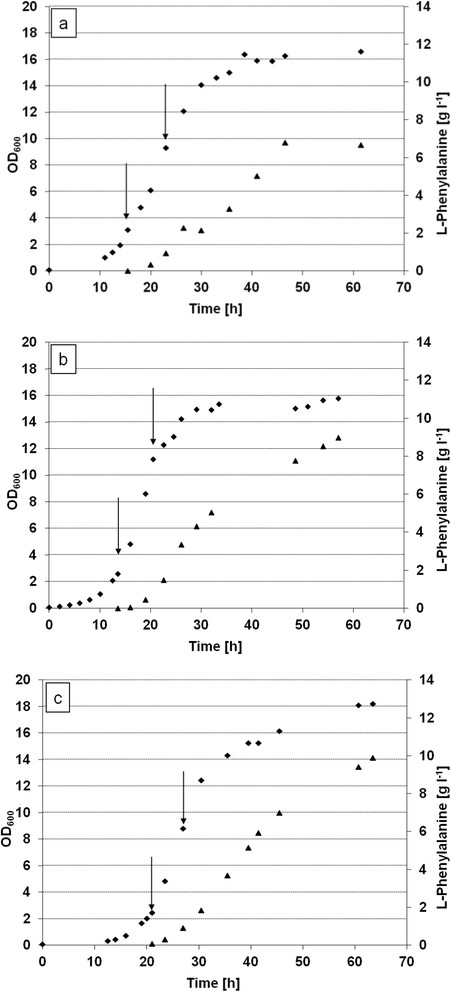
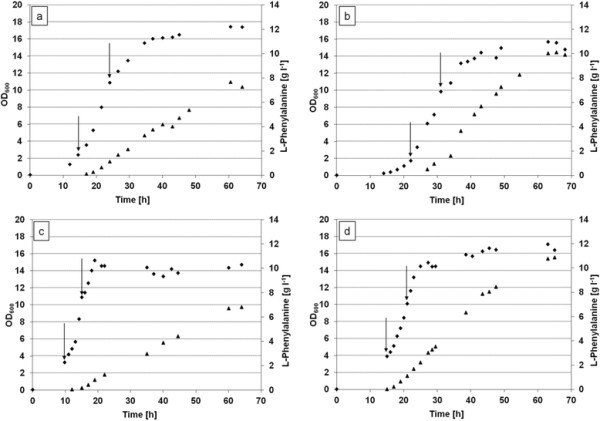
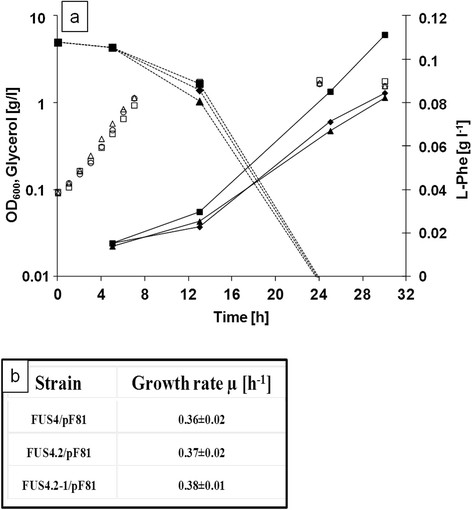
L-Phe productivity of parent strain FUS4/pF81 (plasmid-encoded genes for aroF, aroB, aroL, pheA) was compared on glucose and glycerol as C sources. On glucose, a maximal carbon recovery of 0.19 mM C(Phe)/C(Glucose) and a maximal space-time-yield (STY) of 0.13 g l(-1) h(-1) was found. With glycerol, the maximal carbon recovery was nearly the same (0.18 mM C(Phe)/C(Glycerol)), but the maximal STY was higher (0.21 g l(-1) h(-1)). We raised the chromosomal gene copy number of the genes glpK (encoding glycerol kinase), tktA (encoding transketolase), and glpX (encoding fructose-1,6-bisphosphatase) individually. Overexpression of glpK (or its feedback-resistant variant, glpK(G232D)) had little effect on growth rate; L-Phe production was about 30% lower than in FUS4/pF81. Whereas the overexpression of either glpX or tktA had minor effects on productivity (0.20 mM C(Phe)/C(Glycerol); 0.25 g l(-1) h(-1) and 0.21 mM C(Phe)/C(Glycerol); 0.23 g l(-1) h(-1), respectively), the combination of extra genes of glpX and tktA together led to an increase in maximal STY of about 80% (0.37 g l(-1) h(-1)) and a carbon recovery of 0.26 mM C(Phe)/C(Glycerol).
Enhancing the gene copy numbers for glpX and tktA increased L-Phe productivity from glycerol without affecting growth rate. Engineering of glycerol metabolism towards L-Phe production in E. coli has to balance the pathways of gluconeogenesis, glycolysis, and PPP to improve the supply of the precursors, PEP and E4P.
要生产L-苯丙氨酸(L-Phe),需要两分子磷酸烯醇丙酮酸(PEP)和一分子赤藓糖-4-磷酸(E4P)。PEP来源于糖酵解,而E4P是在磷酸戊糖途径(PPP)中形成的。常用于通过重组大肠杆菌生产L-Phe的葡萄糖,是通过依赖PEP的磷酸转移酶系统摄取的,该系统可提供6-磷酸葡萄糖(G6P)。G6P可进入糖酵解或PPP。相比之下,甘油由依赖ATP的甘油激酶(GlpK)磷酸化,从而节省一分子PEP。然而,生长和提供E4P需要两个糖异生反应(果糖-1,6-二磷酸醛缩酶、果糖-1,6-二磷酸酶,FBPase)。甘油已成为生物技术的重要碳源,并且有关于从甘油生产L-Phe的报道。然而,FBPase和转酮醇酶反应对L-Phe生产的影响尚未见报道。
比较了亲本菌株FUS4/pF81(编码aroF、aroB、aroL、pheA的质粒编码基因)在葡萄糖和甘油作为碳源时的L-Phe生产率。在葡萄糖上,发现最大碳回收率为0.19 mM C(Phe)/C(葡萄糖),最大时空产率(STY)为0.13 g l⁻¹ h⁻¹。使用甘油时,最大碳回收率几乎相同(0.18 mM C(Phe)/C(甘油)),但最大STY更高(0.21 g l⁻¹ h⁻¹)。我们分别提高了染色体基因glpK(编码甘油激酶)、tktA(编码转酮醇酶)和glpX(编码果糖-1,6-二磷酸酶)的基因拷贝数。glpK(或其抗反馈变体glpK(G232D))的过表达对生长速率影响很小;L-Phe产量比FUS4/pF81低约30%。而glpX或tktA的过表达对生产率影响较小(分别为0.20 mM C(Phe)/C(甘油);0.25 g l⁻¹ h⁻¹和0.21 mM C(Phe)/C(甘油);0.23 g l⁻¹ h⁻¹),glpX和tktA的额外基因组合在一起使最大STY提高了约80%(0.37 g l⁻¹ h⁻¹),碳回收率为0.26 mM C(Phe)/C(甘油)。
增加glpX和tktA的基因拷贝数可提高从甘油生产L-Phe的生产率,而不影响生长速率。在大肠杆菌中对甘油代谢进行工程改造以生产L-Phe时,必须平衡糖异生、糖酵解和PPP途径,以改善前体PEP和E4P的供应。