Bounedjah Ouissame, Desforges Bénédicte, Wu Ting-Di, Pioche-Durieu Catherine, Marco Sergio, Hamon Loic, Curmi Patrick A, Guerquin-Kern Jean-Luc, Piétrement Olivier, Pastré David
Institut National de la Santé et de la Recherche Médicale (INSERM), UMR829; Université Evry-Val d'Essonne, Evry 91025, France.
Institut Curie, INSERM, U759, 91405 Orsay cedex, France.
Nucleic Acids Res. 2014 Jul;42(13):8678-91. doi: 10.1093/nar/gku582. Epub 2014 Jul 10.
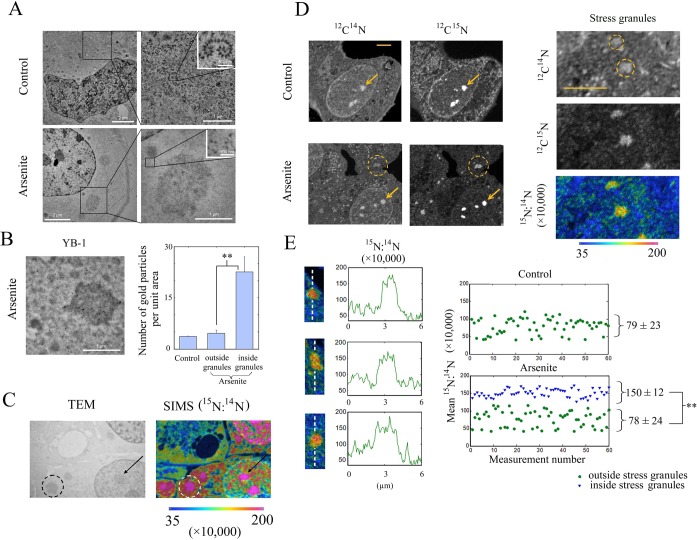
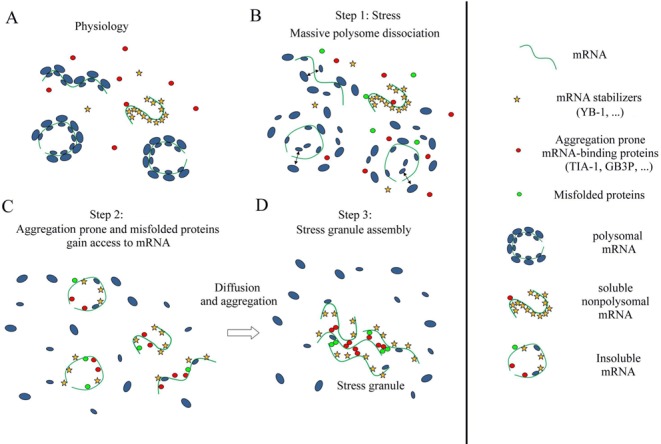
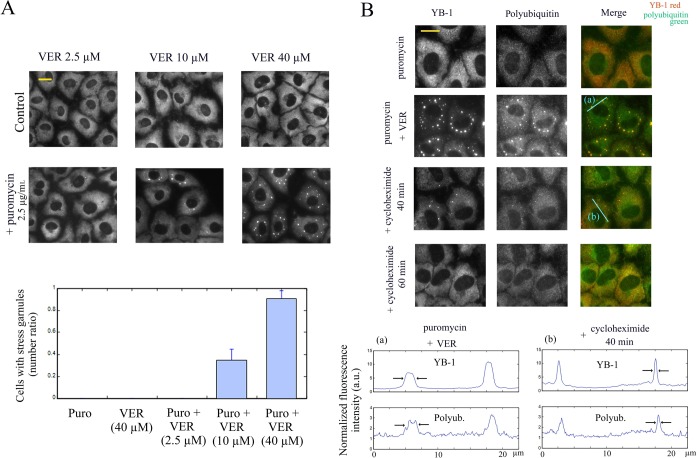
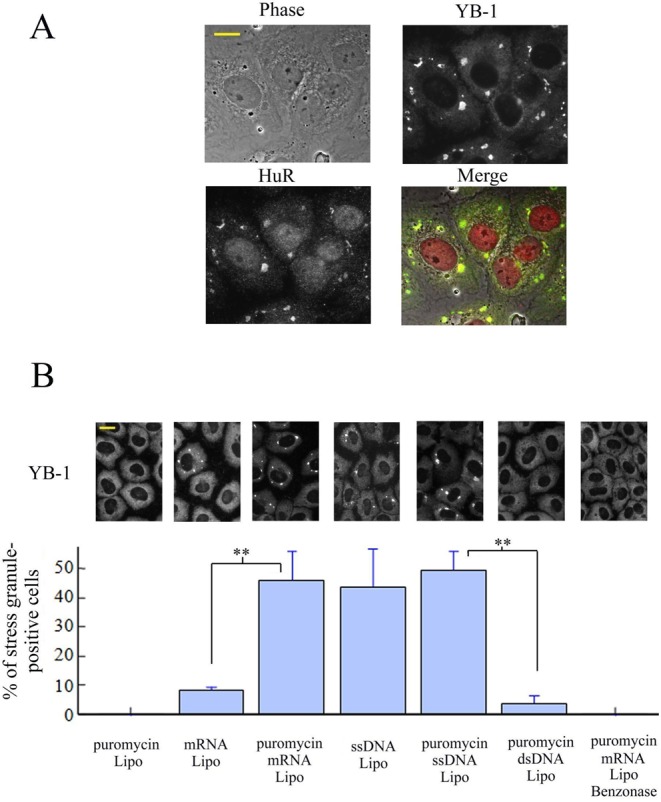
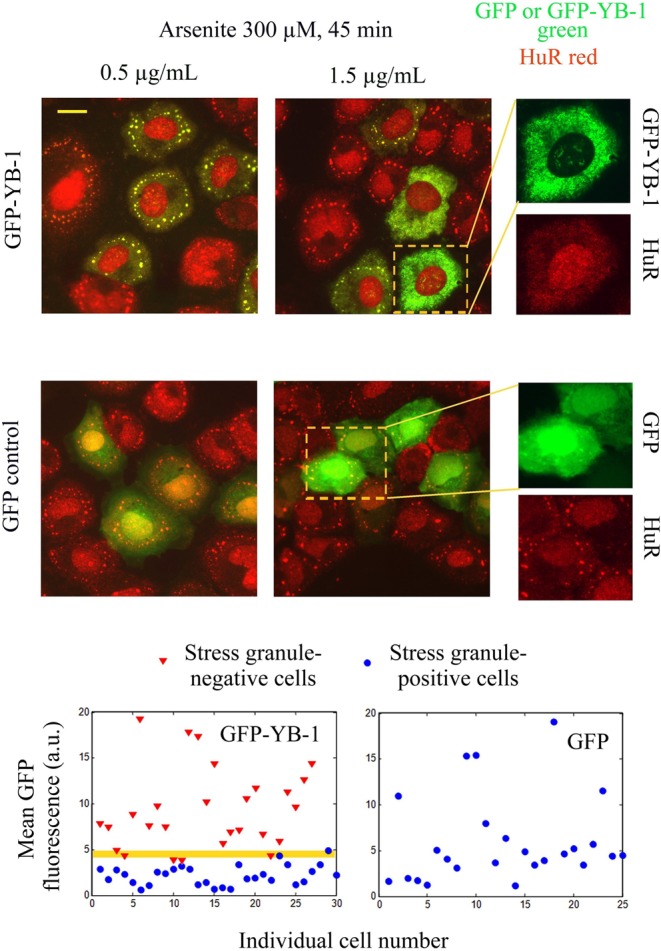
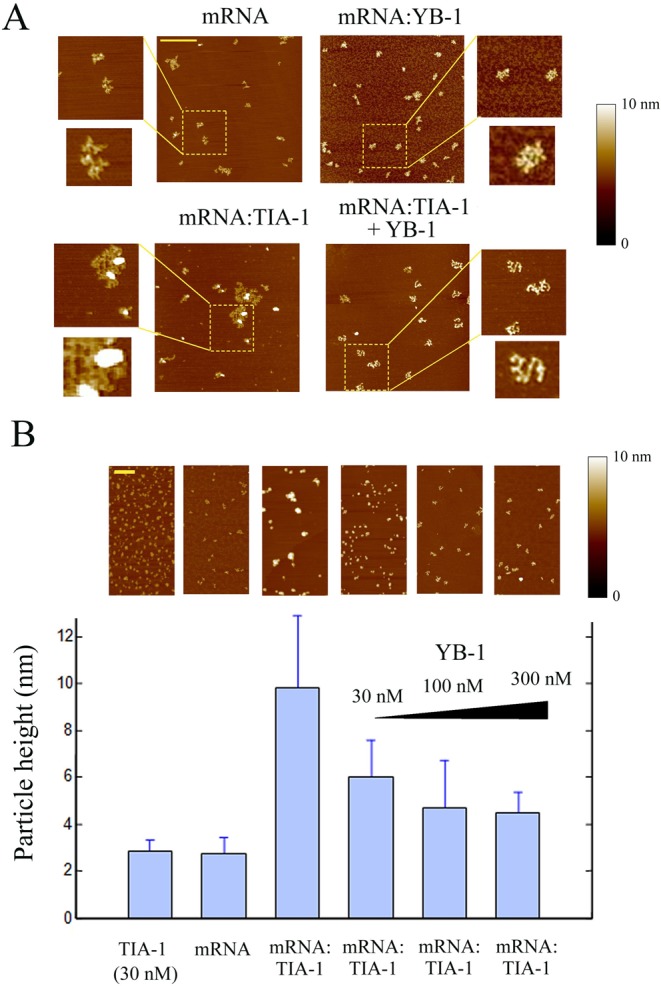
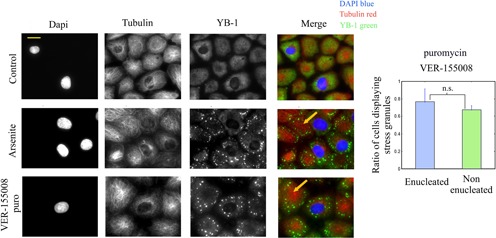
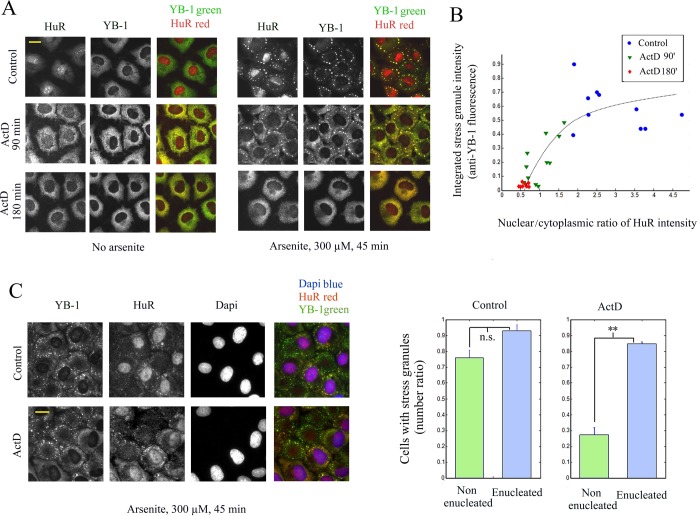
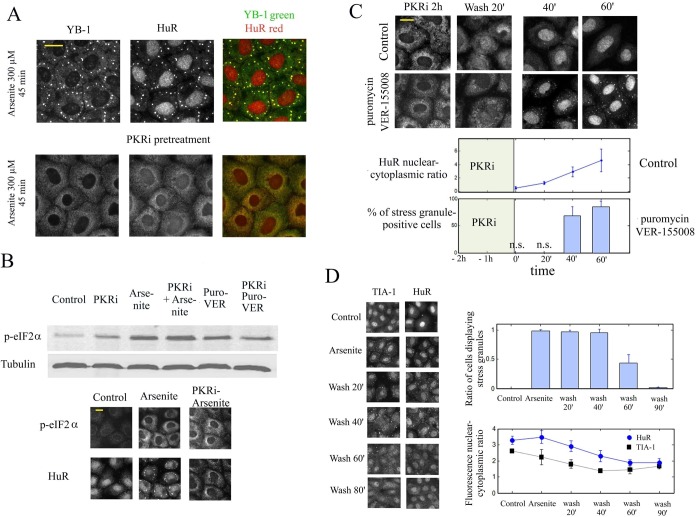
The sequence of events leading to stress granule assembly in stressed cells remains elusive. We show here, using isotope labeling and ion microprobe, that proportionally more RNA than proteins are present in stress granules than in surrounding cytoplasm. We further demonstrate that the delivery of single strand polynucleotides, mRNA and ssDNA, to the cytoplasm can trigger stress granule assembly. On the other hand, increasing the cytoplasmic level of mRNA-binding proteins like YB-1 can directly prevent the aggregation of mRNA by forming isolated mRNPs, as evidenced by atomic force microscopy. Interestingly, we also discovered that enucleated cells do form stress granules, demonstrating that the translocation to the cytoplasm of nuclear prion-like RNA-binding proteins like TIA-1 is dispensable for stress granule assembly. The results lead to an alternative view on stress granule formation based on the following sequence of events: after the massive dissociation of polysomes during stress, mRNA-stabilizing proteins like YB-1 are outnumbered by the burst of nonpolysomal mRNA. mRNA freed of ribosomes thus becomes accessible to mRNA-binding aggregation-prone proteins or misfolded proteins, which induces stress granule formation. Within the frame of this model, the shuttling of nuclear mRNA-stabilizing proteins to the cytoplasm could dissociate stress granules or prevent their assembly.
应激细胞中导致应激颗粒组装的一系列事件仍不清楚。我们在此使用同位素标记和离子微探针表明,与周围细胞质相比,应激颗粒中RNA的比例比蛋白质更高。我们进一步证明,将单链多核苷酸、mRNA和ssDNA递送至细胞质可触发应激颗粒组装。另一方面,如原子力显微镜所证实的,增加诸如YB-1等mRNA结合蛋白的细胞质水平可通过形成孤立的mRNA核糖核蛋白复合体直接阻止mRNA聚集。有趣的是,我们还发现去核细胞确实会形成应激颗粒,这表明像TIA-1等核朊病毒样RNA结合蛋白向细胞质的转运对于应激颗粒组装并非必需。这些结果基于以下一系列事件对应激颗粒形成提出了另一种观点:应激期间多核糖体大量解离后,诸如YB-1等mRNA稳定蛋白的数量数量数量数量少于非多核糖体mRNA的激增。因此,脱离核糖体的mRNA变得易于被易于聚集的mRNA结合蛋白或错误折叠的蛋白接触,从而诱导应激颗粒形成。在该模型框架内,核mRNA稳定蛋白向细胞质的穿梭可使应激颗粒解离或阻止其组装。