Yamamoto Kazuhiro, Mizumoto Atsushi, Nishimura Kohji, Uda Atsushi, Mukai Akira, Yamashita Kazuhiko, Kume Manabu, Makimoto Hiroo, Bito Toshinori, Nishigori Chikako, Nakagawa Tsutomu, Hirano Takeshi, Hirai Midori
Department of Pharmacy, Kobe University Hospital, Kobe, Japan.
Division of Pharmacokinetics, Kobe University Graduate School of Medicine, Kobe, Japan.
PLoS One. 2014 Jul 11;9(7):e102110. doi: 10.1371/journal.pone.0102110. eCollection 2014.
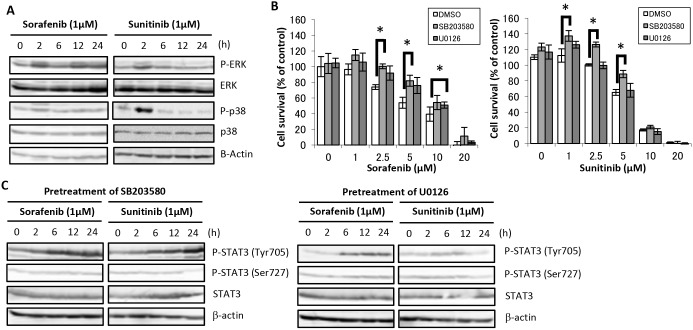
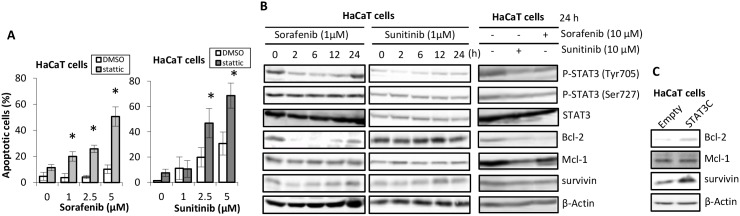
Hand-foot skin reaction is a most common multi-kinase inhibitor-related adverse event. This study aimed to examine whether the toxicity of sorafenib and sunitinib for human keratinocytes was associated with inhibiting signal transduction and activator of transcription 3 (STAT3). We studied whether STAT3 activity affects sorafenib- and sunitinib-induced cell growth inhibition in HaCaT cells by WST-8 assay. Stattic enhanced the cell-growth inhibitory and apoptotic effects of sorafenib and sunitinib. HaCaT cells transfected with constitutively-active STAT3 (STAT3C) were resistant to the sorafenib- and sunitinib-induced cell growth inhibition. STAT3 activity decreased after short-term treatment with sorafenib and sunitinib in a dose-dependent manner and recovered after long-term treatment with sorafenib and sunitinib at low doses. Moreover, the expression of survivin and bcl-2 decreased after treatment with sorafenib and sunitinib was concomitant with variations in STAT3 activity. Sorafenib-induced STAT3 inhibition was mediated by regulation via MAPK pathways in HaCaT cells, while sunitinib-induced STAT3 inhibition was not. Thus, STAT3 activation mediating apoptosis suppressors may be a key factor in sorafenib and sunitinib-induced keratinocyte cytotoxicity.
手足皮肤反应是一种最常见的多激酶抑制剂相关不良事件。本研究旨在探讨索拉非尼和舒尼替尼对人角质形成细胞的毒性是否与抑制信号转导和转录激活因子3(STAT3)有关。我们通过WST-8法研究了STAT3活性是否影响索拉非尼和舒尼替尼对HaCaT细胞的生长抑制作用。Stattic增强了索拉非尼和舒尼替尼的细胞生长抑制和凋亡作用。转染组成型激活STAT3(STAT3C)的HaCaT细胞对索拉非尼和舒尼替尼诱导的细胞生长抑制具有抗性。索拉非尼和舒尼替尼短期处理后,STAT3活性呈剂量依赖性降低,低剂量索拉非尼和舒尼替尼长期处理后活性恢复。此外,索拉非尼和舒尼替尼处理后survivin和bcl-2的表达降低,与STAT3活性变化一致。索拉非尼诱导的STAT3抑制在HaCaT细胞中由MAPK途径调控介导,而舒尼替尼诱导的STAT3抑制则不是。因此,STAT3激活介导凋亡抑制因子可能是索拉非尼和舒尼替尼诱导角质形成细胞毒性的关键因素。