Sinha Amit, Langnick Claudia, Sommer Ralf J, Dieterich Christoph
Max Planck Institute for Developmental Biology, Department for Evolutionary Biology, 72076 Tübingen, Germany.
Berlin Institute for Medical Systems Biology (BIMSB) at the Max Delbrück Center for Molecular Medicine Berlin, 13125 Berlin, Germany.
RNA. 2014 Sep;20(9):1386-97. doi: 10.1261/rna.041954.113. Epub 2014 Jul 11.
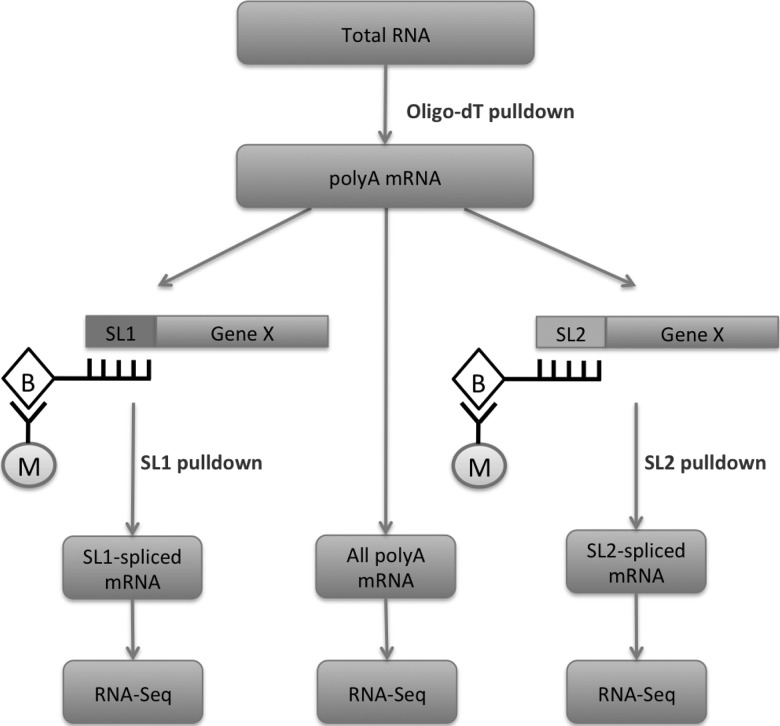
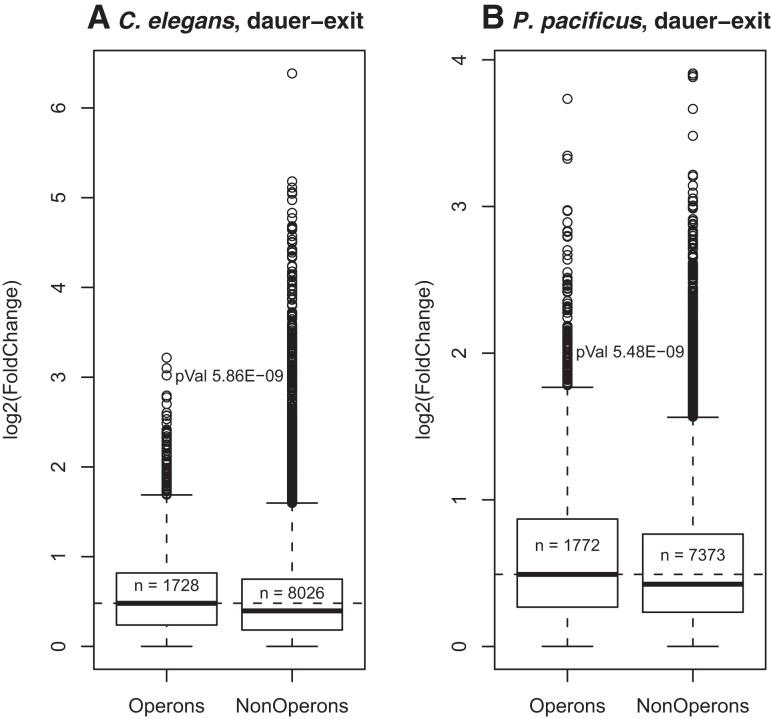
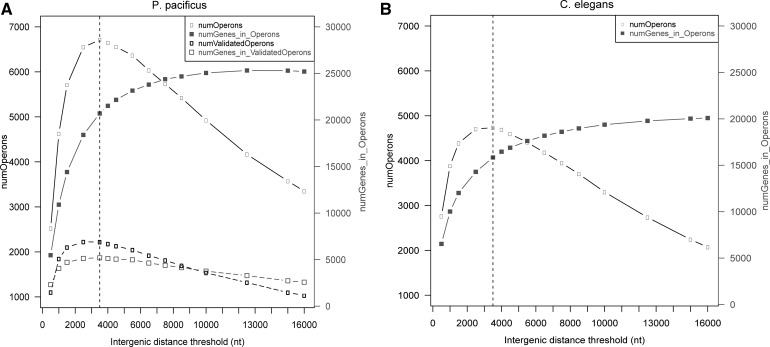
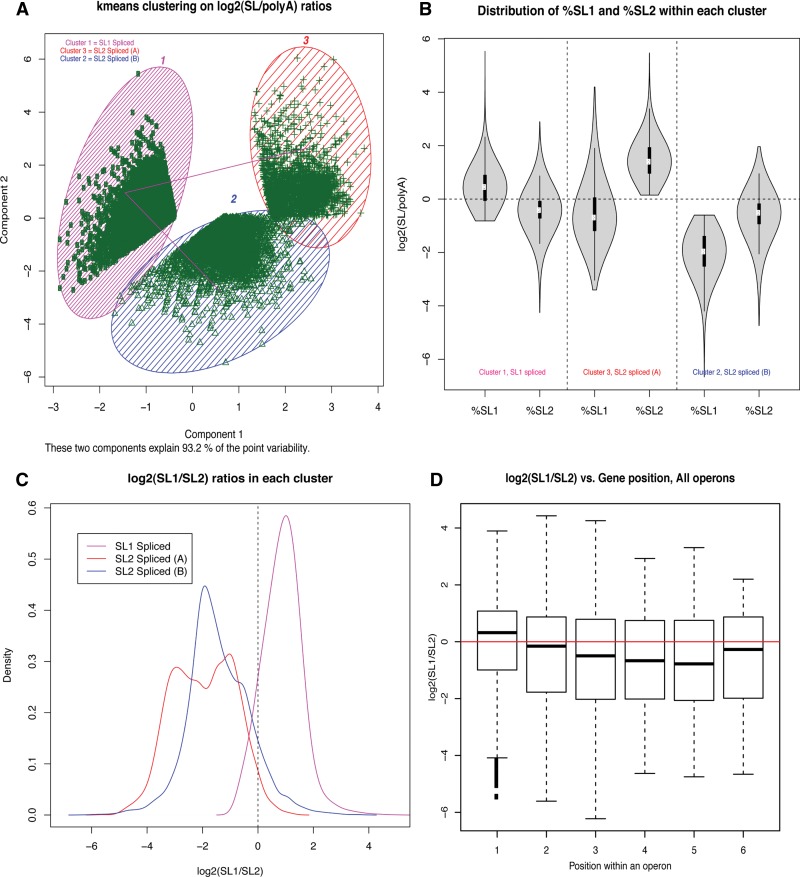
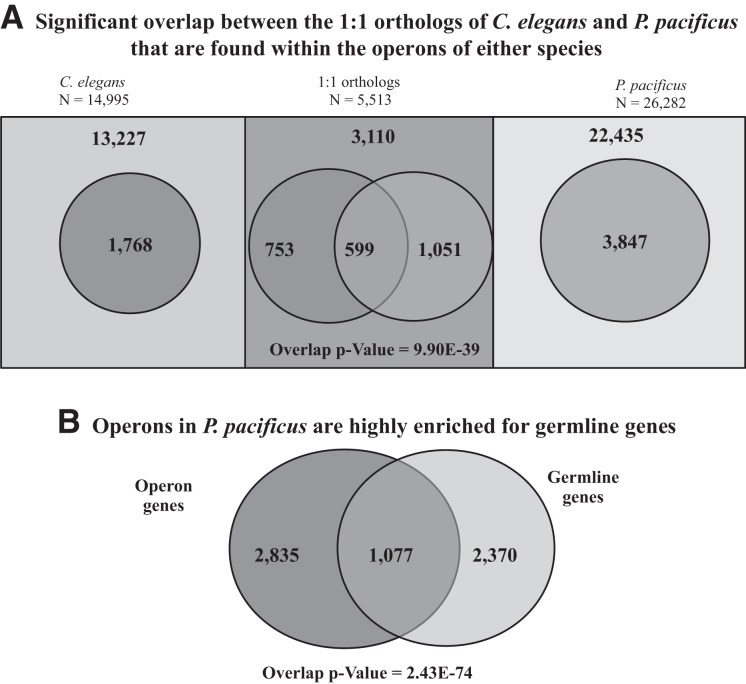
Discovery of trans-splicing in multiple metazoan lineages led to the identification of operon-like gene organization in diverse organisms, including trypanosomes, tunicates, and nematodes, but the functional significance of such operons is not completely understood. To see whether the content or organization of operons serves similar roles across species, we experimentally defined operons in the nematode model Pristionchus pacificus. We performed affinity capture experiments on mRNA pools to specifically enrich for transcripts that are trans-spliced to either the SL1- or SL2-spliced leader, using spliced leader-specific probes. We obtained distinct trans-splicing patterns from the analysis of three mRNA pools (total mRNA, SL1 and SL2 fraction) by RNA-seq. This information was combined with a genome-wide analysis of gene orientation and spacing. We could confirm 2219 operons by RNA-seq data out of 6709 candidate operons, which were predicted by sequence information alone. Our gene order comparison of the Caenorhabditis elegans and P. pacificus genomes shows major changes in operon organization in the two species. Notably, only 128 out of 1288 operons in C. elegans are conserved in P. pacificus. However, analysis of gene-expression profiles identified conserved functions such as an enrichment of germline-expressed genes and higher expression levels of operonic genes during recovery from dauer arrest in both species. These results provide support for the model that a necessity for increased transcriptional efficiency in the context of certain developmental processes could be a selective constraint for operon evolution in metazoans. Our method is generally applicable to other metazoans to see if similar functional constraints regulate gene organization into operons.
在多个后生动物谱系中发现反式剪接,从而在包括锥虫、被囊动物和线虫在内的多种生物中鉴定出类似操纵子的基因组织,但此类操纵子的功能意义尚未完全明了。为了探究操纵子的组成或组织在不同物种间是否发挥相似作用,我们通过实验确定了线虫模式生物太平洋钝齿棒线虫中的操纵子。我们使用剪接前导序列特异性探针,对mRNA池进行亲和捕获实验,以特异性富集与SL1或SL2剪接前导序列发生反式剪接的转录本。通过RNA测序分析三个mRNA池(总mRNA、SL1和SL2组分),我们获得了不同的反式剪接模式。这些信息与全基因组范围的基因方向和间距分析相结合。我们能够通过RNA测序数据从仅由序列信息预测的6709个候选操纵子中确认2219个操纵子。我们对秀丽隐杆线虫和太平洋钝齿棒线虫基因组的基因顺序比较显示,这两个物种的操纵子组织发生了重大变化。值得注意的是,秀丽隐杆线虫的1288个操纵子中只有128个在太平洋钝齿棒线虫中保守。然而,对基因表达谱的分析确定了保守功能,例如在这两个物种中,生殖系表达基因的富集以及在从滞育期恢复过程中操纵子基因的更高表达水平。这些结果为以下模型提供了支持,即在某些发育过程中提高转录效率的必要性可能是后生动物操纵子进化的一个选择性限制因素。我们的方法通常适用于其他后生动物,以探究是否有类似的功能限制将基因组织成操纵子。