Lin Hai, Sun Li-Hua, Han Wei, He Tie-Ying, Xu Xin-Jian, Cheng Kun, Geng Cheng, Su Li-Dan, Wen Hao, Wang Xi-Yan, Chen Qi-Long
Department of Pancreatic Surgery, The First Affiliated Hospital of Xinjiang Medical University, Urumqi, Xinjiang 830054, P.R. China.
Liver Disease Center, The First Affiliated Hospital of Xinjiang Medical University, Urumqi, Xinjiang 830054, P.R. China.
Mol Med Rep. 2014 Sep;10(3):1335-42. doi: 10.3892/mmr.2014.2367. Epub 2014 Jul 7.
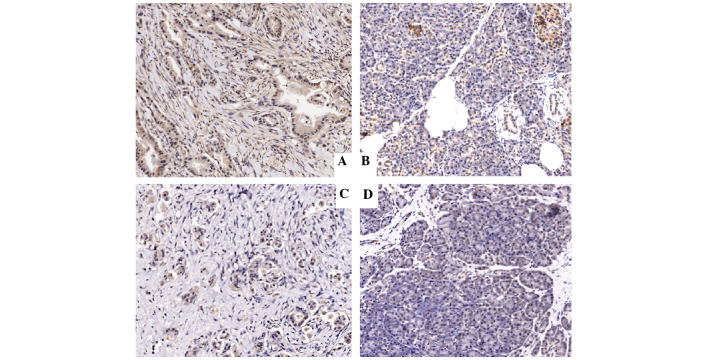
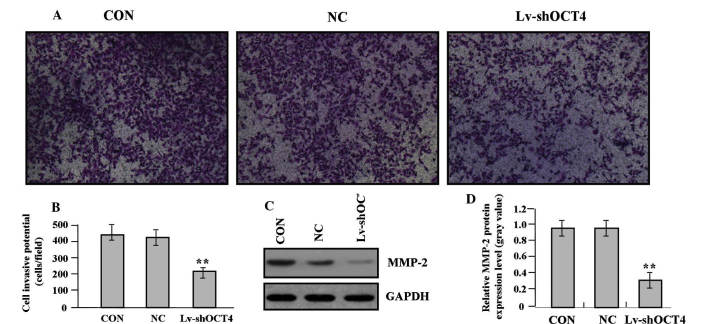
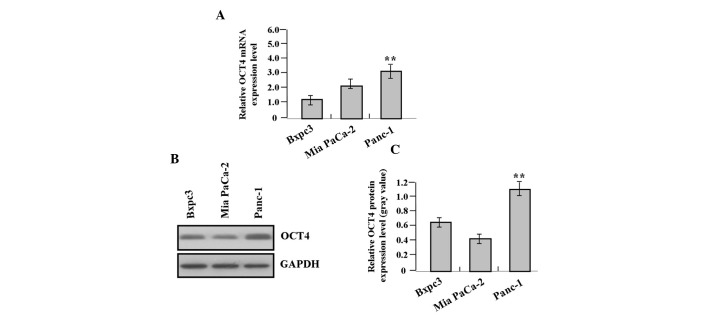
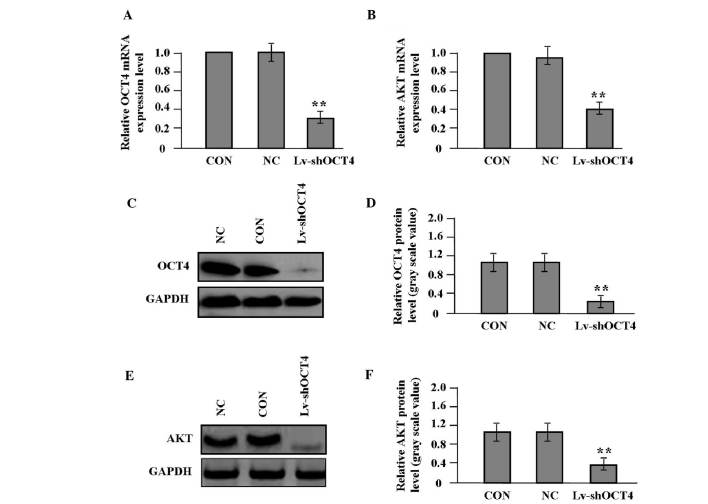
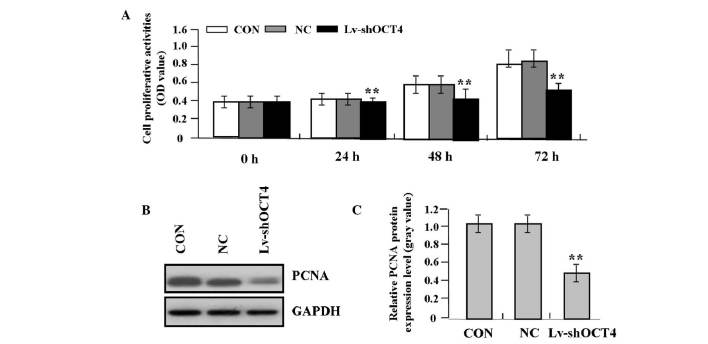
Octamer‑binding transcription factor 4 (OCT4) is one of the factors associated with self‑renewal and differentiation in cancer stem cells, and is crucial for the progression of various types of human malignancy. However, the expression and function of OCT4 in human pancreatic cancer has not been fully elucidated. The purpose of the present study was to investigate the function and molecular mechanisms of OCT4 in pancreatic cancer cells. The clinical significance of OCT4 expression was assessed by an immunohistochemical assay using a tissue microarray procedure in pancreatic cancer tissues and cells with different degrees of differentiation. A loss‑of‑function approach was used to examine the effects of a lentivirus‑mediated OCT4 small hairpin RNA vector on biological behaviors, including cell proliferative activity and invasive potential. The results demonstrated that the expression levels of OCT4 protein in cancer tissues were significantly elevated compared with those in adjacent non‑cancerous tissues (65.0 vs. 42.5%; P=0.005), which was correlated with tumor differentiation (P=0.008). The knockdown of OCT4 inhibited the proliferation and invasion of pancreatic cancer cells (Panc‑1) expressing high levels of OCT4, accompanied with decreased expression of AKT, proliferating cell nuclear antigen (PCNA) and matrix metalloproteinase‑2 (MMP‑2). In conclusion, the present study reveals that the increased expression of OCT4 is correlated with the differentiation of pancreatic cancer, while knockdown of OCT4 suppresses the growth and invasion of pancreatic cancer cells through inhibition of AKT pathway‑mediated PCNA and MMP‑2 expression, suggesting that OCT4 might serve as a potential therapeutic target for the treatment of pancreatic cancer.
八聚体结合转录因子4(OCT4)是与癌症干细胞自我更新和分化相关的因子之一,对各种类型人类恶性肿瘤的进展至关重要。然而,OCT4在人类胰腺癌中的表达和功能尚未完全阐明。本研究的目的是探讨OCT4在胰腺癌细胞中的功能及分子机制。采用组织芯片技术,通过免疫组化分析评估OCT4在不同分化程度的胰腺癌组织和细胞中的表达及其临床意义。采用功能缺失方法,检测慢病毒介导的OCT4小发夹RNA载体对细胞增殖活性和侵袭潜能等生物学行为的影响。结果表明,癌组织中OCT4蛋白表达水平显著高于相邻癌旁组织(65.0% 对42.5%;P=0.005),且与肿瘤分化相关(P=0.008)。敲低OCT4可抑制高表达OCT4的胰腺癌细胞(Panc-1)的增殖和侵袭,同时伴有AKT、增殖细胞核抗原(PCNA)和基质金属蛋白酶-2(MMP-2)表达降低。总之,本研究表明OCT4表达增加与胰腺癌分化相关,敲低OCT4可通过抑制AKT通路介导的PCNA和MMP-2表达来抑制胰腺癌细胞的生长和侵袭,提示OCT4可能是胰腺癌治疗的潜在靶点。