Cozzani Mauro, Pasini Marco, Zallio Francesco, Ritucci Robert, Mutinelli Sabrina, Mazzotta Laura, Giuca Maria Rita, Piras Vincenzo
Scientific Committee UOC Odontoiatria "G. Gaslini-Galliera" Hospital, Dipartimento di Scienze Chirurgiche, Università di Cagliari, Via Binaghi 4, 09121 Cagliari, Italy.
Università di Pisa, Lungarno Pacinotti 43, 56126 Pisa, Italy.
Int J Dent. 2014;2014:937059. doi: 10.1155/2014/937059. Epub 2014 Jun 11.
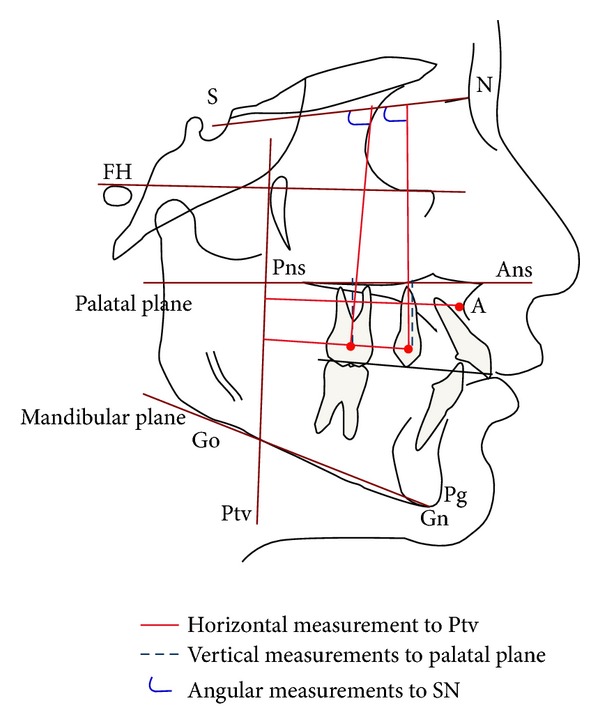
Aim. To investigate and compare the efficiency of two appliances for molar distalization: the bone-anchored distal screw (DS) and the traditional tooth-supported distal jet (DJ) for molar distalization and anchorage loss. Methods. Tests (18 subjects) were treated with a DS and controls (18 subjects) were treated with a DJ. Lateral cephalograms were obtained before and at the end of molar distalization and were analysed. Shapiro Wilk test, unpaired t-test, and Wilcoxon rank-sum test were applied according to values distribution. The α level was fixed at 0.05. Results. Maxillary first molars were successfully distalized into a Class I relationship in all patients. The mean molar distalization and treatment time were similar in both groups. The DS group exhibited a spontaneous distalization (2.1 ± 0.9 mm) of the first premolar with control of anchorage loss, distal tipping, extrusion, and skeletal changes. Conclusions. The DS is an adequate compliance-free distalizing appliance that can be used safely for the correction of Class II malocclusions. In comparison to the traditional DJ, the DS enables not only a good rate of molar distalization, but also a spontaneous distalization of the first premolars.
目的。研究并比较两种用于磨牙远移的矫治器的效率:骨锚式远移螺钉(DS)和传统的牙齿支持式远移矫治器(DJ)在磨牙远移和支抗丧失方面的情况。方法。试验组(18名受试者)使用DS进行治疗,对照组(18名受试者)使用DJ进行治疗。在磨牙远移开始前和结束时获取头颅侧位片并进行分析。根据数值分布应用夏皮罗 - 威尔克检验、非配对t检验和威尔科克森秩和检验。α水平设定为0.05。结果。所有患者的上颌第一磨牙均成功远移至I类关系。两组的平均磨牙远移量和治疗时间相似。DS组第一前磨牙出现自发远移(2.1±0.9毫米),同时支抗丧失、远中倾斜、伸长及骨骼变化得到控制。结论。DS是一种无需患者配合的合适远移矫治器,可安全用于矫治II类错牙合畸形。与传统的DJ相比,DS不仅能实现良好的磨牙远移率,还能使第一前磨牙自发远移。