Takei Yoshifumi, Ohnishi Naomi, Kisaka Mayumi, Mihara Keichiro
Division of Disease Models, Center for Neurological Diseases and Cancer, Nagoya University Graduate School of Medicine, 65 Tsurumai-cho, Showa-ku, Nagoya, 466-8550 Japan ; Department of Biochemistry, Nagoya University Graduate School of Medicine, 65 Tsurumai-cho, Showa-ku, Nagoya, 466-8550 Japan.
Division of Disease Models, Center for Neurological Diseases and Cancer, Nagoya University Graduate School of Medicine, 65 Tsurumai-cho, Showa-ku, Nagoya, 466-8550 Japan.
Springerplus. 2014 Jun 7;3:288. doi: 10.1186/2193-1801-3-288. eCollection 2014.
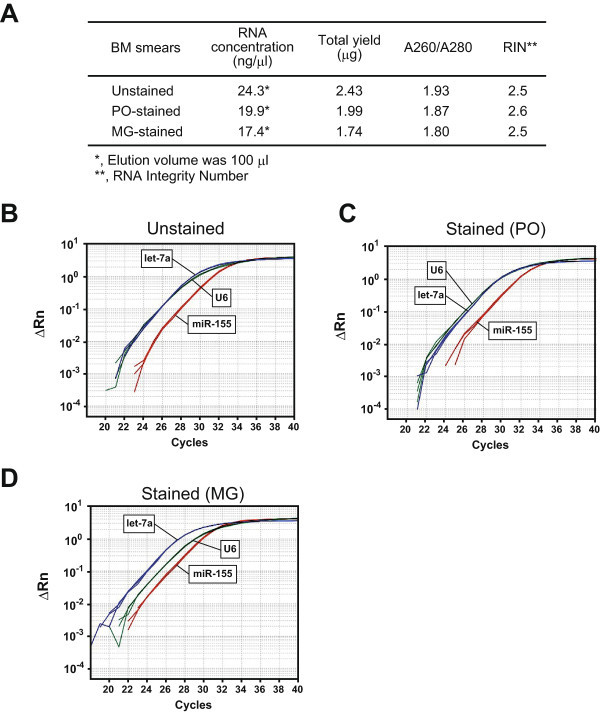
The abnormal expression of microRNAs (miRNAs) is implicated in various human diseases, including cancers. Accordingly, miRNA expressions have been examined in many cancer tissues and blood, but there have been few studies examining smear samples from bone marrow (BM) or peripheral blood. Here we successfully isolated small RNAs from BM smears using a mirVana miRNA Isolation Kit with our original modifications. The isolated small RNAs were then used to measure the levels of representative miRNAs such as miR-155, let-7a, and U6 via real-time PCR with a specific TaqMan probe, although peaks for the ribosomal RNAs (18S, and 28S) were not identified. The PCR curves of the miRNAs were indistinguishable from those from BM living cells from the same donor. Finally, our method for BM smears identified numerous abnormally altered miRNAs (significantly decreased, 39 miRNAs; significantly increased, 27 miRNAs) in follicular lymphomas (FL) compared with normal donors via TaqMan real-time PCR miRNA array. The array indicated that miR-451 showed the greatest decrease in FL (a 345-fold decrease), while miR-338-5p showed the greatest increase in FL (172-fold) relative to normal donors. The miRNAs identified by our study might serve as markers to predict the invasion of FL cells into BM without biopsy. Furthermore, our method will provide a new avenue for the analysis of miRNAs in BM smear samples from various hematologic diseases.
微小RNA(miRNA)的异常表达与包括癌症在内的多种人类疾病有关。因此,人们已经在许多癌症组织和血液中检测了miRNA的表达,但很少有研究检测骨髓(BM)或外周血的涂片样本。在这里,我们使用mirVana miRNA分离试剂盒并进行了原始改进,成功地从骨髓涂片中分离出了小RNA。然后,使用分离出的小RNA,通过带有特异性TaqMan探针的实时PCR来测量代表性miRNA(如miR-155、let-7a和U6)的水平,尽管未鉴定出核糖体RNA(18S和28S)的峰值。这些miRNA的PCR曲线与来自同一供体的骨髓活细胞的曲线无法区分。最后,通过TaqMan实时PCR miRNA阵列,我们用于骨髓涂片的方法在滤泡性淋巴瘤(FL)中鉴定出了许多异常改变的miRNA(显著降低的有39种miRNA;显著增加的有27种miRNA),与正常供体相比。该阵列表明,相对于正常供体,miR-451在FL中下降幅度最大(下降345倍),而miR-338-5p在FL中上升幅度最大(上升172倍)。我们的研究鉴定出的这些miRNA可能作为预测FL细胞在无活检情况下侵入骨髓的标志物。此外,我们的方法将为分析各种血液系统疾病的骨髓涂片样本中的miRNA提供一条新途径。