Helenius Ilkka, Mattila Mikko, Jalanko Tuomas
Department of Paediatric Orthopaedic Surgery, Turku University Central Hospital, Kiinamyllynkatu 4-8, 21520, Turku, Finland,
J Child Orthop. 2014 Aug;8(4):345-52. doi: 10.1007/s11832-014-0604-1. Epub 2014 Aug 2.
Untreated severe scoliosis is associated with increased mortality and remains a significant surgical challenge. Few studies have reported mortality after the surgical treatment of severe scoliosis beyond a 2-year follow-up. The objectives of this study were to evaluate mortality beyond standard 2-year follow-up and compare radiographic outcomes using hybrid or pedicle screw instrumentation for severe scoliosis.
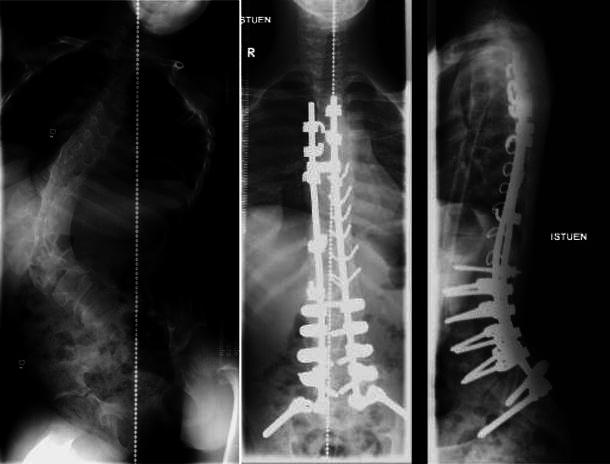
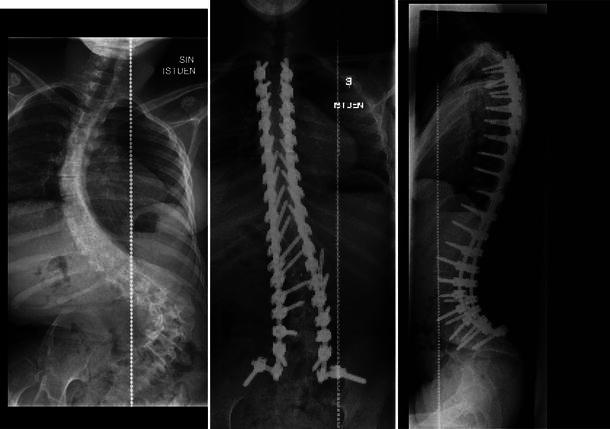
We evaluated 32 consecutive patients [11 males, mean age at surgery 15.3 (range 10.7-20.7) years] operated for a scoliosis of 90° or more using either hybrid (n = 15) or pedicle screw (n = 17) instrumentation. The follow-up time averaged 2.9 (2.0-6.6) years for radiographic and quality of life measurements and 5.5 years (2.0-9.0) years for mortality data. Of these patients, one had adolescent idiopathic scoliosis, three secondary scoliosis, and 28 neuromuscular scoliosis. Twelve patients in the hybrid and two patients in the pedicle screw groups underwent anteroposterior surgery (p < 0.001), and three patients in both groups had an apical vertebral column resection.
One (3.1 %) patient died during follow-up for severe pneumonia. Preoperatively, the mean magnitude of the major curve was 109° (90°-127°) in the hybrid and 100° (90°-116°) in the pedicle screw groups (p = 0.015), and was corrected to 45° (19°-69°) in the hybrid and 27° (18°-40°) in the pedicle screw groups at the 2-year follow-up (p < 0.001), with a mean correction of the major curve of 59 % (37-81 %) in the hybrid versus 73 % (60-81 %) in the pedicle screw groups, respectively (p = 0.0023). There were six postoperative complications, including one transient spinal cord deficit necessitating reoperation in the hybrid group as compared with five complications in the pedicle screw group (p = 0.53).
The mid-term mortality rate after the surgical treatment of severe scoliosis was low. Severe scoliosis can be treated safely with significantly better correction of the spinal deformity using pedicle screws than hybrid instrumentation.
未经治疗的严重脊柱侧弯与死亡率增加相关,并且仍然是一项重大的外科挑战。很少有研究报告严重脊柱侧弯手术治疗超过2年随访期后的死亡率。本研究的目的是评估超过标准2年随访期后的死亡率,并比较使用混合或椎弓根螺钉器械治疗严重脊柱侧弯的影像学结果。
我们评估了32例连续患者[11例男性,手术时平均年龄15.3岁(范围10.7 - 20.7岁)],他们因90°或更大的脊柱侧弯接受手术,使用混合器械(n = 15)或椎弓根螺钉器械(n = 17)。影像学和生活质量测量的随访时间平均为2.9年(2.0 - 6.6年),死亡率数据的随访时间为5.5年(2.0 - 9.0年)。这些患者中,1例为青少年特发性脊柱侧弯,3例为继发性脊柱侧弯,28例为神经肌肉型脊柱侧弯。混合器械组12例患者和椎弓根螺钉组2例患者接受了前后路手术(p < 0.001),两组均有3例患者进行了顶椎椎体切除术。
1例(3.1%)患者在随访期间因严重肺炎死亡。术前,混合器械组主弯平均角度为109°(90° - 127°),椎弓根螺钉组为100°(90° - 116°)(p = 0.015);在2年随访时,混合器械组主弯矫正至45°(19° - 69°),椎弓根螺钉组矫正至27°(18° - 40°)(p < 0.001),混合器械组主弯平均矫正率为59%(37 - 81%),椎弓根螺钉组为73%(60 - 81%)(p = 0.0023)。术后有6例并发症,其中混合器械组有1例短暂性脊髓功能障碍需要再次手术,椎弓根螺钉组有5例并发症(p = 0.53)。
严重脊柱侧弯手术治疗后的中期死亡率较低。与混合器械相比,使用椎弓根螺钉治疗严重脊柱侧弯可更安全有效地矫正脊柱畸形。