Souza Joao Paulo, Widmer Mariana, Gülmezoglu Ahmet Metin, Lawrie Theresa Anne, Adejuyigbe Ebunoluwa Aderonke, Carroli Guillermo, Crowther Caroline, Currie Sheena M, Dowswell Therese, Hofmeyr Justus, Lavender Tina, Lawn Joy, Mader Silke, Martinez Francisco Eulógio, Mugerwa Kidza, Qureshi Zahida, Silvestre Maria Asuncion, Soltani Hora, Torloni Maria Regina, Tsigas Eleni Z, Vowles Zoe, Ouedraogo Léopold, Serruya Suzanne, Al-Raiby Jamela, Awin Narimah, Obara Hiromi, Mathai Matthews, Bahl Rajiv, Martines José, Ganatra Bela, Phillips Sharon Jelena, Johnson Brooke Ronald, Vogel Joshua P, Oladapo Olufemi T, Temmerman Marleen
UNDP/UNFPA/UNICEF/WHO/World Bank Special Programme of Research, Development and Research Training in Human Reproduction (HRP), Department of Reproductive Health and Research, World Health Organization, Geneva, Switzerland.
Reprod Health. 2014 Aug 7;11:61. doi: 10.1186/1742-4755-11-61.
Maternal mortality has declined by nearly half since 1990, but over a quarter million women still die every year of causes related to pregnancy and childbirth. Maternal-health related targets are falling short of the 2015 Millennium Development Goals and a post-2015 Development Agenda is emerging. In connection with this, setting global research priorities for the next decade is now required.
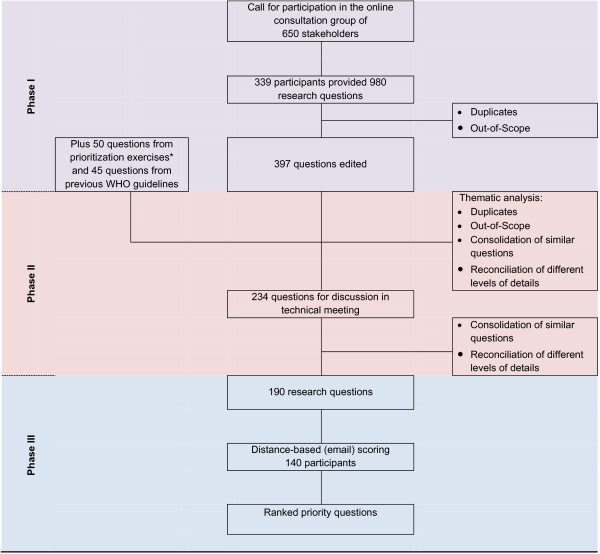
We adapted the methods of the Child Health and Nutrition Research Initiative (CHNRI) to identify and set global research priorities for maternal and perinatal health for the period 2015 to 2025. Priority research questions were received from various international stakeholders constituting a large reference group, and consolidated into a final list of research questions by a technical working group. Questions on this list were then scored by the reference working group according to five independent and equally weighted criteria. Normalized research priority scores (NRPS) were calculated, and research priority questions were ranked accordingly.
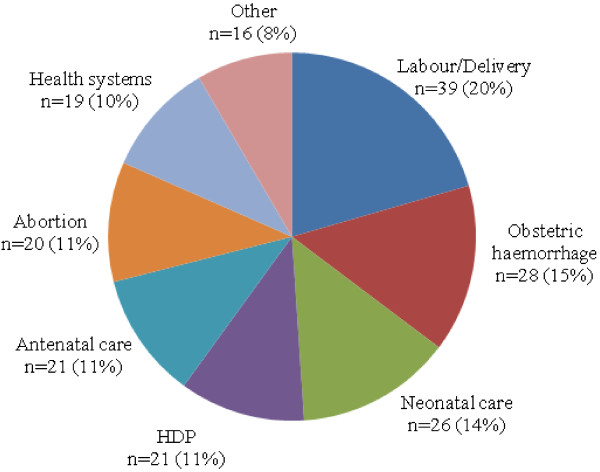
A list of 190 priority research questions for improving maternal and perinatal health was scored by 140 stakeholders. Most priority research questions (89%) were concerned with the evaluation of implementation and delivery of existing interventions, with research subthemes frequently concerned with training and/or awareness interventions (11%), and access to interventions and/or services (14%). Twenty-one questions (11%) involved the discovery of new interventions or technologies.
Key research priorities in maternal and perinatal health were identified. The resulting ranked list of research questions provides a valuable resource for health research investors, researchers and other stakeholders. We are hopeful that this exercise will inform the post-2015 Development Agenda and assist donors, research-policy decision makers and researchers to invest in research that will ultimately make the most significant difference in the lives of mothers and babies.
自1990年以来,孕产妇死亡率已下降近一半,但每年仍有超过25万妇女死于与妊娠和分娩相关的原因。与孕产妇健康相关的目标未达到2015年千年发展目标,2015年后发展议程正在形成。与此相关的是,现在需要确定未来十年的全球研究重点。
我们采用了儿童健康与营养研究倡议(CHNRI)的方法,以确定并设定2015年至2025年期间孕产妇和围产期健康的全球研究重点。优先研究问题来自构成大型参考小组的各国际利益相关者,并由一个技术工作组整合为最终的研究问题清单。然后,参考工作组根据五个独立且权重相等的标准对清单上的问题进行评分。计算出标准化研究优先级分数(NRPS),并据此对研究优先问题进行排序。
140名利益相关者对一份包含190个改善孕产妇和围产期健康的优先研究问题清单进行了评分。大多数优先研究问题(89%)涉及对现有干预措施的实施和提供情况的评估,研究子主题经常涉及培训和/或提高认识干预措施(11%)以及获得干预措施和/或服务的情况(14%)。21个问题(11%)涉及新干预措施或技术的发现。
确定了孕产妇和围产期健康的关键研究重点。由此产生的研究问题排名清单为卫生研究投资者、研究人员和其他利益相关者提供了宝贵资源。我们希望这项工作将为2015年后发展议程提供参考,并协助捐助者、研究政策决策者和研究人员投资于最终能对母亲和婴儿的生活产生最大影响的研究。