Cognitive Psychology Unit, Leiden Institute for Brain and Cognition, Leiden University Leiden, Netherlands.
Front Psychol. 2014 Jul 22;5:768. doi: 10.3389/fpsyg.2014.00768. eCollection 2014.
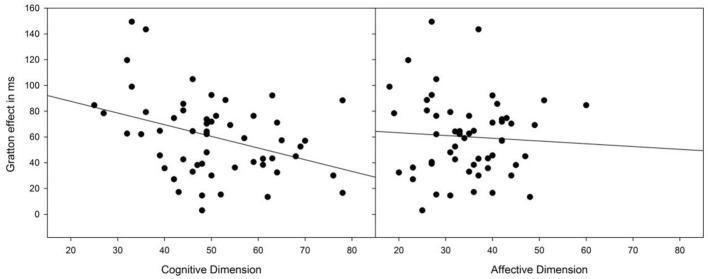
Stimulus-induced response conflict (e.g., in Simon or Stroop tasks) is often reduced after conflict trials-the Gratton effect. It is generally assumed that this effect is due to a strengthening of the representation of the current intention or goal, which in turn increases the degree of stimulus and/or response control. Recent evidence suggests that the motivational signal driving the Gratton effect might be affective in nature. If so, individual differences in either the strength of affective signals and/or the ability to interpret such signals might explain individual differences in cognitive-control adjustments as reflected in the Gratton effect. We tested this hypothesis by relating individual sizes of the Gratton effect in a Simon task to scores on the affective and the cognitive dimension of the Bermond/Vorst Alexithymia Questionnaire (BVAQ)-which we assumed to assess individual differences in affective-signal strength and ability to interpret affective signals, respectively. Results show that the cognitive, but not the affective dimension predicted control adjustment, while the accuracy of heartbeat detection was only (and only weakly) related to online control. This suggests that the motivation to fine-tune one's cognitive-control operations is mediated by, and may depend on one's ability to interpret one's own affective signals.
刺激引起的反应冲突(例如,在 Simon 或 Stroop 任务中)在冲突试验后通常会减少——即 Gratton 效应。通常认为,这种效应是由于当前意图或目标的表示得到了加强,这反过来又增加了刺激和/或反应控制的程度。最近的证据表明,驱动 Gratton 效应的动机信号可能具有情感性质。如果是这样,情感信号的强度和/或解释这种信号的能力的个体差异可能会解释 Gratton 效应所反映的认知控制调整的个体差异。我们通过将 Simon 任务中 Gratton 效应的个体大小与 Bermond/Vorst 述情障碍问卷(BVAQ)的情感和认知维度的得分相关联来检验这一假设——我们假设这分别评估情感信号强度和解释情感信号能力的个体差异。结果表明,认知维度而不是情感维度预测了控制调整,而心跳检测的准确性仅(且仅微弱地)与在线控制相关。这表明,微调认知控制操作的动机是由个体解释自身情感信号的能力所介导的,并可能依赖于这种能力。