Department of Pathology, Oslo University Hospital, Rikshospitalet, Post Box 4950 Nydalen, 0424 Oslo, Norway.
Membranes (Basel). 2014 Aug 6;4(3):424-46. doi: 10.3390/membranes4030424.
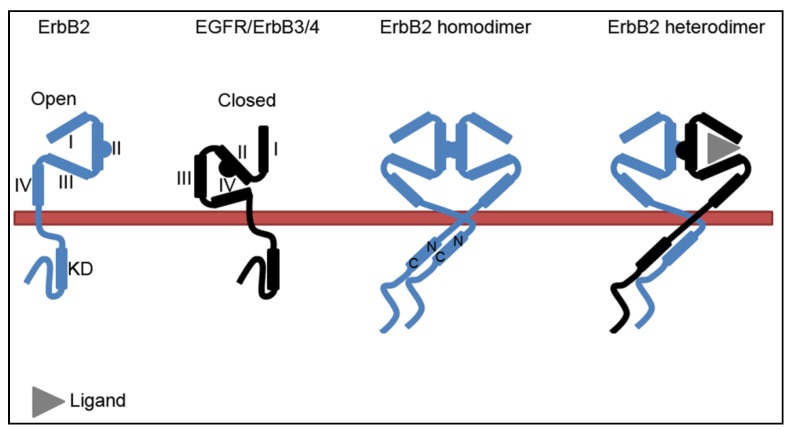
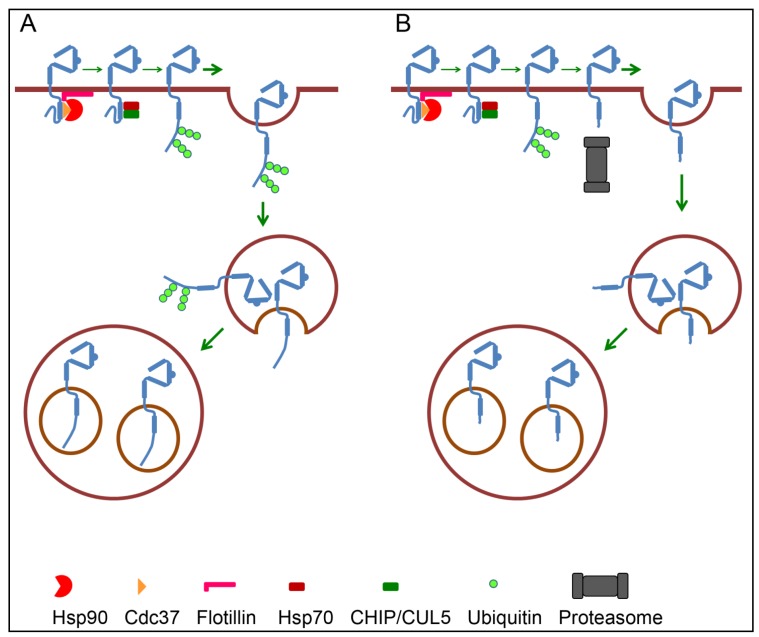
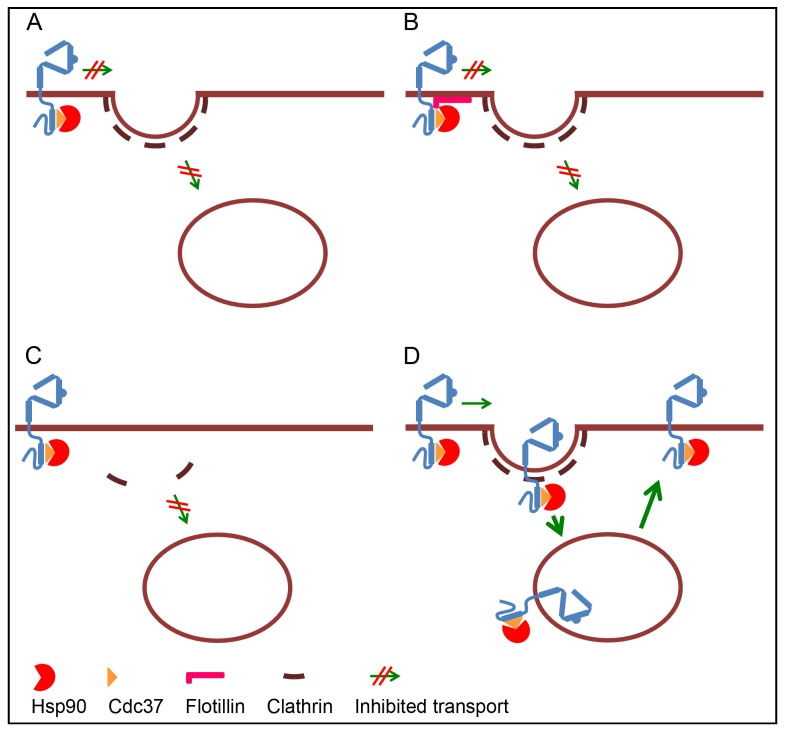
The EGFR- or ErbB-family of receptor tyrosine kinases consists of EGFR/ErbB1, ErbB2/HER2, ErbB3/HER3 and ErbB4/HER4. Receptor activation and downstream signaling are generally initiated upon ligand-induced receptor homo- or heterodimerization at the plasma membrane, and endocytosis and intracellular membrane transport are crucial for regulation of the signaling outcome. Among the receptors, ErbB2 is special in several ways. Unlike the others, ErbB2 has no known ligand, but is still the favored dimerization partner. Furthermore, while the other receptors are down-regulated either constitutively or upon ligand-binding, ErbB2 is resistant to down-regulation, and also inhibits down-regulation of its partner upon heterodimerization. The reason(s) why ErbB2 is resistant to down-regulation are the subject of debate. Contrary to other ErbB-proteins, mature ErbB2 needs Hsp90 as chaperone. Several data suggest that Hsp90 is an important regulator of factors like ErbB2 stability, dimerization and/or signaling. Hsp90 inhibitors induce degradation of ErbB2, but whether Hsp90 directly makes ErbB2 endocytosis resistant is unclear. Exposure to anti-ErbB2 antibodies can also induce down-regulation of ErbB2. Down-regulation induced by Hsp90 inhibitors or antibodies does at least partly involve internalization and endosomal sorting to lysosomes for degradation, but also retrograde trafficking to the nucleus has been reported. In this review, we will discuss different molecular mechanisms suggested to be important for making ErbB2 resistant to down-regulation, and review how membrane trafficking is involved when down-regulation and/or relocalization of ErbB2 is induced.
表皮生长因子受体(EGFR)或表皮生长因子受体家族由 EGFR/ErbB1、ErbB2/HER2、ErbB3/HER3 和 ErbB4/HER4 组成。受体激活和下游信号转导通常在配体诱导的质膜上受体同源或异源二聚化后开始,内吞作用和细胞内膜转运对于调节信号转导结果至关重要。在这些受体中,ErbB2 在几个方面很特殊。与其他受体不同,ErbB2 没有已知的配体,但仍然是首选的二聚化伴侣。此外,虽然其他受体要么在配体结合后要么在组成性下调,ErbB2 对下调具有抗性,并且在异源二聚化时也抑制其伴侣的下调。ErbB2 对下调具有抗性的原因仍存在争议。与其他 ErbB 蛋白相反,成熟的 ErbB2 需要热休克蛋白 90(Hsp90)作为伴侣。有几项数据表明,Hsp90 是调节 ErbB2 稳定性、二聚化和/或信号转导等因素的重要调节剂。Hsp90 抑制剂诱导 ErbB2 的降解,但 Hsp90 是否直接使 ErbB2 内吞作用具有抗性尚不清楚。暴露于抗 ErbB2 抗体也可以诱导 ErbB2 的下调。Hsp90 抑制剂或抗体诱导的下调至少部分涉及内化和内体分选到溶酶体进行降解,但也有报道称逆行转运到核内。在这篇综述中,我们将讨论被认为对使 ErbB2 对下调具有抗性很重要的不同分子机制,并回顾下调和/或 ErbB2 重定位时膜转运如何参与其中。