Biomedical Science Programme, Faculty of Health Sciences, Universiti Kebangsaan Malaysia, Jalan Raja Muda Abdul Aziz, 50300 Kuala Lumpur, Malaysia.
BMC Complement Altern Med. 2014 Aug 9;14:295. doi: 10.1186/1472-6882-14-295.
Selective Alzheimer Disease Indicator-1 (or Seladin-1) is a multifunctional protein first discovered by downregulation of its expression in Alzheimer's disease. Interestingly, the expression of this protein is upregulated in several cancers, including primary bladder cancer. However, its role in cancer formation has yet to be discovered. Goniothalamin is a natural product that has been demonstrated to induce apoptosis in various cancer cell lines. In this study, we have elucidated the role of Seladin-1 in goniothalamin-induced cytotoxicity towards human urinary bladder cancer cell line RT4.
The cytotoxicity of goniothalamin in human urinary bladder cancer cell line RT4 was assessed using MTT assay and the mode of cell death was determined by Annexin V-FITC/PI labeling assay. Finally, the expression of Seladin-1 protein in goniothalamin-treated RT4 cells was determined by Western blot.
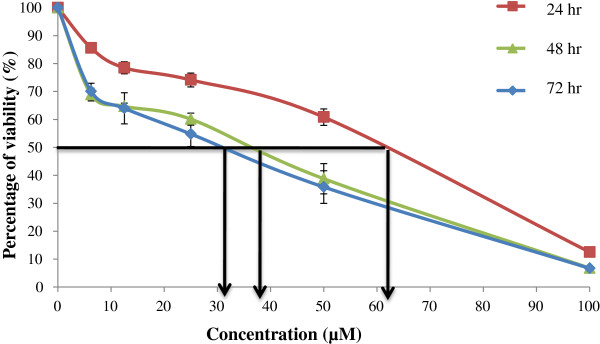
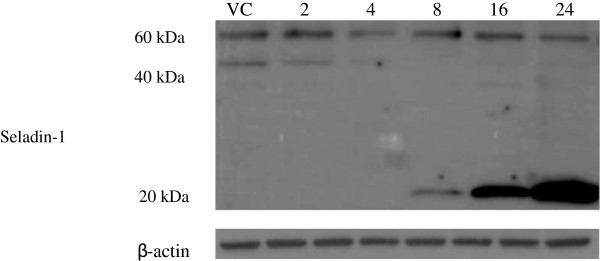
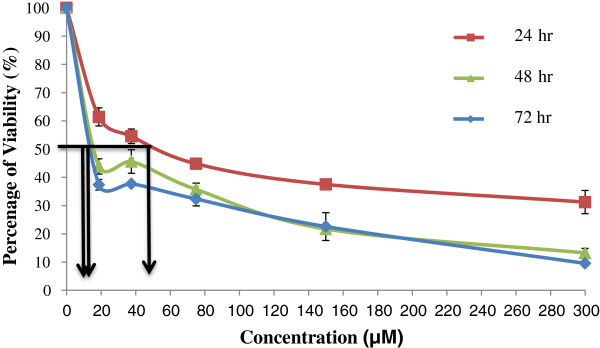
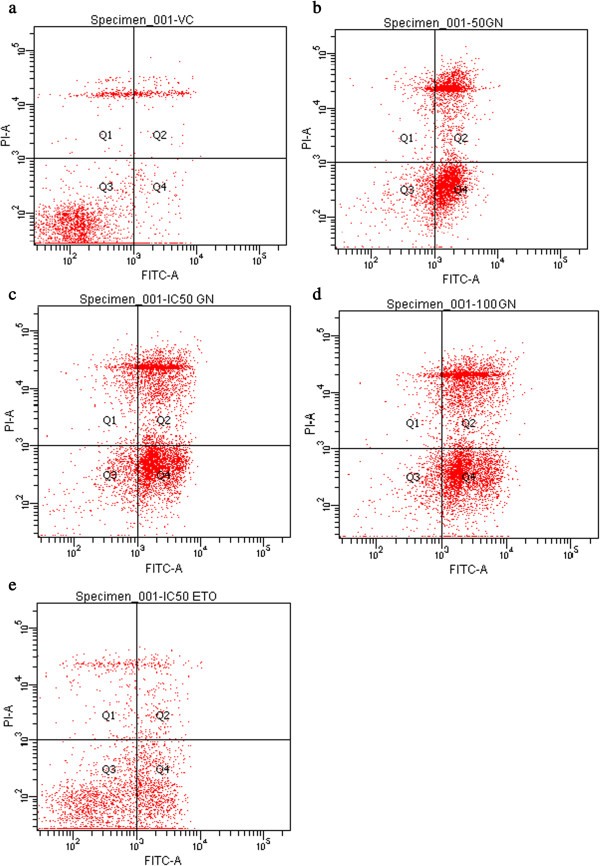
MTT assay showed that the cytotoxicity of goniothalamin on RT4 cells was concentration and time dependent with IC50 values of 61 μM (24 hr), 38 μM (48 hr) and 31 μM for 72 hr, respectively. Cell death induced was confirmed through apoptosis; as assessed using the Annexin V-FITC/PI labeling assay. Furthermore, the involvement of Seladin-1 in goniothalamin-induced apoptosis was evidenced through the cleavage of 60 kDa protein to 40 kDa and 20 kDa. This was followed by a gradual increase of 20 kDa fragment suggesting the involvement of Seladin-1 in goniothalamin-induced apoptosis on RT4 cells.
This study demonstrates that goniothalamin induce cytotoxicity and apoptosis on RT4 cells. The involvement of Seladin-1 in goniothalamin-induced apoptosis further suggested that Seladin-1 may play a role in the formation of primary bladder cancer.
选择性阿尔茨海默病标志物-1(或 Seladin-1)是一种多功能蛋白,最初是在阿尔茨海默病中发现其表达下调而发现的。有趣的是,这种蛋白在包括原发性膀胱癌在内的几种癌症中表达上调。然而,其在癌症形成中的作用尚未被发现。戈尼醇是一种天然产物,已被证明可诱导多种癌细胞系凋亡。在这项研究中,我们阐明了 Seladin-1 在戈尼醇诱导人膀胱癌 RT4 细胞系细胞毒性中的作用。
使用 MTT 测定法评估戈尼醇对人膀胱癌 RT4 细胞系的细胞毒性,并用 Annexin V-FITC/PI 标记测定法确定细胞死亡方式。最后,通过 Western blot 测定 Seladin-1 蛋白在戈尼醇处理的 RT4 细胞中的表达。
MTT 测定表明,戈尼醇对 RT4 细胞的细胞毒性呈浓度和时间依赖性,IC50 值分别为 61 μM(24 小时)、38 μM(48 小时)和 31 μM(72 小时)。通过 Annexin V-FITC/PI 标记测定法证实诱导的细胞死亡是通过凋亡实现的。此外,通过将 60 kDa 蛋白切割成 40 kDa 和 20 kDa,证明了 Seladin-1 在戈尼醇诱导的凋亡中的参与。这随后伴随着 20 kDa 片段的逐渐增加,表明 Seladin-1 参与了戈尼醇诱导的 RT4 细胞凋亡。
这项研究表明戈尼醇诱导 RT4 细胞产生细胞毒性和凋亡。Seladin-1 参与戈尼醇诱导的凋亡进一步表明 Seladin-1 可能在原发性膀胱癌的形成中发挥作用。