Yang Bob, Kang Heechan, Fung Anthony, Zhao Hailin, Wang Tianlong, Ma Daqing
Department of Anesthesiology, Xuanwu Hospital, Capital Medical University, Beijing 100053, China ; Anaesthetics, Pain Medicine and Intensive Care, Department of Surgery and Cancer, Faculty of Medicine, Imperial College London, Chelsea & Westminster Hospital, London SW10 9NH, UK.
Anaesthetics, Pain Medicine and Intensive Care, Department of Surgery and Cancer, Faculty of Medicine, Imperial College London, Chelsea & Westminster Hospital, London SW10 9NH, UK.
Mediators Inflamm. 2014;2014:623759. doi: 10.1155/2014/623759. Epub 2014 Jul 7.
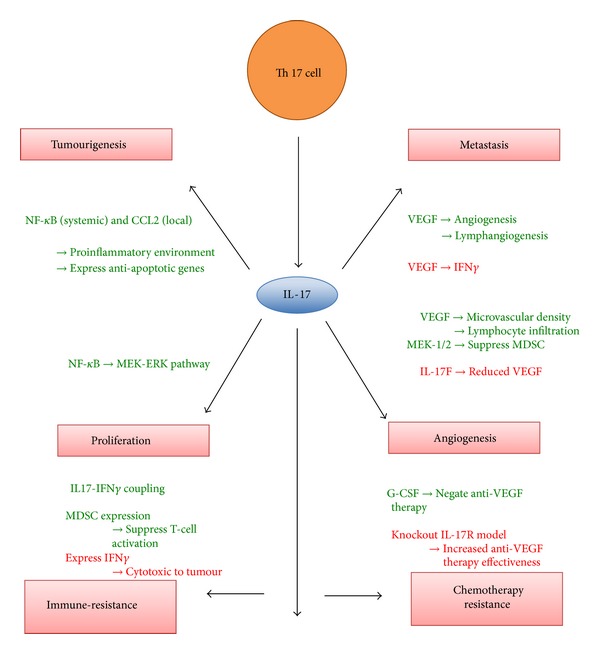
With 7.6 million deaths globally, cancer according to the World Health Organisation is still one of the leading causes of death worldwide. Interleukin 17 (IL-17) is a cytokine produced by Th17 cells, a T helper cell subset developed from an activated CD4+ T-cell. Whilst the importance of IL-17 in human autoimmune disease, inflammation, and pathogen defence reactions has already been established, its potential role in cancer progression still needs to be updated. Interestingly studies have demonstrated that IL-17 plays an intricate role in the pathophysiology of cancer, from tumorigenesis, proliferation, angiogenesis, and metastasis, to adapting the tumour in its ability to confer upon itself both immune, and chemotherapy resistance. This review will look into IL-17 and summarise the current information and data on its role in the pathophysiology of cancer as well as its potential application in the overall management of the disease.
据世界卫生组织统计,癌症仍是全球主要死因之一,全球每年有760万人死于癌症。白细胞介素17(IL-17)是一种由Th17细胞产生的细胞因子,Th17细胞是从活化的CD4 + T细胞发育而来的T辅助细胞亚群。虽然IL-17在人类自身免疫性疾病、炎症和病原体防御反应中的重要性已经得到证实,但其在癌症进展中的潜在作用仍有待更新。有趣的是,研究表明IL-17在癌症的病理生理学中发挥着复杂的作用,从肿瘤发生、增殖、血管生成和转移,到使肿瘤具有免疫和化疗抗性。这篇综述将探讨IL-17,并总结关于其在癌症病理生理学中的作用以及在疾病整体管理中的潜在应用的当前信息和数据。