Kristoffersen Espen Saxhaug, Straand Jørund, Vetvik Kjersti Grøtta, Benth Jūratė Šaltytė, Russell Michael Bjørn, Lundqvist Christofer
Department of General Practice, Institute of Health and Society, University of Oslo, Oslo, Norway HØKH, Research Centre, Akershus University Hospital, Lørenskog, Norway.
Department of General Practice, Institute of Health and Society, University of Oslo, Oslo, Norway.
J Neurol Neurosurg Psychiatry. 2015 May;86(5):505-12. doi: 10.1136/jnnp-2014-308548. Epub 2014 Aug 11.
Medication-overuse headache (MOH) is common in the general population. We investigated effectiveness of brief intervention (BI) for achieving drug withdrawal in primary care patients with MOH.
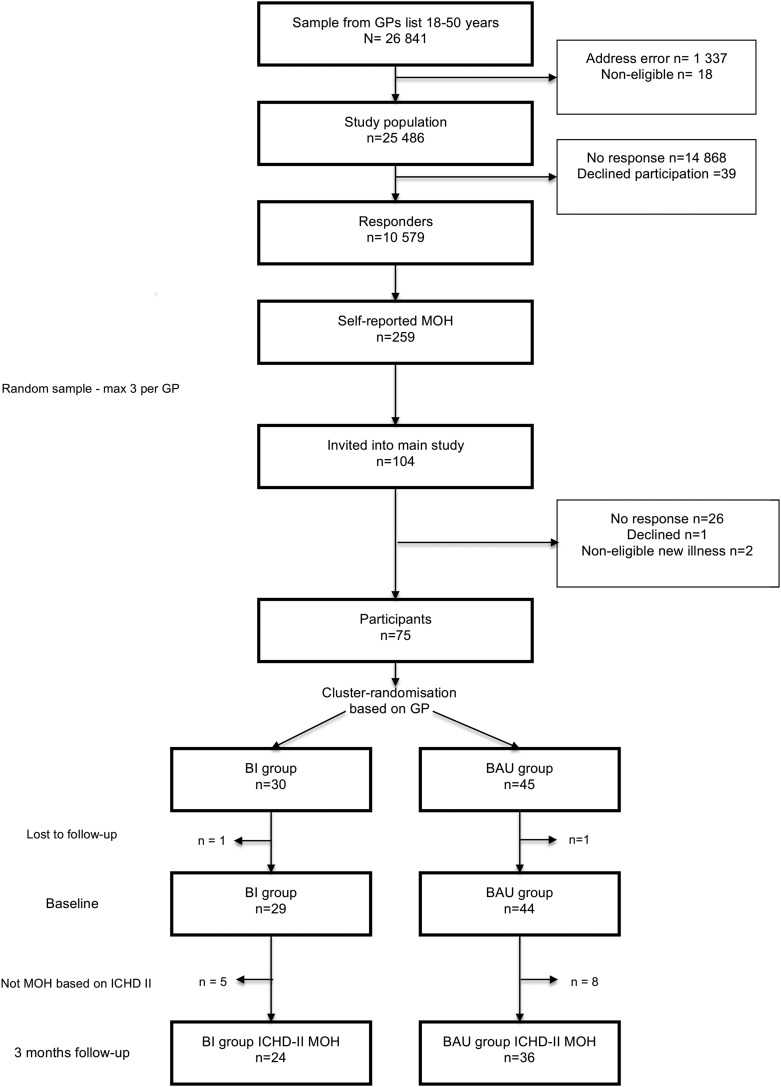
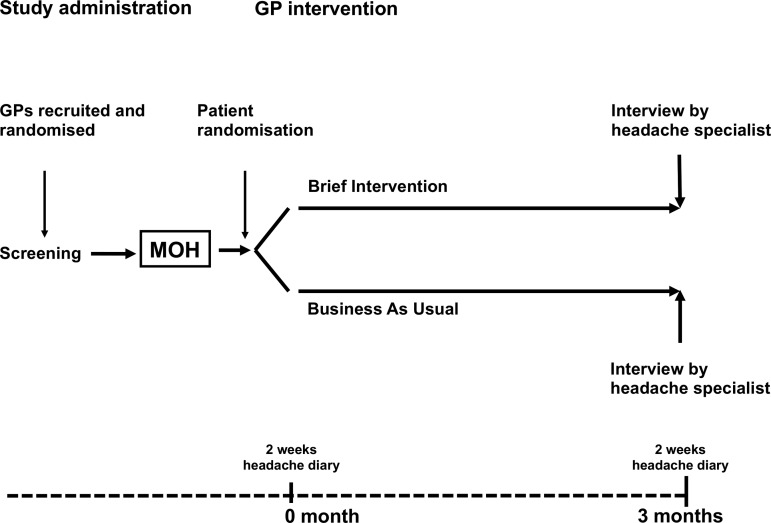
The study was double-blind, pragmatic and cluster-randomised controlled. A total of 25,486 patients (age 18-50) from 50 general practitioners (GPs) were screened for MOH. GPs defined clusters and were randomised to receive BI training (23 GPs) or to continue business as usual (BAU; 27 GPs). The Severity of Dependence Scale was applied as a part of the BI. BI involved feedback about individual risk of MOH and how to reduce overuse. Primary outcome measures were reduction in medication and headache days/month 3 months after the intervention and were assessed by a blinded clinical investigator.
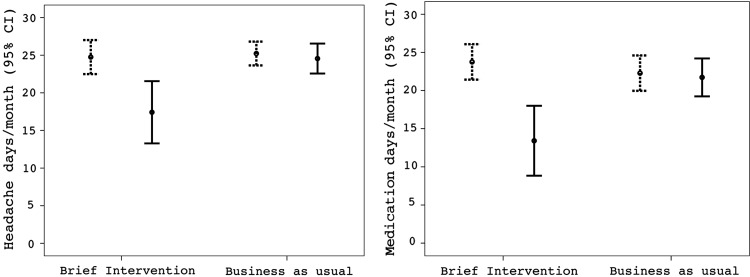
42% responded to the postal screening questionnaire, and 2.4% screened positive for MOH. A random selection of up to three patients with MOH from each GP were invited (104 patients), 75 patients were randomised and 60 patients included into the study. BI was significantly better than BAU for the primary outcomes (p<0.001). Headache and medication days were reduced by 7.3 and 7.9 (95% CI 3.2 to 11.3 and 3.2 to 12.5) days/month in the BI compared with the BAU group. Chronic headache resolved in 50% of the BI and 6% of the BAU group.
The BI method provides GPs with a simple and effective instrument that reduces medication-overuse and headache frequency in patients with MOH.
NCT01314768.
药物过度使用性头痛(MOH)在普通人群中很常见。我们调查了简短干预(BI)对初级保健中MOH患者实现药物戒断的有效性。
该研究为双盲、实用且整群随机对照研究。对来自50名全科医生(GP)的25486名患者(年龄18 - 50岁)进行了MOH筛查。全科医生定义群组并被随机分配接受BI培训(23名全科医生)或照常开展业务(BAU;27名全科医生)。依赖程度量表作为BI的一部分应用。BI包括关于个体MOH风险以及如何减少过度使用的反馈。主要结局指标是干预后3个月用药量和每月头痛天数的减少情况,由一名盲态临床研究者进行评估。
42%的患者回复了邮寄筛查问卷,2.4%的患者MOH筛查呈阳性。从每位全科医生中随机挑选最多三名MOH患者受邀参与研究(104名患者),75名患者被随机分组,60名患者纳入研究。对于主要结局,BI显著优于BAU(p<0.001)。与BAU组相比,BI组头痛天数和用药天数每月分别减少7.3天和7.9天(95%CI 3.2至11.3和3.2至12.5)。50%的BI组和6%的BAU组慢性头痛得到缓解。
BI方法为全科医生提供了一种简单有效的工具,可减少MOH患者的药物过度使用和头痛频率。
NCT01314768。