Photonic Network Research Institute, National Institute of Information and Communications Technology, 4-2-1 Nukui-kita, Koganei, Tokyo 184-8795, Japan.
WPI Center for Materials Nanoarchitectonics, National Institute for Materials Science, 1-1 Namiki, Tsukuba, Ibaraki 305-0044, Japan.
Sci Rep. 2014 Aug 12;4:6039. doi: 10.1038/srep06039.
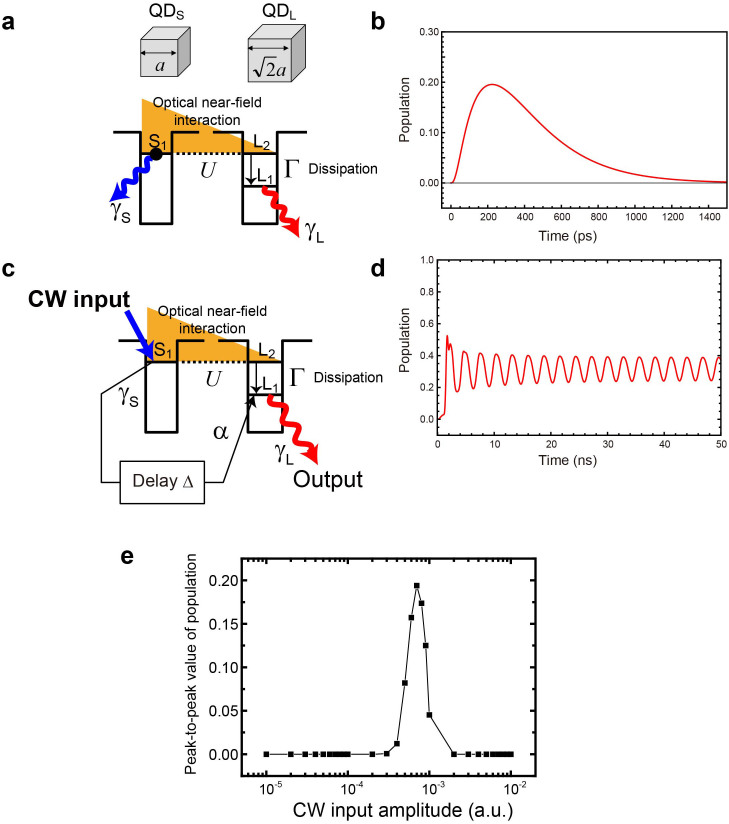
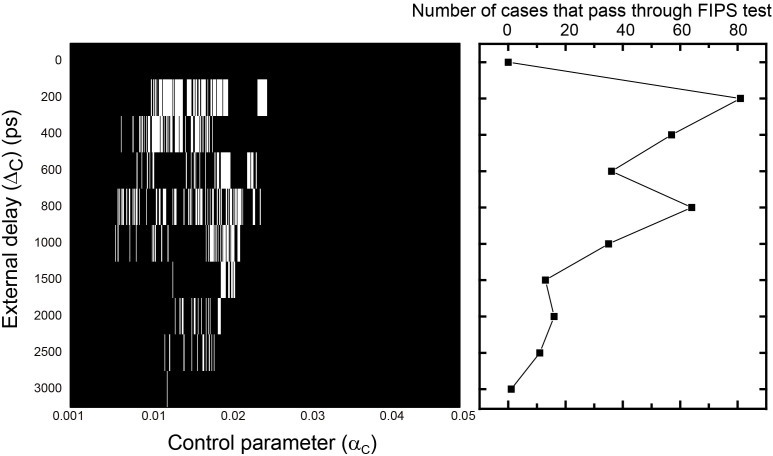
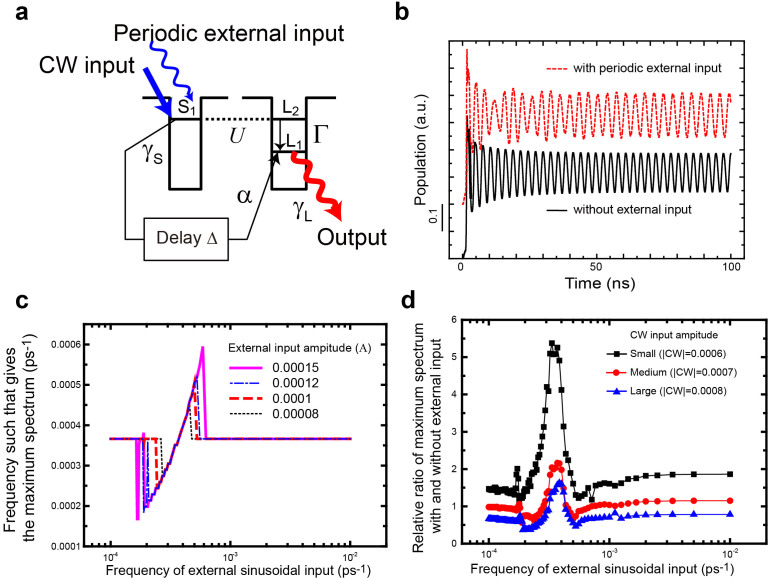
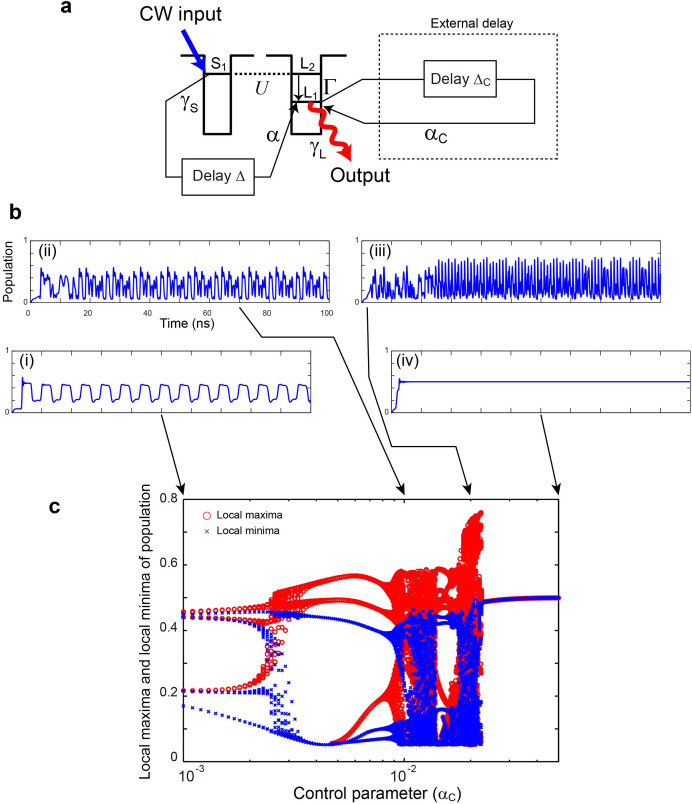
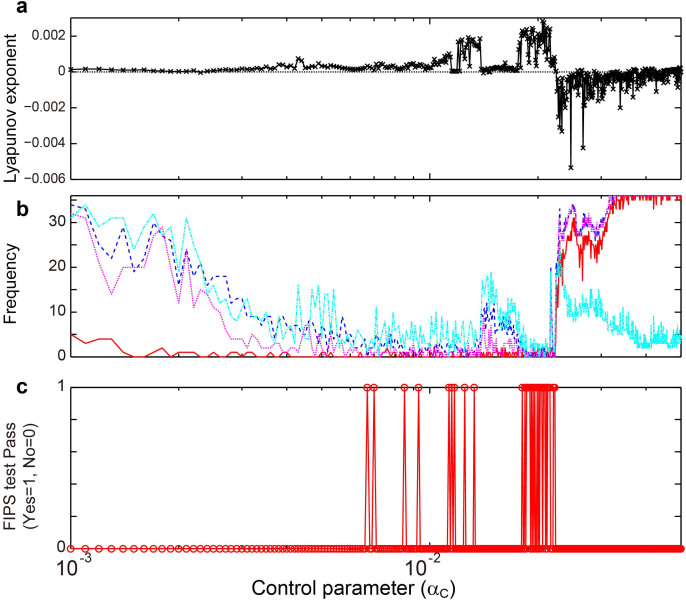
By using nanoscale energy-transfer dynamics and density matrix formalism, we demonstrate theoretically and numerically that chaotic oscillation and random-number generation occur in a nanoscale system. The physical system consists of a pair of quantum dots (QDs), with one QD smaller than the other, between which energy transfers via optical near-field interactions. When the system is pumped by continuous-wave radiation and incorporates a timing delay between two energy transfers within the system, it emits optical pulses. We refer to such QD pairs as nano-optical pulsers (NOPs). Irradiating an NOP with external periodic optical pulses causes the oscillating frequency of the NOP to synchronize with the external stimulus. We find that chaotic oscillation occurs in the NOP population when they are connected by an external time delay. Moreover, by evaluating the time-domain signals by statistical-test suites, we confirm that the signals are sufficiently random to qualify the system as a random-number generator (RNG). This study reveals that even relatively simple nanodevices that interact locally with each other through optical energy transfer at scales far below the wavelength of irradiating light can exhibit complex oscillatory dynamics. These findings are significant for applications such as ultrasmall RNGs.
通过利用纳米尺度能量转移动力学和密度矩阵形式理论,我们从理论和数值上证明混沌振荡和随机数生成发生在纳米尺度系统中。物理系统由一对量子点(QD)组成,其中一个量子点小于另一个量子点,通过光近场相互作用在它们之间传递能量。当系统被连续波辐射泵浦,并在系统内的两次能量转移之间包含时间延迟时,它会发射光脉冲。我们将这样的量子点对称为纳米光脉冲器(NOP)。用外部周期性光脉冲辐照 NOP 会导致 NOP 的振荡频率与外部刺激同步。我们发现,当 NOP 通过外部时滞连接时,会发生混沌振荡。此外,通过对时域信号进行统计测试套件评估,我们确认信号足够随机,足以使系统成为随机数生成器(RNG)。这项研究表明,即使是相对简单的纳米器件,通过在远低于辐照光波长的尺度上通过光能量转移相互局部作用,也可以表现出复杂的振荡动力学。这些发现对于超小型 RNG 等应用具有重要意义。