Laboratory of Genetics, University of Wisconsin-Madison, Madison, WI, USA.
BMC Evol Biol. 2014 Aug 13;14:179. doi: 10.1186/s12862-014-0179-y.
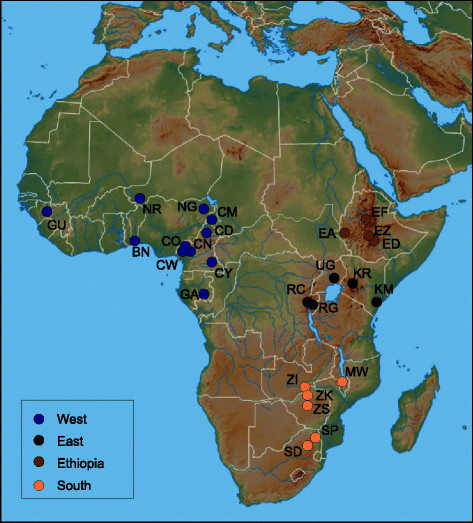
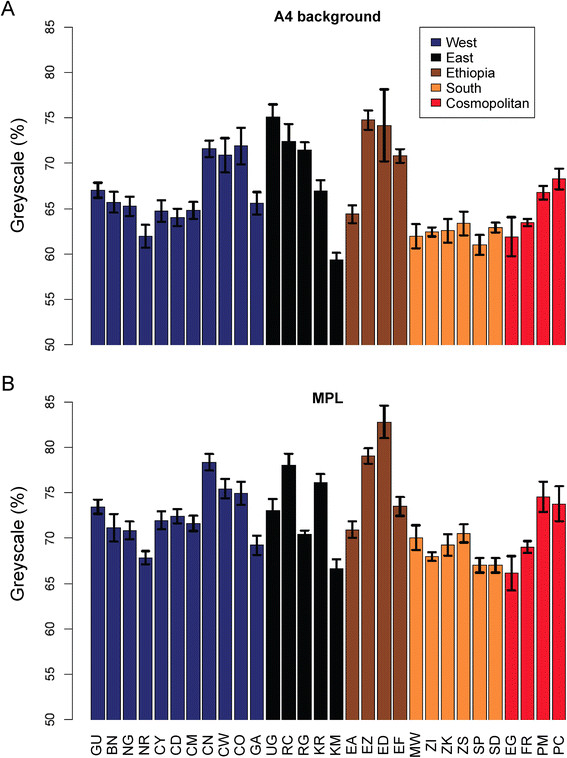
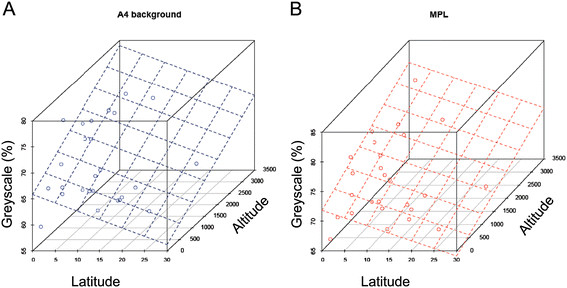
Pigmentation has a long history of investigation in evolutionary biology. In Drosophila melanogaster, latitudinal and altitudinal clines have been found but their underlying causes remain unclear. Moreover, most studies were conducted on cosmopolitan populations which have a relatively low level of genetic structure and diversity compared to sub-Saharan African populations. We investigated: 1) the correlation between pigmentation traits within and between the thorax and the fourth abdominal segment, and 2) their associations with different geographical and ecological variables, using 710 lines belonging to 30 sub-Saharan and cosmopolitan populations.
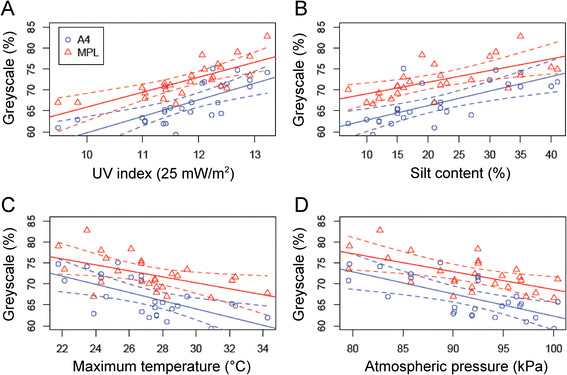
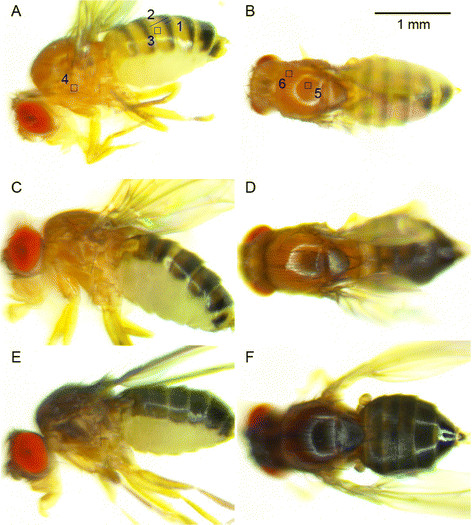
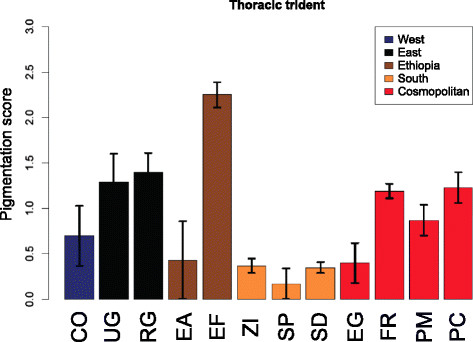
Pigmentation clines substantially differed between sub-Saharan and cosmopolitan populations. While positive correlations with latitude have previously been described in Europe, India and Australia, in agreement with Bogert's rule or the thermal melanism hypothesis, we found a significant negative correlation in Africa. This correlation persisted even after correction for altitude, which in its turn showed a positive correlation with pigmentation independently from latitude. More importantly, we found that thoracic pigmentation reaches its maximal values in this species in high-altitude populations of Ethiopia (1,600-3,100 m). Ethiopian flies have a diffuse wide thoracic trident making the mesonotum and the head almost black, a phenotype that is absent from all other sub-Saharan or cosmopolitan populations including high-altitude flies from Peru (~3,400 m). Ecological analyses indicated that the variable most predictive of pigmentation in Africa, especially for the thorax, was ultra-violet (UV) intensity, consistent with the so-called Gloger's rule invoking a role of melanin in UV protection.
Our data suggest that different environmental factors may shape clinal variation in tropical and temperate regions, and may lead to the evolution of different degrees of melanism in different high altitude populations in the tropics.
在进化生物学中,色素沉着一直是一个备受关注的研究领域。在黑腹果蝇中,已经发现了纬度和海拔梯度,但它们的潜在原因仍不清楚。此外,大多数研究都是在世界性种群中进行的,与撒哈拉以南非洲种群相比,这些种群的遗传结构和多样性相对较低。我们调查了:1)胸部和第四腹节内部和之间的色素沉着特征之间的相关性,以及 2)它们与不同地理和生态变量的关联,使用了属于 30 个撒哈拉以南和世界性种群的 710 条线。
色素沉着梯度在撒哈拉以南和世界性种群之间存在显著差异。虽然以前在欧洲、印度和澳大利亚已经描述了与纬度呈正相关的情况,与 Bogert 法则或热黑化假说一致,但我们在非洲发现了一个显著的负相关。即使在对海拔进行校正后,这种相关性仍然存在,而海拔本身则与纬度无关,与色素沉着呈正相关。更重要的是,我们发现该物种在埃塞俄比亚的高海拔种群中(1600-3100 米)达到了胸部色素沉着的最大值。埃塞俄比亚的苍蝇具有宽阔的胸部三叉戟,使中胸和头部几乎呈黑色,这种表型在包括秘鲁高海拔苍蝇(约 3400 米)在内的所有其他撒哈拉以南或世界性种群中都不存在。生态分析表明,在非洲,特别是对胸部来说,最能预测色素沉着的变量是紫外线(UV)强度,这与所谓的 Gloger 法则一致,该法则认为黑色素在 UV 保护中起作用。
我们的数据表明,不同的环境因素可能会影响热带和温带地区的渐变变异,并可能导致不同高海拔热带种群中不同程度的黑化进化。