Wu Xin, Ding Nan, Hu Wentao, He Jinpeng, Xu Shuai, Pei Hailong, Hua Junrui, Zhou Guangming, Wang Jufang
Department of Space Radiobiology, Key Laboratory of Heavy Ion Radiation Biology and Medicine, Institute of Modern Physics, Chinese Academy of Sciences, Lanzhou 509 Nanchang Road, Lanzhou 730000, China.
Radiat Oncol. 2014 Aug 12;9:179. doi: 10.1186/1748-717X-9-179.
B cell translocation gene 1 (BTG1) has long been recognized as a tumor suppressor gene. Recent reports demonstrated that BTG1 plays an important role in progression of cell cycle and is involved in cellular response to stressors. However, the microRNAs mediated regulatory mechanism of BTG1 expression has not been reported so far. MicroRNAs can effectively influence tumor radiosensitivity by preventing cell cycle progression, resulting in enhancement of the cytotoxicity of radiotherapy efficacy. This study aimed to demonstrating the effects of microRNAs on the BTG1 expression and cellular radiosensitivity.
The human renal carcinoma 786-O cells were treated with 5 Gy of X-rays. Expressions of BTG1 gene and miR-454-3p, which was predicted to target BTG1 by software algorithm, were analyzed by quantitative polymerase chain reaction. Protein expressions were assessed by Western blot. Luciferase assays were used to quantify the interaction between BTG1 3'-untranslated region (3'-UTR) and miR-454-3p. The radiosensitivity was quantified by the assay of cell viability, colony formation and caspase-3 activity.
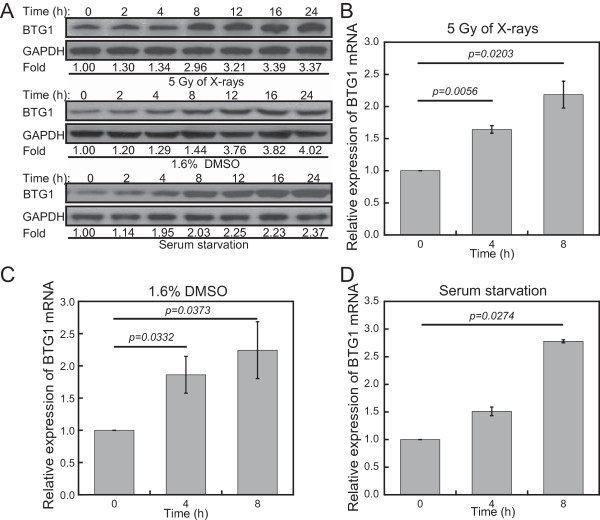
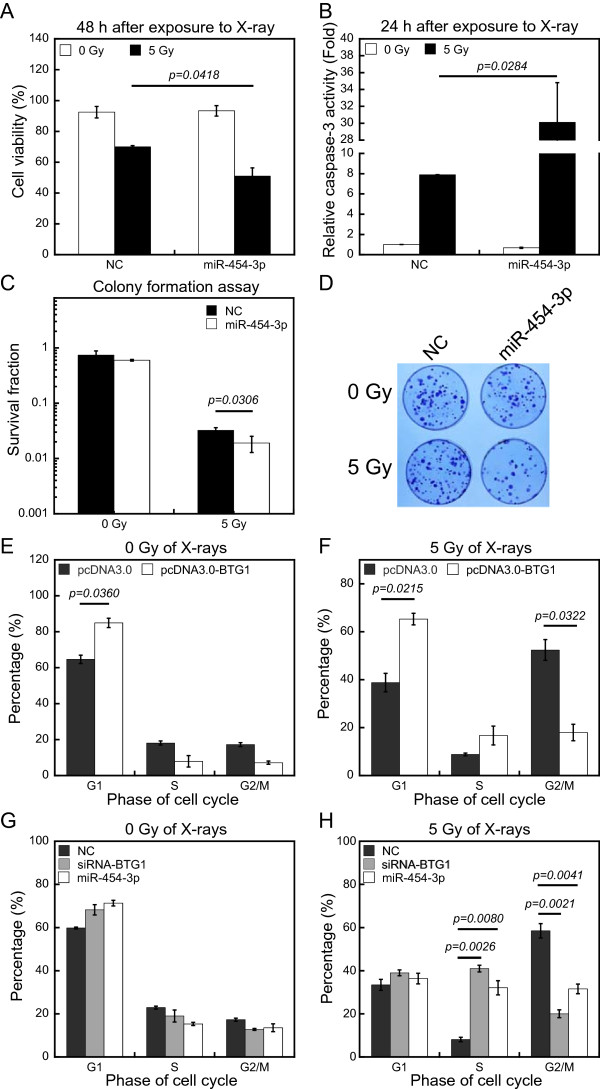
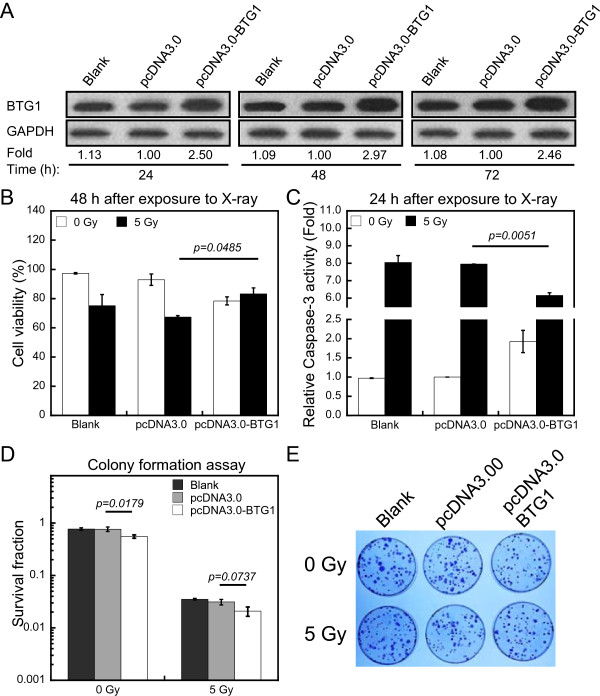
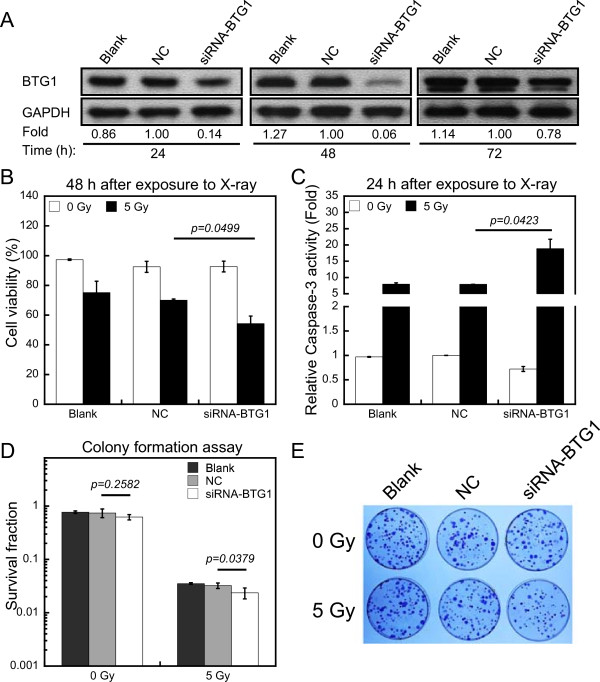
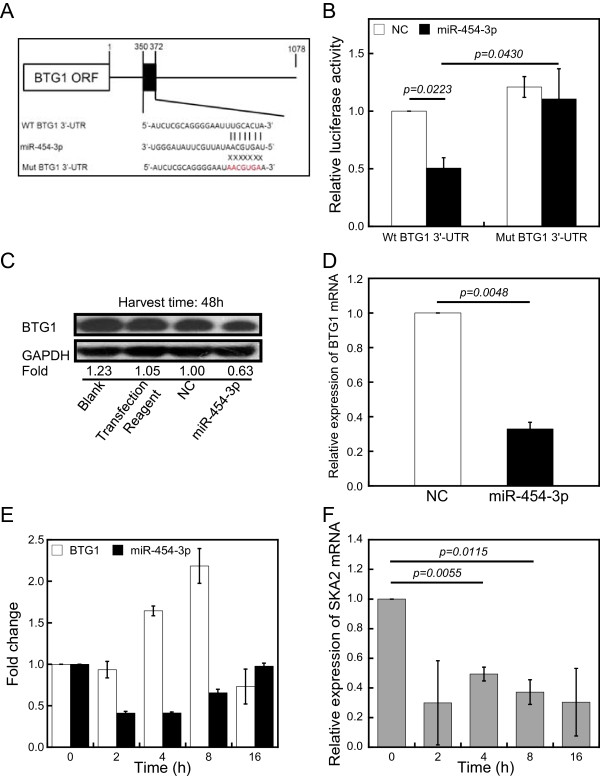
The expression of the BTG1 gene in 786-O cells was significantly elevated after treatments with X-ray irradiation, DMSO, or serum starvation. The up-regulation of BTG1 after irradiation reduced cellular radiosensitivity as demonstrated by the enhanced cell viability and colony formation, as well as the repressed caspase-3 activity. In comparison, knock down of BTG1 by siRNA led to significantly enhanced cellular radiosensitivity. It was found that miR-454-3p can regulate the expression of BTG1 through a direct interaction with the 3'-UTR of BTG1 mRNA. Decreasing of its expression level correlates well with BTG1 up-regulation during X-ray irradiation. Particularly, we observed that over-expression of miR-454-3p by transfection inhibited the BTG1 expression and enhanced the radiosensitivity. In addition, cell cycle analysis showed that over-expression of miR-454-3p shifted the cell cycle arrest from G2/M phase to S phase.
Our results indicate that BTG1 is a direct target of miR-454-3p. Down-regulation of BTG1 by miR-454-3p renders tumor cells sensitive to radiation. These results may shed light on the potential application in tumor radiotherapy.
B细胞易位基因1(BTG1)长期以来被认为是一种肿瘤抑制基因。最近的报道表明,BTG1在细胞周期进程中起重要作用,并参与细胞对应激源的反应。然而,迄今为止,尚未报道微小RNA介导的BTG1表达调控机制。微小RNA可通过阻止细胞周期进程有效影响肿瘤放射敏感性,从而增强放射治疗疗效的细胞毒性。本研究旨在证明微小RNA对BTG1表达和细胞放射敏感性的影响。
用人肾癌细胞786-O细胞接受5 Gy的X射线照射。通过定量聚合酶链反应分析BTG1基因和软件算法预测靶向BTG1的miR-454-3p的表达。通过蛋白质印迹评估蛋白质表达。荧光素酶测定用于量化BTG1 3'-非翻译区(3'-UTR)与miR-454-3p之间的相互作用。通过细胞活力、集落形成和半胱天冬酶-3活性测定来量化放射敏感性。
在用X射线照射、二甲基亚砜或血清饥饿处理后,786-O细胞中BTG1基因的表达显著升高。照射后BTG1的上调降低了细胞放射敏感性,这表现为细胞活力和集落形成增强,以及半胱天冬酶-3活性受到抑制。相比之下,用小干扰RNA敲低BTG1导致细胞放射敏感性显著增强。发现miR-454-3p可通过与BTG1 mRNA的3'-UTR直接相互作用来调节BTG1的表达。在X射线照射期间,其表达水平的降低与BTG1上调密切相关。特别地,我们观察到通过转染过表达miR-454-3p可抑制BTG1表达并增强放射敏感性。此外,细胞周期分析表明,过表达miR-454-3p可使细胞周期停滞从G2/M期转变为S期。
我们的结果表明,BTG1是miR-454-3p的直接靶标。miR-454-3p下调BTG1使肿瘤细胞对辐射敏感。这些结果可能为肿瘤放射治疗的潜在应用提供线索。