Arpino Grazia, De Placido Sabino, De Angelis Carmine
Department of Clinical Medicine, Division of Medical Oncology, University of Naples Federico II, Naples, Italy.
Anticancer Drugs. 2015 Jan;26(1):117-22. doi: 10.1097/CAD.0000000000000159.
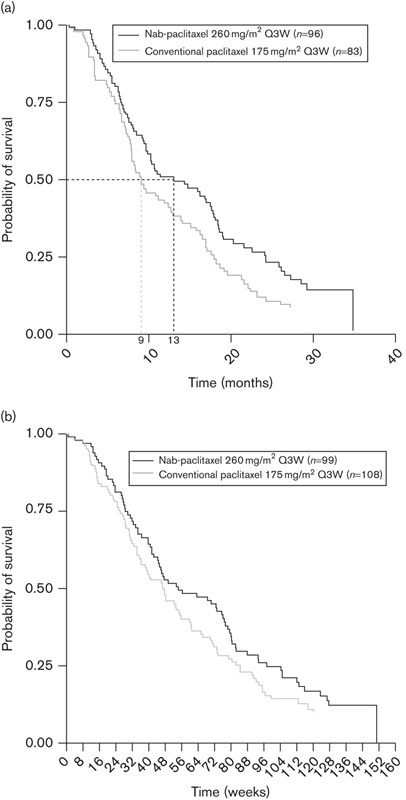
The optimal sequence of systemic chemotherapy in metastatic breast cancer (MBC) is unknown. We report the case of a woman who was successfully treated with nanoparticle albumin-bound (nab)-paclitaxel for triple negative MBC in our institution. In November 2008, a 48-year-old woman underwent surgical treatment for a triple negative invasive ductal breast cancer and subsequently received adjuvant chemotherapy with fluorouracil/epirubicin/cyclophosphamide and radiotherapy. Sixteen months after surgery, she presented with a left chest wall metastatasis. The patient received combination therapy with conventional paclitaxel (90 mg/m² weekly for 3 out of 4 weeks [QW 3/4]) and bevacizumab (10 mg/kg every 2 weeks [Q2W]) as first-line treatment for MBC (six cycles; March to September 2010) and achieved a partial response at the metastatic site. Bevacizumab monotherapy was continued until disease progression (April 2011) with the development of a single infraclavicular lymph node metastasis and an increase in the dimensions of the left chest wall lesion. From May to December 2011, the patient received nab-paclitaxel 260 mg/m² every 3 weeks (Q3W) as second-line treatment (11 cycles). After three cycles, the left chest wall lesion and the infraclavicular lymph node metastasis were undetectable and the patient was considered to have achieved a complete response. Treatment was well tolerated with no significant toxicity or need for dose reduction. Given our case, here we review the clinical evidence and discuss the potential role of nab-paclitaxel for the treatment of triple negative MBC, a subgroup typically characterized as having aggressive disease and limited treatment options.
转移性乳腺癌(MBC)全身化疗的最佳顺序尚不清楚。我们报告了一例在我院成功接受纳米白蛋白结合型(nab)紫杉醇治疗三阴性MBC的女性病例。2008年11月,一名48岁女性因三阴性浸润性导管癌接受了手术治疗,随后接受了氟尿嘧啶/表柔比星/环磷酰胺辅助化疗及放疗。术后16个月,她出现左胸壁转移。该患者接受了传统紫杉醇(90mg/m²,每4周中的3周每周一次[QW 3/4])联合贝伐单抗(10mg/kg,每2周一次[Q2W])作为MBC的一线治疗(六个周期;2010年3月至9月),并在转移部位获得部分缓解。贝伐单抗单药治疗持续至疾病进展(2011年4月),出现单个锁骨下淋巴结转移且左胸壁病变增大。2011年5月至12月,该患者接受nab紫杉醇260mg/m²每3周一次(Q3W)作为二线治疗(11个周期)。三个周期后,左胸壁病变及锁骨下淋巴结转移均不可检测,患者被认为达到完全缓解。治疗耐受性良好,无明显毒性或需要降低剂量。鉴于我们的病例,在此我们回顾临床证据并讨论nab紫杉醇在治疗三阴性MBC中的潜在作用,三阴性MBC这一亚组通常以疾病侵袭性强和治疗选择有限为特征。