Simo Gustave, Mbida Mbida Jean Arthur, Ebo'o Eyenga Vincent, Asonganyi Tazoacha, Njiokou Flobert, Grébaut Pascal
Molecular Parasitology and Entomology Unit (MPEU), Department of Biochemistry, Faculty of science, University of Dschang, PO Box 67, Dschang, Cameroon.
Parasit Vectors. 2014 Aug 16;7:374. doi: 10.1186/1756-3305-7-374.
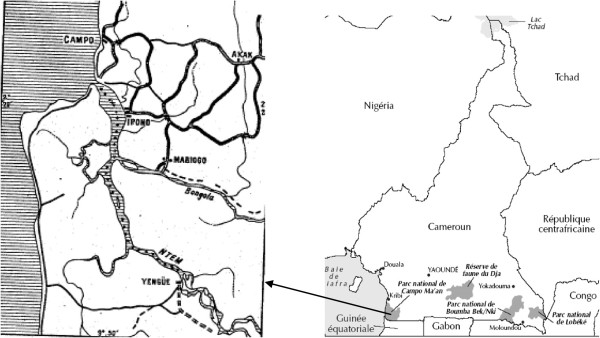
The sleeping sickness focus of Campo lies along the Atlantic coast and extends along the Ntem River, which constitutes the Cameroonian and Equatorial Guinean border. It is a hypo-endemic focus with the disease prevalence varying from 0.3 to 0.86% during the last few decades. Investigations on animal reservoirs revealed a prevalence of Trypanosoma brucei gambiense of 0.6% in wild animals and 4.83% in domestic animals of this focus. From 2001 to 2012, about 19 931 tsetse were collected in this focus and five tsetse species including Glossina palpalis palpalis, G. pallicera, G. nigrofusca, G. tabaniformis and G. caliginea were identified. The analysis of blood meals of these flies showed that they feed on human, pig, goat, sheep, and wild animals such as antelope, duiker, wild pig, turtle and snake. The percentage of blood meals taken on these hosts varies according to sampling periods. For instance, 6.8% of blood meals from pig were reported in 2004 and 22% in 2008. This variation is subjected to considerable evolutions because the Campo HAT focus is submitted to socio-economic mutations including the reopening of a new wood company, the construction of autonomous port at "Kribi" as well as the dam at "Memve ele". These activities will bring more that 3000 inhabitants around Campo and induce the deforestation for the implementation of farmlands as well as breeding of domestic animals. Such mutations have impacts on the transmission and the epidemiology of sleeping sickness due to the modification of the fauna composition, the nutritional behavior of tsetse, the zoophilic/anthropophilic index. To achieve the elimination goal in the sleeping sickness focus of Campo, we report in this paper the current epidemiological situation of the disease, the research findings of the last decades notably on the population genetics of trypanosomes, the modifications of nutritional behavior of tsetse, the prevalence of T. b. gambiense in humans, domestic and wild animals. An overview on the types of mutations occurring in the region has been raised and a discussion on the strategies that can be implemented to achieve the elimination of the disease has been made.
坎波的昏睡病疫源地位于大西洋沿岸,沿着构成喀麦隆和赤道几内亚边界的恩特姆河延伸。这是一个低流行疫源地,在过去几十年中疾病患病率在0.3%至0.86%之间波动。对动物宿主的调查显示,该疫源地野生动物中布氏冈比亚锥虫的患病率为0.6%,家畜中为4.83%。2001年至2012年期间,在该疫源地收集了约19931只采采蝇,并鉴定出包括冈比亚须舌蝇、苍白须舌蝇、黑褐须舌蝇、似虻须舌蝇和卡里金须舌蝇在内的五种采采蝇。对这些采采蝇血餐的分析表明,它们以人类、猪、山羊、绵羊以及羚羊、非洲麂羚、野猪、乌龟和蛇等野生动物为食。从这些宿主获取血餐的百分比因采样时期而异。例如,2004年报告来自猪的血餐占6.8%,2008年为22%。这种变化经历了相当大的演变,因为坎波人类非洲锥虫病疫源地受到社会经济变革的影响,包括一家新木材公司的重新开业、在“克里比”建设自治港口以及在“门韦埃莱”修建大坝。这些活动将使坎波周边地区新增3000多名居民,并导致为开垦农田和饲养家畜而砍伐森林。由于动物群落组成、采采蝇营养行为、嗜动物性/嗜人性指数的改变,此类变革对昏睡病的传播和流行病学产生影响。为了实现坎波昏睡病疫源地的消除目标,我们在本文中报告了该疾病当前的流行病学状况、过去几十年的研究结果,特别是关于锥虫群体遗传学、采采蝇营养行为的改变、布氏冈比亚锥虫在人类、家畜和野生动物中的患病率。概述了该地区发生的变革类型,并讨论了为实现疾病消除可实施的策略。