
癌症诊断后元认知信念与情绪困扰的关联。
The association of metacognitive beliefs with emotional distress after diagnosis of cancer.
作者信息
Cook Sharon A, Salmon Peter, Dunn Graham, Holcombe Chris, Cornford Philip, Fisher Peter
机构信息
Department of Psychological Sciences.
Centre for Biostatistics, The University of Manchester.
出版信息
Health Psychol. 2015 Mar;34(3):207-15. doi: 10.1037/hea0000096. Epub 2014 Aug 18.
OBJECTIVE
Emotional distress after a diagnosis of cancer is normal and, for most people, will diminish over time. However, a significant minority of patients with cancer experience persistent or recurrent symptoms of emotional distress for which they need help. A model developed in mental health, the self-regulatory executive function model (S-REF), specifies that maladaptive metacognitive beliefs and processes, including persistent worry, are key to understanding why such emotional problems persist. This cross-sectional study explored, for the first, time whether metacognitive beliefs were associated with emotional distress in a cancer population, and whether this relationship was mediated by worry, as predicted by the S-REF model.
METHOD
Two hundred twenty-nine participants within 3 months of diagnosis of, and before treatment for, primary breast or prostate cancer completed self-report questionnaires measuring anxiety, depression, posttraumatic stress disorder (PTSD) symptoms, metacognitive beliefs, worry, and illness perceptions.
RESULTS
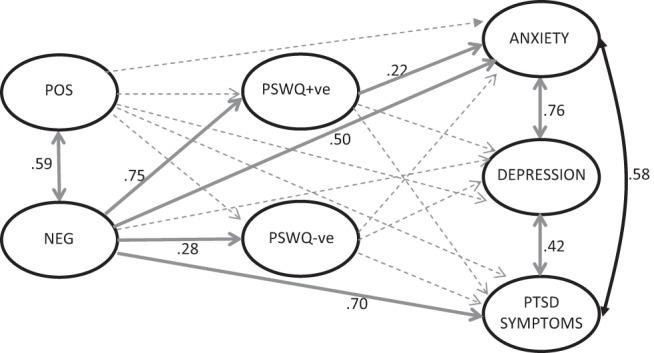
Regression analysis showed that metacognitive beliefs were associated with symptoms of anxiety, depression, and PTSD, and explained additional variance in these outcomes after controlling for age, gender, and illness perceptions. Structural equation modeling was consistent with cross-sectional hypotheses derived from the theory that metacognitive beliefs cause and maintain distress both directly and indirectly by driving worry.
CONCLUSIONS
The findings provide promising first evidence that the S-REF model may be usefully applied in cancer. Further study is required to establish the predictive and clinical utility of these findings.
目的
癌症确诊后的情绪困扰很正常,对大多数人来说,会随着时间推移而减轻。然而,相当一部分癌症患者会经历持续或反复的情绪困扰症状,需要帮助。心理健康领域开发的一种模型,即自我调节执行功能模型(S-REF)指出,适应不良的元认知信念和过程,包括持续担忧,是理解此类情绪问题为何持续存在的关键。这项横断面研究首次探讨了元认知信念是否与癌症患者群体的情绪困扰相关,以及这种关系是否如S-REF模型所预测的那样由担忧介导。
方法
229名在原发性乳腺癌或前列腺癌确诊后3个月内且在治疗前的参与者完成了自我报告问卷,这些问卷测量了焦虑、抑郁、创伤后应激障碍(PTSD)症状、元认知信念、担忧和疾病认知。
结果
回归分析表明,元认知信念与焦虑、抑郁和PTSD症状相关,并且在控制了年龄、性别和疾病认知后,解释了这些结果中的额外变异。结构方程模型与从元认知信念通过引发担忧直接和间接导致并维持困扰这一理论推导的横断面假设一致。
结论
这些发现提供了有前景的初步证据,表明S-REF模型可能在癌症领域有用。需要进一步研究来确定这些发现的预测和临床效用。


 Zotero 插件