Zhang Xiaoju, Walker Ross C, Phizicky Eric M, Mathews David H
Department of Biochemistry and Biophysics and Center for RNA Biology, University of Rochester Medical Center , Rochester, New York 14642, United States.
San Diego Supercomputer Center, University of California San Diego , La Jolla, California 92093, United States ; Department of Chemistry and Biochemistry, University of California San Diego , La Jolla, California 92093, United States.
J Chem Theory Comput. 2014 Aug 12;10(8):3473-3483. doi: 10.1021/ct500107y. Epub 2014 May 28.
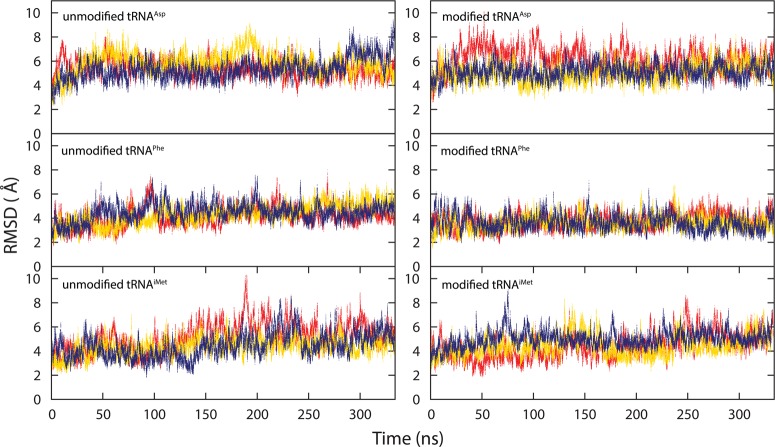
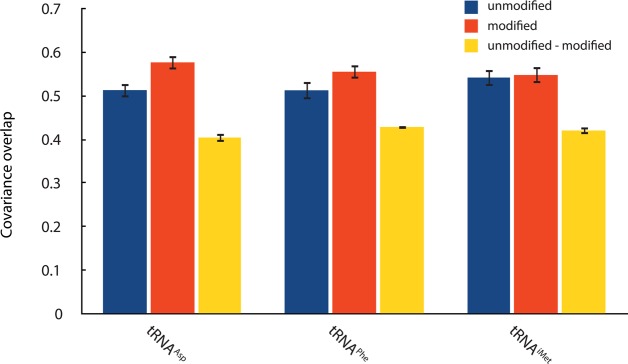
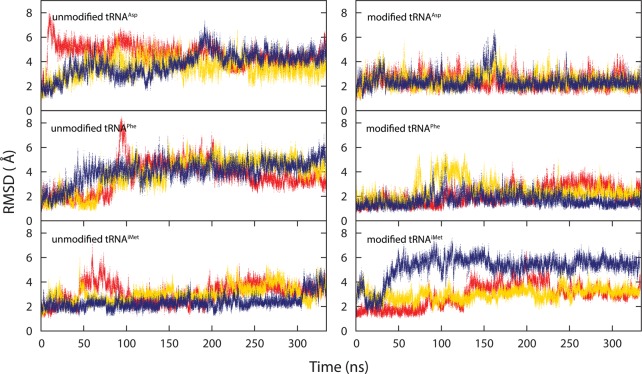
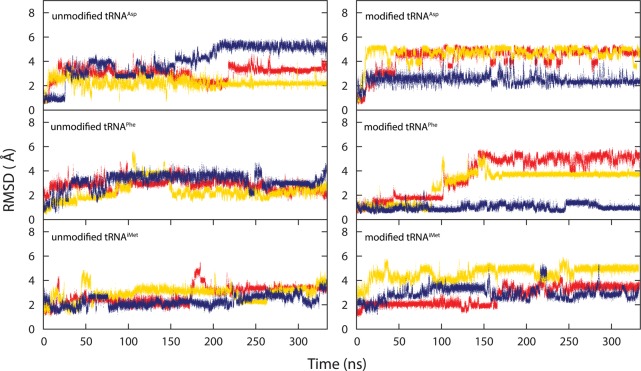
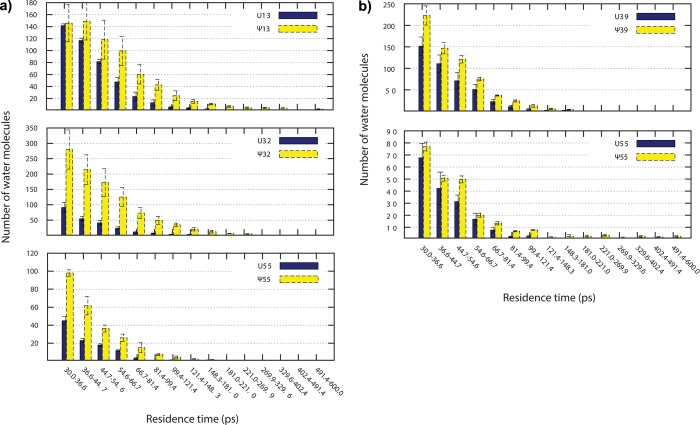
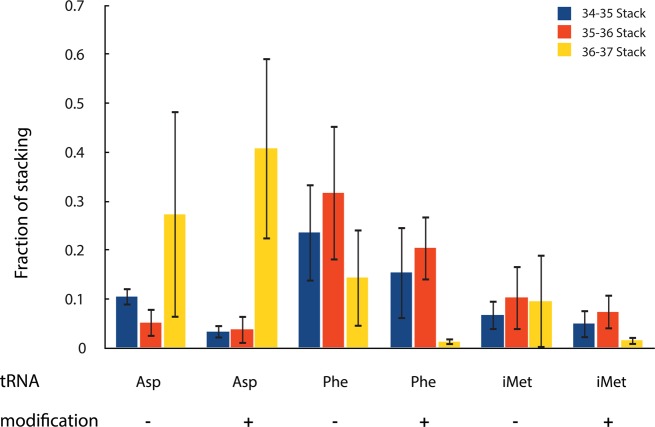
Modified nucleotides are prevalent in tRNA. Experimental studies reveal that these covalent modifications play an important role in tuning tRNA function. In this study, molecular dynamics (MD) simulations were used to investigate how modifications alter tRNA dynamics. The X-ray crystal structures of tRNA(Asp), tRNA(Phe), and tRNA(iMet), both with and without modifications, were used as initial structures for 333 ns explicit solvent MD simulations with AMBER. For each tRNA molecule, three independent trajectory calculations were performed, giving an aggregate of 6 μs of total MD across six molecules. The global root-mean-square deviations (RMSD) of atomic positions show that modifications only introduce significant rigidity to the global structure of tRNA(Phe). Interestingly, RMSDs of the anticodon stem-loop (ASL) suggest that modified tRNA has a more rigid structure compared to the unmodified tRNA in this domain. The anticodon RMSDs of the modified tRNAs, however, are higher than those of corresponding unmodified tRNAs. These findings suggest that the rigidity of the anticodon stem-loop is finely tuned by modifications, where rigidity in the anticodon arm is essential for tRNA translocation in the ribosome, and flexibility of the anticodon is important for codon recognition. Sugar pucker and water residence time of pseudouridines in modified tRNAs and corresponding uridines in unmodified tRNAs were assessed, and the results reinforce that pseudouridine favors the 3'-endo conformation and has a higher tendency to interact with water. Principal component analysis (PCA) was used to examine correlated motions in tRNA. Additionally, covariance overlaps of PCAs were compared for trajectories of the same molecule and between trajectories of modified and unmodified tRNAs. The comparison suggests that modifications alter the correlated motions. For the anticodon bases, the extent of stacking was compared between modified and unmodified molecules, and only unmodified tRNA(Asp) has significantly higher percentage of stacking time. Overall, the simulations reveal that the effect of covalent modification on tRNA dynamics is not simple, with modifications increasing flexibility in some regions of the structure and increasing rigidity in other regions.
修饰核苷酸在转运RNA(tRNA)中普遍存在。实验研究表明,这些共价修饰在调节tRNA功能方面发挥着重要作用。在本研究中,利用分子动力学(MD)模拟来研究修饰如何改变tRNA的动力学。tRNA(Asp)、tRNA(Phe)和起始甲硫氨酸tRNA(tRNA(iMet))的X射线晶体结构,无论有无修饰,都被用作使用AMBER进行333纳秒显式溶剂MD模拟的初始结构。对于每个tRNA分子,进行了三次独立的轨迹计算,六个分子的总MD时间总计为6微秒。原子位置的全局均方根偏差(RMSD)表明,修饰仅给tRNA(Phe)的全局结构带来显著的刚性。有趣的是,反密码子茎环(ASL)的RMSD表明,与该结构域中未修饰的tRNA相比,修饰后的tRNA具有更刚性的结构。然而,修饰后tRNA的反密码子RMSD高于相应未修饰tRNA的RMSD。这些发现表明,反密码子茎环的刚性通过修饰进行微调,其中反密码子臂的刚性对于tRNA在核糖体中的转位至关重要,而反密码子的灵活性对于密码子识别很重要。评估了修饰tRNA中假尿苷的糖环构象和水停留时间以及未修饰tRNA中相应尿苷的情况,结果进一步证明假尿苷有利于3'-内型构象,并且与水相互作用的倾向更高。主成分分析(PCA)用于检查tRNA中的相关运动。此外,还比较了同一分子轨迹之间以及修饰和未修饰tRNA轨迹之间PCA的协方差重叠。比较结果表明修饰改变了相关运动。对于反密码子碱基,比较了修饰和未修饰分子之间的堆积程度,只有未修饰的tRNA(Asp)具有显著更高的堆积时间百分比。总体而言,模拟结果表明共价修饰对tRNA动力学的影响并不简单,修饰在结构的某些区域增加了灵活性,而在其他区域增加了刚性。