Scola Alexander, Gebhard Florian, Dehner Christoph, Röderer Götz
Ulm University, Department of Orthopaedic Trauma, Ulm, Germany.
Open Orthop J. 2014 Jul 11;8:232-6. doi: 10.2174/1874325001408010232. eCollection 2014.
Modern implants for proximal femur fracture treatment have clearly improved clinical results. However, complications, including cut-out and loss of reduction, requiring revision surgery still occur. A major challenge in these cases is a loss of bone stock due to the existing implant, which is usually exacerbated by osteoporosis. A potential solution is the augmentation of implants, for example, of the femoral neck blade using bone cement.
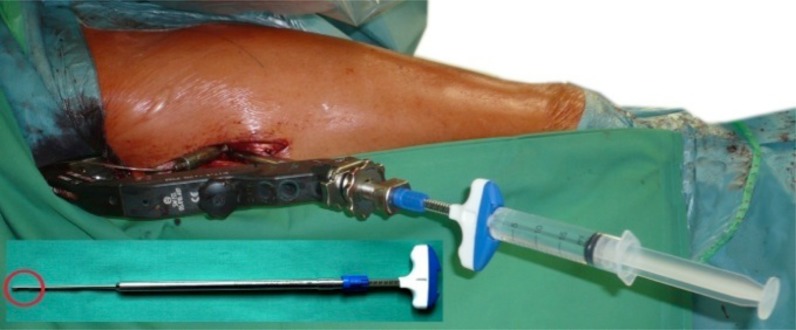
Ten patients (five loosening of femoral neck implant, two pseudarthrosis, two implant failures and one acute fracture) were included. The initial hardware was removed and a PFNA augmented was implanted. The perforated femoral neck blade was augmented using polymethyl methacrylate cement. Clinical and radiological follow-up was performed at a mean of 5.4 months (SD ±4.34). The main outcome parameters were fracture healing and implant-related complications.
Technical handling was uneventful in all cases. No cement leakage into the joint occurred in any of the cases. The mean amount of cement injected was 5.3 ml. The fracture healed during follow-up in all cases except two patients who died from causes unrelated to the procedure and prior to complete consolidation. Problem-free elective hardware removal of the PFNA augmented was performed in two cases.
The PFNA augmented is a potential implant for joint-preserving revision surgery in proximal femur fractures. The augmentation improves implant anchorage in the impaired bone stock. In this preliminary series, no negative biological side effects of the cement (i.e. osteonecrosis) were observed.
现代用于治疗股骨近端骨折的植入物显著改善了临床效果。然而,包括穿出和复位丢失在内的并发症仍会发生,这需要进行翻修手术。在这些病例中,一个主要挑战是由于现有植入物导致的骨量丢失,而骨质疏松通常会加剧这种情况。一种潜在的解决方案是增强植入物,例如使用骨水泥增强股骨颈刀片。
纳入10例患者(5例股骨颈植入物松动、2例假关节形成、2例植入物失败和1例急性骨折)。取出初始内固定装置,植入增强型股骨近端防旋髓内钉(PFNA)。使用聚甲基丙烯酸甲酯骨水泥增强有孔的股骨颈刀片。平均随访5.4个月(标准差±4.34),进行临床和影像学随访。主要结局参数为骨折愈合和与植入物相关的并发症。
所有病例技术操作均顺利。所有病例均未发生骨水泥渗漏至关节内。平均注入骨水泥量为5.3 ml。除2例因与手术无关的原因在骨折完全愈合前死亡的患者外,所有病例在随访期间骨折均愈合。2例患者顺利进行了增强型PFNA的选择性内固定取出。
增强型PFNA是一种用于股骨近端骨折保关节翻修手术的潜在植入物。增强可改善植入物在受损骨量中的锚固。在这个初步系列研究中,未观察到骨水泥的负面生物学副作用(即骨坏死)。