Du Xiuyuan, Li Baizhan, Liu Hong, Yang Dong, Yu Wei, Liao Jianke, Huang Zhichao, Xia Kechao
Key Laboratory of Three Gorges Reservoir Region's Eco-Environment, Ministry of Education, Chongqing University, Chongqing, China; National Centre for International Research of Low-carbon and Green Buildings, Chongqing University, Chongqing, China.
PLoS One. 2014 Aug 19;9(8):e104320. doi: 10.1371/journal.pone.0104320. eCollection 2014.
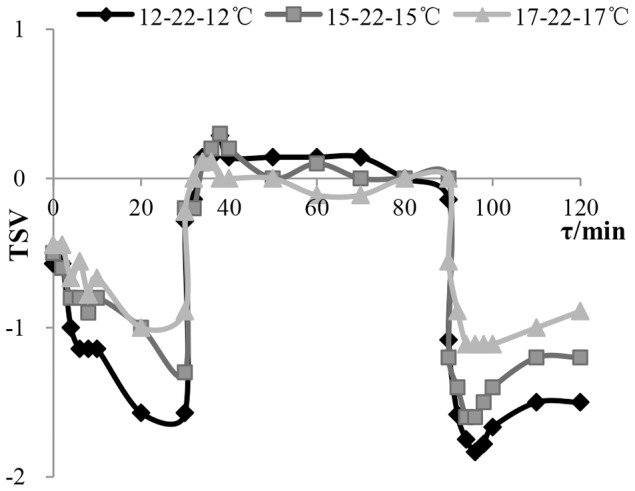
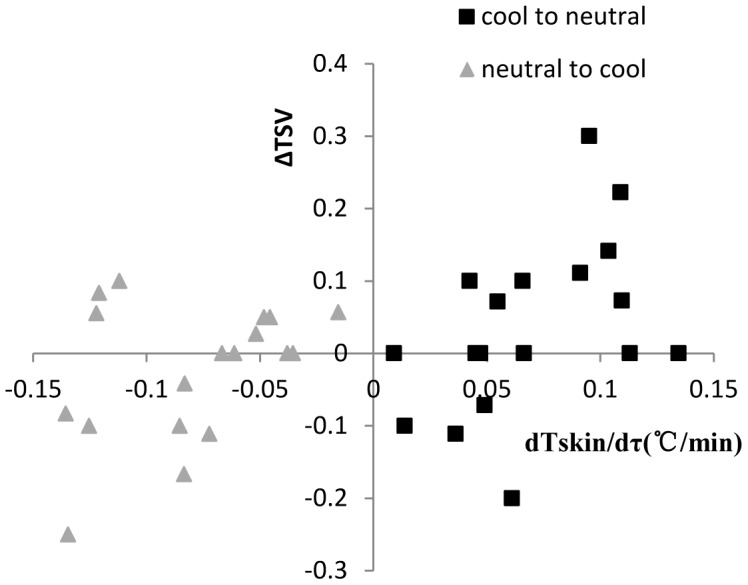
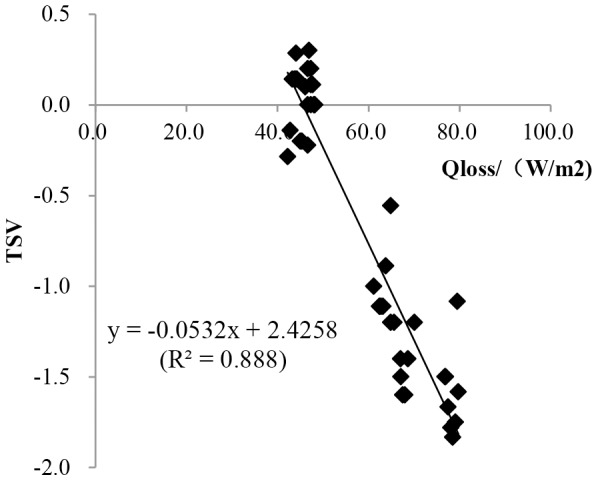
This paper reports on studies of the effect of temperature step-change (between a cool and a neutral environment) on human thermal sensation and skin temperature. Experiments with three temperature conditions were carried out in a climate chamber during the period in winter. Twelve subjects participated in the experiments simulating moving inside and outside of rooms or cabins with air conditioning. Skin temperatures and thermal sensation were recorded. Results showed overshoot and asymmetry of TSV due to the step-change. Skin temperature changed immediately when subjects entered a new environment. When moving into a neutral environment from cool, dynamic thermal sensation was in the thermal comfort zone and overshoot was not obvious. Air-conditioning in a transitional area should be considered to limit temperature difference to not more than 5°C to decrease the unacceptability of temperature step-change. The linear relationship between thermal sensation and skin temperature or gradient of skin temperature does not apply in a step-change environment. There is a significant linear correlation between TSV and Qloss in the transient environment. Heat loss from the human skin surface can be used to predict dynamic thermal sensation instead of the heat transfer of the whole human body.
本文报道了温度阶跃变化(在凉爽和中性环境之间)对人体热感觉和皮肤温度影响的研究。在冬季期间,在气候室中进行了三种温度条件的实验。12名受试者参与了模拟在有空调的房间或小屋里进出的实验。记录了皮肤温度和热感觉。结果表明,由于阶跃变化,热感觉投票(TSV)出现了超调量和不对称性。当受试者进入新环境时,皮肤温度立即发生变化。当从凉爽环境进入中性环境时,动态热感觉处于热舒适区内,超调量不明显。应考虑在过渡区域设置空调,将温差限制在不超过5°C,以降低温度阶跃变化的不可接受性。在阶跃变化环境中,热感觉与皮肤温度或皮肤温度梯度之间的线性关系不适用。在瞬态环境中,TSV与热损失(Qloss)之间存在显著的线性相关性。人体皮肤表面的热损失可用于预测动态热感觉,而不是整个人体的热传递。