Shum Kenny, Alperin Peter, Shalnova Svetlana, Boytsov Sergey, Kontsevaya Anna, Vigdorchik Alexey, Guetz Adam, Eriksson Jennifer, Hughes David
Archimedes, San Francisco, California, United States of America.
National Research Center for Preventive Medicine, Moscow, Russia.
PLoS One. 2014 Aug 20;9(8):e103280. doi: 10.1371/journal.pone.0103280. eCollection 2014.
Russia faces a high burden of cardiovascular disease. Prevalence of all cardiovascular risk factors, especially hypertension, is high. Elevated blood pressure is generally poorly controlled and medication usage is suboptimal. With a disease-model simulation, we forecast how various treatment programs aimed at increasing blood pressure control would affect cardiovascular outcomes. In addition, we investigated what additional benefit adding lipid control and smoking cessation to blood pressure control would generate in terms of reduced cardiovascular events. Finally, we estimated the direct health care costs saved by treating fewer cardiovascular events.
The Archimedes Model, a detailed computer model of human physiology, disease progression, and health care delivery was adapted to the Russian setting. Intervention scenarios of achieving systolic blood pressure control rates (defined as systolic blood pressure <140 mmHg) of 40% and 60% were simulated by modifying adherence rates of an antihypertensive medication combination and compared with current care (23.9% blood pressure control rate). Outcomes of major adverse cardiovascular events; cerebrovascular event (stroke), myocardial infarction, and cardiovascular death over a 10-year time horizon were reported. Direct health care costs of strokes and myocardial infarctions were derived from official Russian statistics and tariff lists.
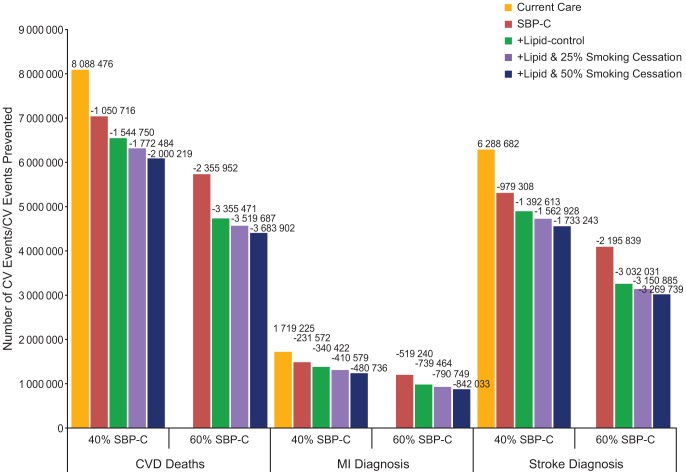
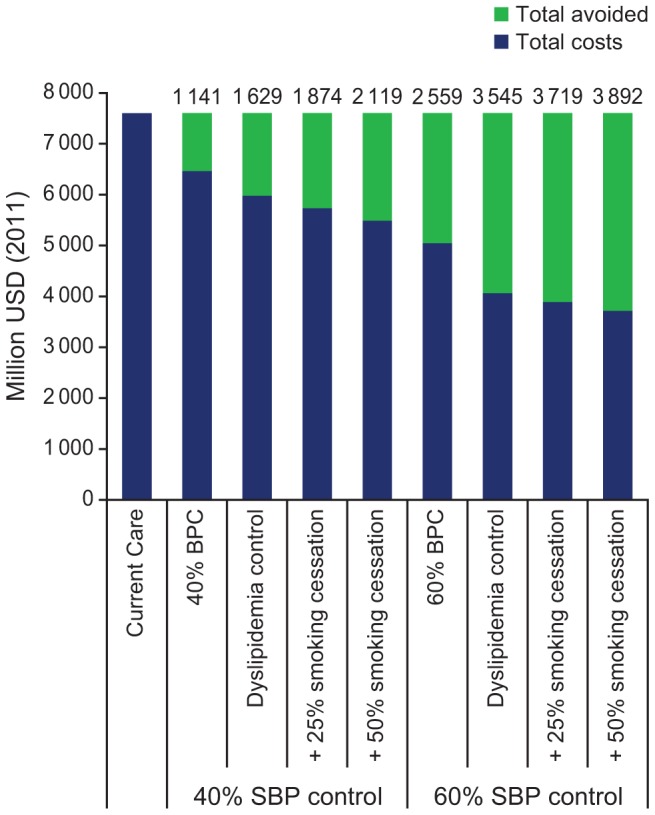
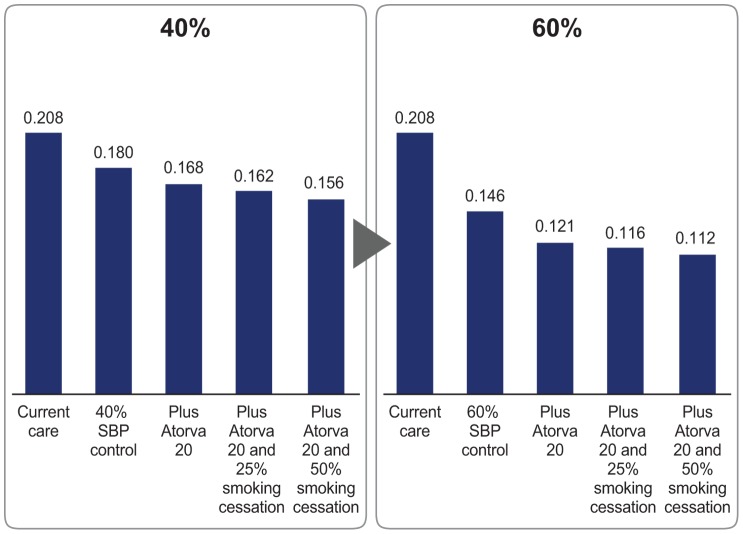
To achieve systolic blood pressure control rates of 40% and 60%, adherence rates to the antihypertensive treatment program were 29.4% and 65.9%. Cardiovascular death relative risk reductions were 13.2%, and 29.6%, respectively. For the current estimated 43,855,000-person Russian hypertensive population, each control-rate scenario resulted in an absolute reduction of 1.0 million and 2.4 million cardiovascular deaths, and a reduction of 1.2 million and 2.7 million stroke/myocardial infarction diagnoses, respectively. Averted direct costs from current care levels ($7.6 billion [in United States dollars]) were $1.1 billion and $2.6 billion, respectively.
俄罗斯面临着很高的心血管疾病负担。所有心血管危险因素的患病率都很高,尤其是高血压。血压升高一般控制不佳,药物使用也不理想。通过疾病模型模拟,我们预测了各种旨在提高血压控制率的治疗方案将如何影响心血管疾病的转归。此外,我们还研究了在血压控制基础上增加血脂控制和戒烟在减少心血管事件方面会产生哪些额外益处。最后,我们估算了因心血管事件减少而节省的直接医疗费用。
阿基米德模型是一个关于人体生理学、疾病进展和医疗服务的详细计算机模型,已针对俄罗斯的情况进行了调整。通过改变一种抗高血压药物组合的依从率,模拟了实现收缩压控制率(定义为收缩压<140 mmHg)分别为40%和60%的干预方案,并与当前治疗情况(血压控制率为23.9%)进行比较。报告了10年期间主要不良心血管事件的转归;脑血管事件(中风)、心肌梗死和心血管死亡情况。中风和心肌梗死的直接医疗费用来自俄罗斯官方统计数据和收费清单。
为实现收缩压控制率分别为40%和60%,抗高血压治疗方案的依从率分别为29.4%和65.9%。心血管死亡相对风险降低率分别为13.2%和29.6%。对于目前估计有4385.5万人的俄罗斯高血压人群,每种控制率方案分别导致心血管死亡绝对减少100万例和240万例,中风/心肌梗死诊断减少120万例和270万例。与当前治疗水平相比避免的直接费用(76亿美元[以美元计])分别为11亿美元和26亿美元。