Russian Cancer Research Centre, Moscow, Russia.
Clinical Trial Service Unit and Epidemiological Studies Unit (CTSU), Nuffield Department of Population Health, Oxford University, Oxford, UK.
Lancet. 2014 Apr 26;383(9927):1465-1473. doi: 10.1016/S0140-6736(13)62247-3. Epub 2014 Jan 31.
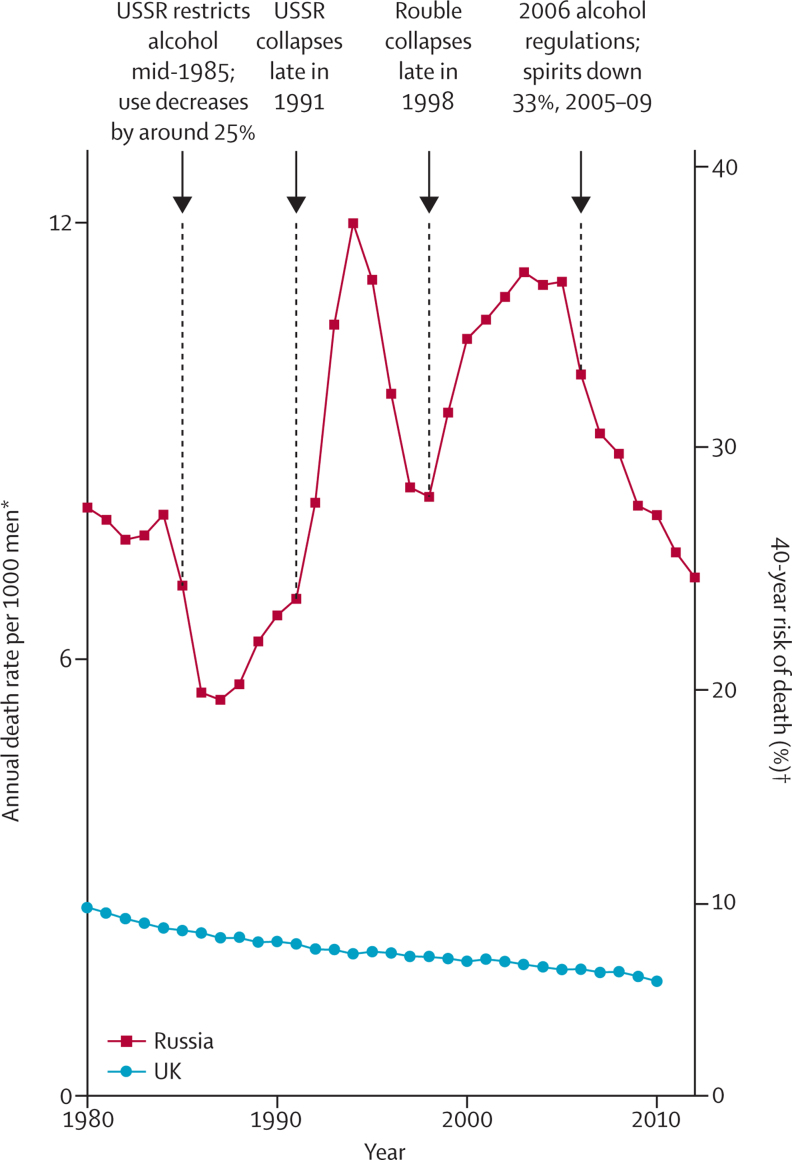
Russian adults have extraordinarily high rates of premature death. Retrospective enquiries to the families of about 50,000 deceased Russians had found excess vodka use among those dying from external causes (accident, suicide, violence) and eight particular disease groupings. We now seek prospective evidence of these associations.
In three Russian cities (Barnaul, Byisk, and Tomsk), we interviewed 200,000 adults during 1999-2008 (with 12,000 re-interviewed some years later) and followed them until 2010 for cause-specific mortality. In 151,000 with no previous disease and some follow-up at ages 35-74 years, Poisson regression (adjusted for age at risk, amount smoked, education, and city) was used to calculate the relative risks associating vodka consumption with mortality. We have combined these relative risks with age-specific death rates to get 20-year absolute risks.
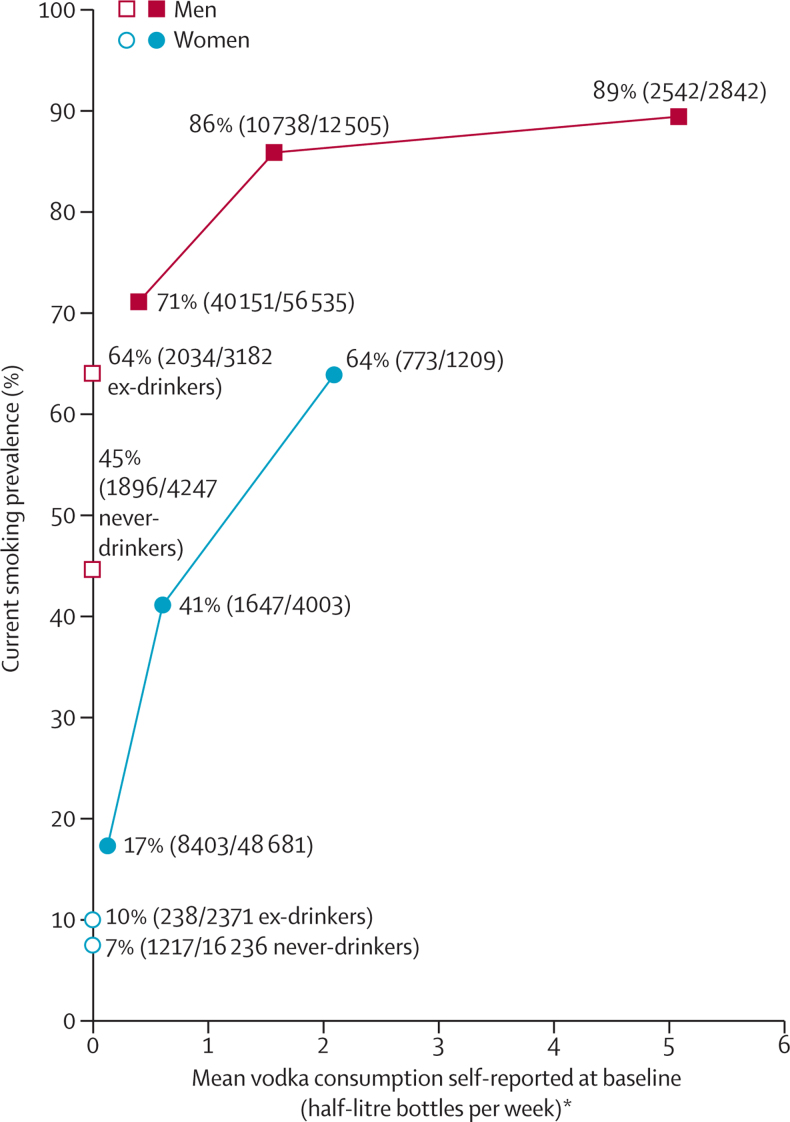
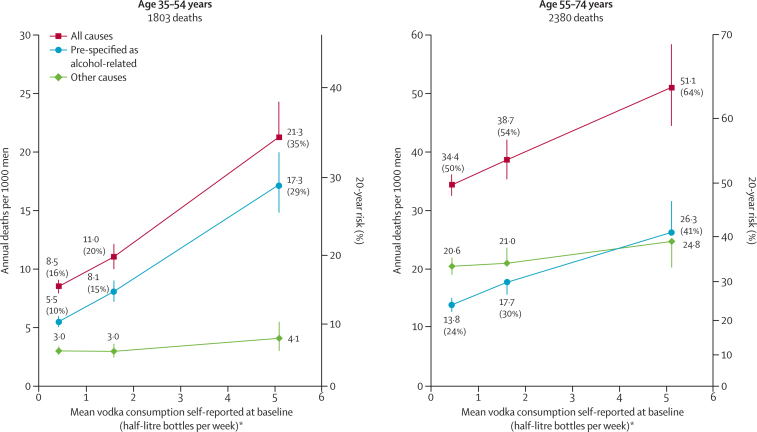
Among 57,361 male smokers with no previous disease, the estimated 20-year risks of death at ages 35-54 years were 16% (95% CI 15-17) for those who reported consuming less than a bottle of vodka per week at baseline, 20% (18-22) for those consuming 1-2·9 bottles per week, and 35% (31-39) for those consuming three or more bottles per week; trend p<0·0001. The corresponding risks of death at ages 55-74 years were 50% (48-52) for those who reported consuming less than a bottle of vodka per week at baseline, 54% (51-57) for those consuming 1-2·9 bottles per week, and 64% (59-69) for those consuming three or more bottles per week; trend p<0·0001. In both age ranges most of the excess mortality in heavier drinkers was from external causes or the eight disease groupings strongly associated with alcohol in the retrospective enquiries. Self-reported drinking fluctuated; of the men who reported drinking three or more bottles of vodka per week who were reinterviewed a few years later, about half (185 of 321) then reported drinking less than one bottle per week. Such fluctuations must have substantially attenuated the apparent hazards of heavy drinking in this study, yet self-reported vodka use at baseline still strongly predicted risk. Among male non-smokers and among females, self-reported heavy drinking was uncommon, but seemed to involve similar absolute excess risks.
This large prospective study strongly reinforces other evidence that vodka is a major cause of the high risk of premature death in Russian adults.
UK Medical Research Council, British Heart Foundation, Cancer Research UK, European Union, WHO International Agency for Research on Cancer.
俄罗斯成年人的过早死亡率极高。对约 5 万名俄罗斯死者家属的回顾性调查发现,过量饮酒与因外部原因(意外、自杀、暴力)和八个特定疾病组死亡的人有关。我们现在寻求这些关联的前瞻性证据。
在俄罗斯的三个城市(巴尔瑙尔、别斯克和托木斯克),我们在 1999 年至 2008 年期间采访了 200 万名成年人(其中 12000 人在几年后再次接受采访),并对他们进行了随访,直到 2010 年,以确定特定原因的死亡率。在 151000 名没有既往疾病且在 35-74 岁时有一定随访的人中,使用泊松回归(按年龄、吸烟量、教育程度和城市调整)计算与伏特加消费相关的死亡率的相对风险。我们将这些相对风险与特定年龄的死亡率相结合,得出 20 年的绝对风险。
在 57361 名没有既往疾病的男性吸烟者中,在 35-54 岁时,报告每周饮酒量少于一瓶伏特加的人,估计 20 年的死亡率为 16%(95%CI 15-17);每周饮酒 1-2.9 瓶的人,死亡率为 20%(18-22);每周饮酒 3 瓶或以上的人,死亡率为 35%(31-39);趋势 p<0.0001。在 55-74 岁时,报告每周饮酒量少于一瓶伏特加的人,估计 20 年的死亡率为 50%(48-52);每周饮酒 1-2.9 瓶的人,死亡率为 54%(51-57);每周饮酒 3 瓶或以上的人,死亡率为 64%(59-69);趋势 p<0.0001。在两个年龄组中,大量饮酒者的超额死亡大多来自外部原因或与酒精密切相关的八个疾病组。自我报告的饮酒量波动;在几年后再次接受采访的每周饮酒 3 瓶或以上的男性中,约有一半(185 人中有 321 人)报告每周饮酒量少于一瓶。这种波动肯定会大大降低这项研究中大量饮酒的明显危害,但基线时自我报告的伏特加使用仍然强烈预示着风险。在男性非吸烟者和女性中,自我报告的大量饮酒并不常见,但似乎涉及类似的绝对超额风险。
这项大型前瞻性研究有力地证实了其他证据,即伏特加是俄罗斯成年人过早死亡风险高的主要原因。
英国医学研究理事会、英国心脏基金会、英国癌症研究中心、欧盟、世界卫生组织国际癌症研究机构。