Biela Artur, Coste Franck, Culard Françoise, Guerin Martine, Goffinont Stéphane, Gasteiger Karola, Cieśla Jarosław, Winczura Alicja, Kazimierczuk Zygmunt, Gasparutto Didier, Carell Thomas, Tudek Barbara, Castaing Bertrand
Centre de Biophysique Moléculaire, UPR4301, CNRS, rue Charles Sadron, 45100 Orléans cedex02, France Institute of Biochemistry and Biophysics PAS, Pawinskiego 5A, 02-106 Warsaw, Poland.
Centre de Biophysique Moléculaire, UPR4301, CNRS, rue Charles Sadron, 45100 Orléans cedex02, France.
Nucleic Acids Res. 2014;42(16):10748-61. doi: 10.1093/nar/gku613. Epub 2014 Aug 20.
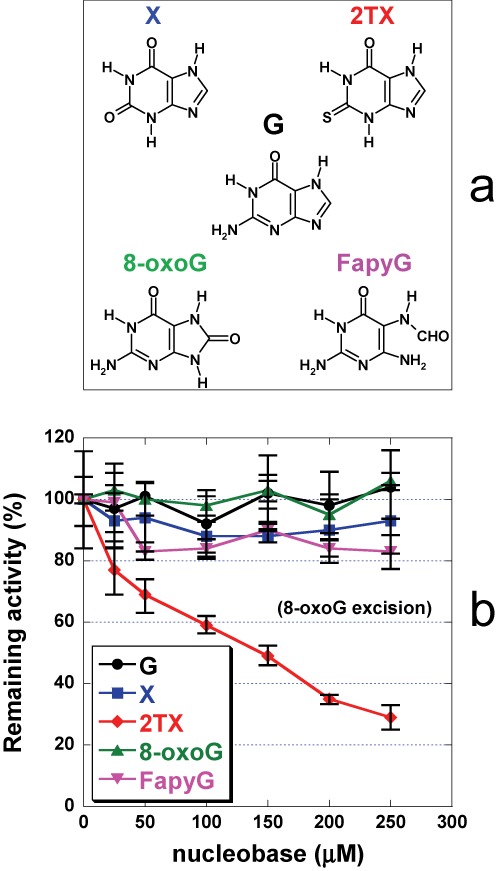
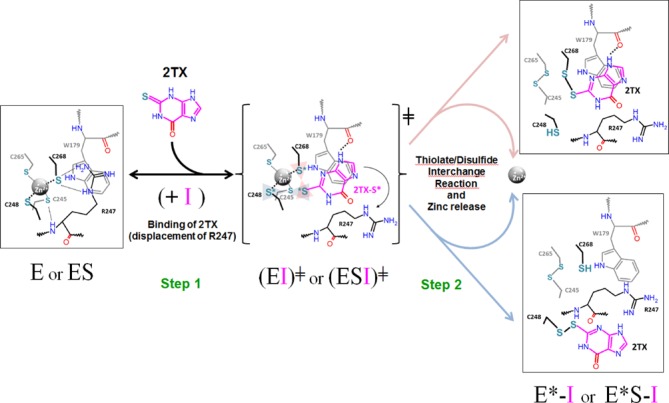
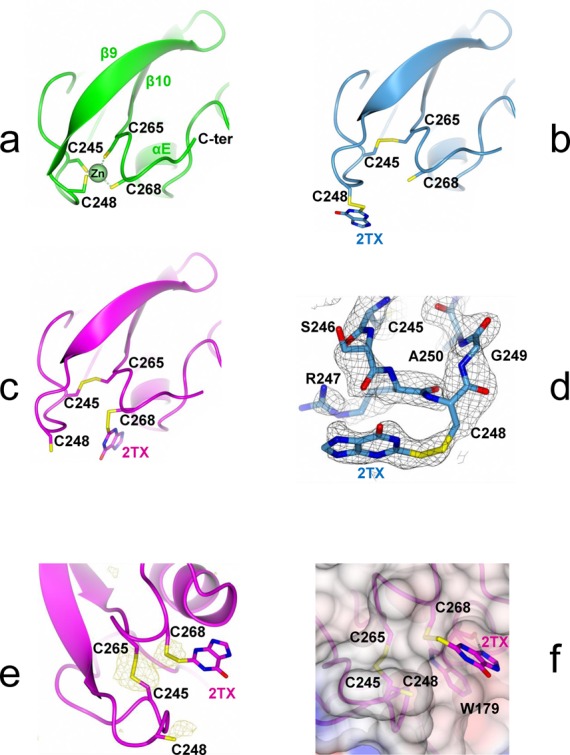
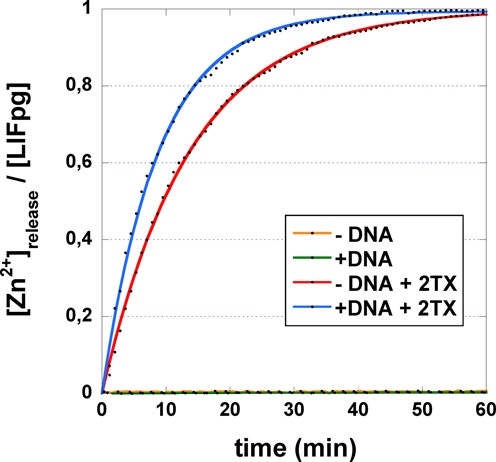
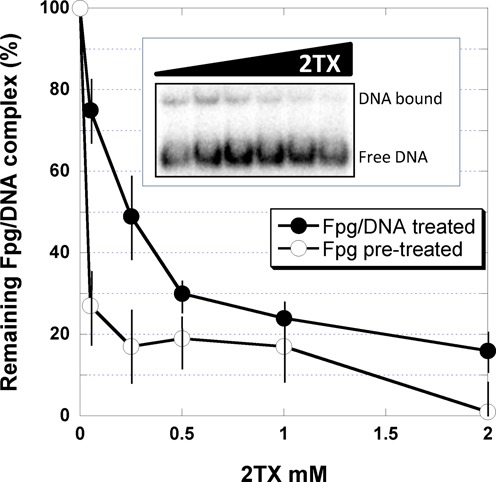
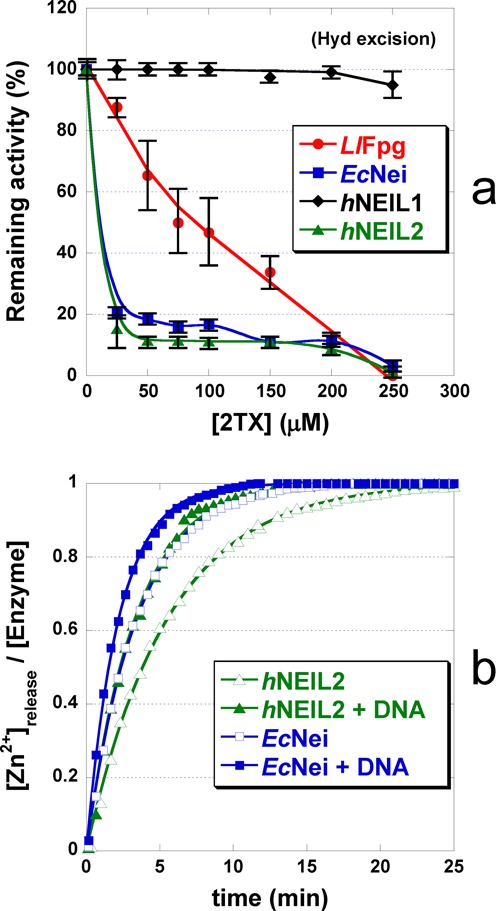
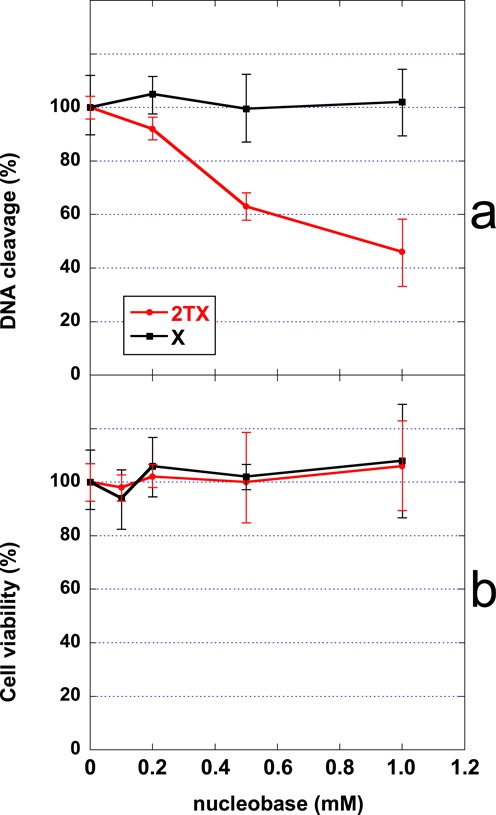
DNA glycosylases from the Fpg/Nei structural superfamily are base excision repair enzymes involved in the removal of a wide variety of mutagen and potentially lethal oxidized purines and pyrimidines. Although involved in genome stability, the recent discovery of synthetic lethal relationships between DNA glycosylases and other pathways highlights the potential of DNA glycosylase inhibitors for future medicinal chemistry development in cancer therapy. By combining biochemical and structural approaches, the physical target of 2-thioxanthine (2TX), an uncompetitive inhibitor of Fpg, was identified. 2TX interacts with the zinc finger (ZnF) DNA binding domain of the enzyme. This explains why the zincless hNEIL1 enzyme is resistant to 2TX. Crystal structures of the enzyme bound to DNA in the presence of 2TX demonstrate that the inhibitor chemically reacts with cysteine thiolates of ZnF and induces the loss of zinc. The molecular mechanism by which 2TX inhibits Fpg may be generalized to all prokaryote and eukaryote ZnF-containing Fpg/Nei-DNA glycosylases. Cell experiments show that 2TX can operate in cellulo on the human Fpg/Nei DNA glycosylases. The atomic elucidation of the determinants for the interaction of 2TX to Fpg provides the foundation for the future design and synthesis of new inhibitors with high efficiency and selectivity.
来自Fpg/Nei结构超家族的DNA糖基化酶是碱基切除修复酶,参与去除多种诱变剂以及潜在致死性的氧化嘌呤和嘧啶。尽管参与基因组稳定性维持,但最近发现DNA糖基化酶与其他途径之间存在合成致死关系,这凸显了DNA糖基化酶抑制剂在癌症治疗未来药物化学开发中的潜力。通过结合生化和结构方法,确定了Fpg的非竞争性抑制剂2-硫代黄嘌呤(2TX)的物理靶点。2TX与该酶的锌指(ZnF)DNA结合结构域相互作用。这解释了无锌的hNEIL1酶对2TX具有抗性的原因。在2TX存在下该酶与DNA结合的晶体结构表明,该抑制剂与ZnF的半胱氨酸硫醇盐发生化学反应并导致锌的丢失。2TX抑制Fpg的分子机制可能适用于所有含锌的原核和真核Fpg/Nei-DNA糖基化酶。细胞实验表明,2TX可在细胞内作用于人类Fpg/Nei DNA糖基化酶。对2TX与Fpg相互作用决定因素的原子水平阐释为未来高效、选择性新型抑制剂的设计与合成奠定了基础。