Kehoe Monica A, Coutts Brenda A, Buirchell Bevan J, Jones Roger A C
School of Plant Biology and Institute of Agriculture, Faculty of Science, University of Western Australia, Crawley, WA, Australia; Crop Protection and Lupin Breeding Branches, Department of Agriculture and Food Western Australia, Bentley Delivery Centre, Perth, WA, Australia.
PLoS One. 2014 Aug 22;9(8):e105770. doi: 10.1371/journal.pone.0105770. eCollection 2014.
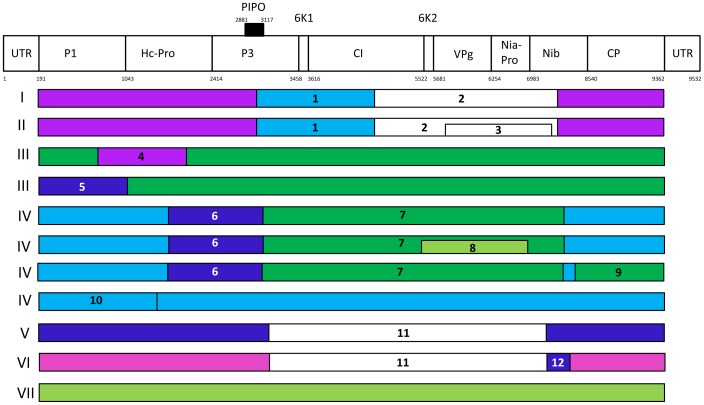
Bean yellow mosaic virus (BYMV), genus Potyvirus, has an extensive natural host range encompassing both dicots and monocots. Its phylogenetic groups were considered to consist of an ancestral generalist group and six specialist groups derived from this generalist group during plant domestication. Recombination was suggested to be playing a role in BYMV's evolution towards host specialization. However, in subsequent phylogenetic analysis of whole genomes, group names based on the original hosts of isolates within each of them were no longer supported. Also, nine groups were found and designated I-IX. Recombination analysis was conducted on the complete coding regions of 33 BYMV genomes and two genomes of the related Clover yellow vein virus (CYVV). This analysis found evidence for 12 firm recombination events within BYMV phylogenetic groups I-VI, but none within groups VII-IX or CYVV. The greatest numbers of recombination events within a sequence (two or three each) occurred in four groups, three which formerly constituted the single ancestral generalist group (I, II and IV), and group VI. The individual sequences in groups III and V had one event each. These findings with whole genomes are consistent with recombination being associated with expanding host ranges, and call into question the proposed role of recombination in the evolution of BYMV, where it was previously suggested to play a role in host specialization. Instead, they (i) indicate that recombination explains the very broad natural host ranges of the three BYMV groups which infect both monocots and dicots (I, II, IV), and (ii) suggest that the three groups with narrow natural host ranges (III, V, VI) which also showed recombination now have the potential to reduce host specificity and broaden their natural host ranges.
菜豆黄花叶病毒(BYMV)属于马铃薯Y病毒属,具有广泛的天然宿主范围,包括双子叶植物和单子叶植物。其系统发育组被认为由一个祖传的泛化组和在植物驯化过程中从该泛化组衍生而来的六个特化组组成。有人认为重组在BYMV向宿主特化的进化过程中发挥了作用。然而,在随后对全基因组的系统发育分析中,基于每个组内分离株原始宿主的组名不再得到支持。此外,发现了九个组并命名为I-IX。对33个BYMV基因组的完整编码区和相关的三叶草黄脉病毒(CYVV)的两个基因组进行了重组分析。该分析在BYMV系统发育组I-VI中发现了12个确凿的重组事件证据,但在组VII-IX或CYVV中未发现。序列中重组事件数量最多的(每个有两到三个)出现在四个组中,其中三个组以前构成了单一的祖传泛化组(I、II和IV)以及组VI。组III和V中的单个序列各有一个事件。这些全基因组的研究结果与重组与宿主范围扩大相关的观点一致,并对之前提出的重组在BYMV进化中的作用提出了质疑,之前认为重组在宿主特化中发挥作用。相反,它们(i)表明重组解释了感染单子叶植物和双子叶植物的三个BYMV组(I、II、IV)非常广泛的天然宿主范围,并且(ii)表明天然宿主范围狭窄的三个组(III、V、VI)也显示出重组,现在有可能降低宿主特异性并扩大其天然宿主范围。