Tsai Mao-Song, Yang Chia-Jui, Lee Nan-Yao, Hsieh Szu-Min, Lin Yu-Hui, Sun Hsin-Yun, Sheng Wang-Huei, Lee Kuan-Yeh, Yang Shan-Ping, Liu Wen-Chun, Wu Pei-Ying, Ko Wen-Chien, Hung Chien-Ching
Department of Internal Medicine, Far Eastern Memorial Hospital, New Taipei City, Taiwan.
Department of Internal Medicine, National Cheng Kung University College of Medicine and Hospital, Tainan, Taiwan.
J Int AIDS Soc. 2014 Aug 28;17(1):18993. doi: 10.7448/IAS.17.1.18993. eCollection 2014.
The Jarisch-Herxheimer reaction, a febrile inflammatory reaction that often occurs after the first dose of chemotherapy in spirochetal diseases, may result in deleterious effects to patients with neurosyphilis and to pregnant women. A single 2-g oral dose of azithromycin is an alternative treatment to benzathine penicillin G for early syphilis in areas with low macrolide resistance. With its potential anti-inflammatory activity, the impact of azithromycin on the incidence of the Jarisch-Herxheimer reaction in HIV-positive patients with early syphilis has rarely been investigated.
In HIV-positive patients with early syphilis, the Jarisch-Herxheimer reaction was prospectively investigated using the same data collection form in 119 patients who received benzathine penicillin G between 2007 and 2009 and 198 who received azithromycin between 2012 and 2013, when shortage of benzathine penicillin G occurred in Taiwan. Between 2012 and 2013, polymerase chain reaction (PCR) assay was performed to detect Treponema pallidum DNA in clinical specimens, and PCR restriction fragment length polymorphism of the 23S ribosomal RNA was performed to detect point mutations (2058G or A2059G) that are associated with macrolide resistance.
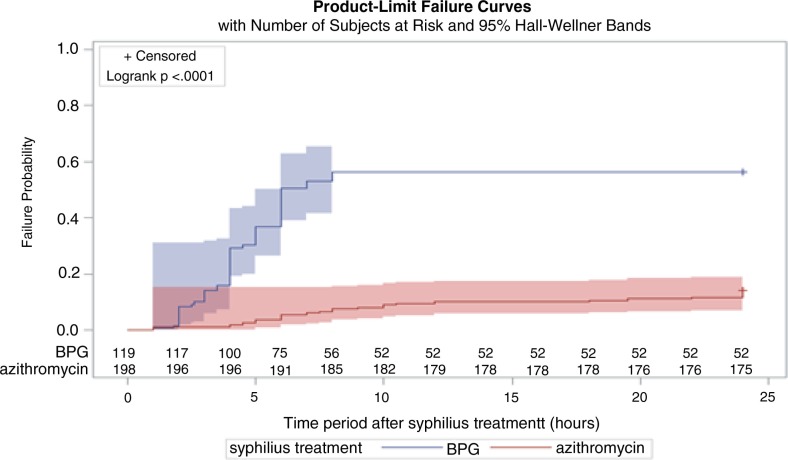
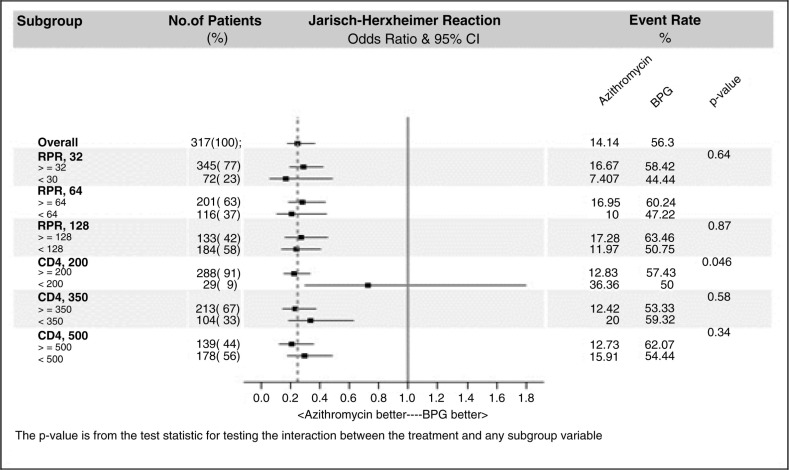
The overall incidence of the Jarisch-Herxheimer reaction was significantly lower in patients receiving azithromycin than those receiving benzathine penicillin G (14.1% vs. 56.3%, p<0.001). The risk increased with higher rapid plasma reagin (RPR) titres (adjusted odds ratio [AOR] per 1-log2 increase, 1.21; confidence interval [CI], 1.04-1.41), but decreased with prior penicillin therapy for syphilis (AOR, 0.37; 95% CI, 0.19-0.71) and azithromycin treatment (AOR, 0.15; 95% CI, 0.08-0.29). During the study period, 310 specimens were obtained from 198 patients with syphilis for PCR assays, from whom T. pallidum was identified in 76 patients, one of whom (1.3%) was found to be infected with T. pallidum harbouring the macrolide resistance mutation (A2058G). In subgroup analyses confined to the 75 patients infected with T. pallidum lacking resistance mutation, a statistically significantly lower risk for the Jarisch-Herxheimer reaction following azithromycin treatment was noted.
Treatment with azithromycin was associated with a lower risk for the Jarisch-Herxheimer reaction than that with benzathine penicillin G in HIV-positive patients with early syphilis. Previous benzathine penicillin G therapy for syphilis decreased the risk, whereas higher RPR titres increased the risk, for the reaction.
雅里希-赫克斯海默反应是一种发热性炎症反应,常发生于螺旋体病首剂化疗后,可能对神经梅毒患者和孕妇产生有害影响。在大环内酯耐药率较低的地区,单次口服2克阿奇霉素是早期梅毒替代苄星青霉素G的一种治疗方法。鉴于阿奇霉素具有潜在的抗炎活性,其对早期梅毒HIV阳性患者雅里希-赫克斯海默反应发生率的影响鲜有研究。
在早期梅毒HIV阳性患者中,前瞻性地采用相同的数据收集表,对2007年至2009年期间接受苄星青霉素G治疗的119例患者以及2012年至2013年期间台湾苄星青霉素G短缺时接受阿奇霉素治疗的198例患者进行雅里希-赫克斯海默反应调查。2012年至2013年期间,对临床标本进行聚合酶链反应(PCR)检测梅毒螺旋体DNA,并对23S核糖体RNA进行PCR限制性片段长度多态性检测,以检测与大环内酯耐药相关的点突变(2058G或A2059G)。
接受阿奇霉素治疗的患者中雅里希-赫克斯海默反应的总体发生率显著低于接受苄星青霉素G治疗的患者(14.1%对56.3%,p<0.001)。风险随快速血浆反应素(RPR)滴度升高而增加(每增加1个log2调整优势比[AOR]为1.21;可信区间[CI]为1.04 - 1.41),但既往梅毒青霉素治疗(AOR为0.37;95%CI为0.19 - 0.71)和阿奇霉素治疗(AOR为0.15;95%CI为0.08 - 0.29)可降低风险。研究期间,从198例梅毒患者中获取310份标本进行PCR检测,76例患者检测到梅毒螺旋体,其中1例(1.3%)感染携带大环内酯耐药突变(A2058G)的梅毒螺旋体。在仅限于75例未感染耐药突变梅毒螺旋体患者的亚组分析中,阿奇霉素治疗后雅里希-赫克斯海默反应的风险在统计学上显著降低。
在早期梅毒HIV阳性患者中,阿奇霉素治疗与雅里希-赫克斯海默反应风险低于苄星青霉素G相关。既往梅毒苄星青霉素G治疗可降低该反应风险,而较高的RPR滴度则增加该反应风险。