Fujisawa Manabu, Seike Keisuke, Fukumoto Kouta, Suehara Yasuhito, Fukaya Masafumi, Sugihara Hiroki, Takeuchi Masami, Matsue Kosei
Division of Hematology/Oncology, Department of Medicine, Kameda Medical Center, Kamogawa, Japan.
Cancer Sci. 2014 Nov;105(11):1442-6. doi: 10.1111/cas.12527. Epub 2014 Oct 9.
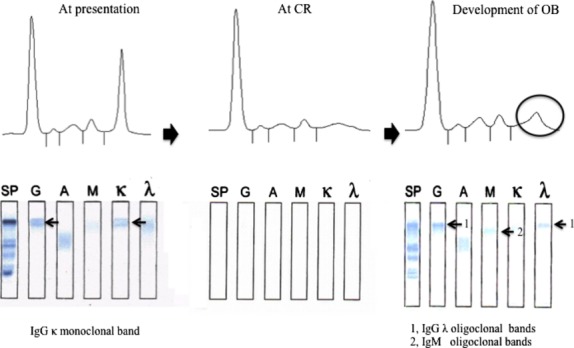
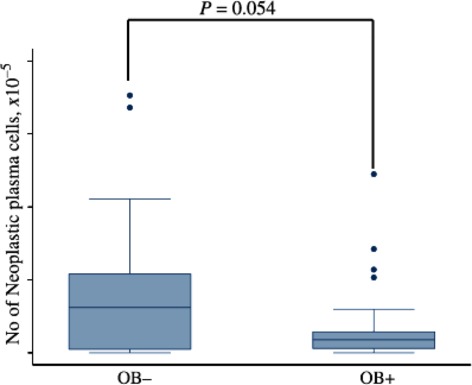
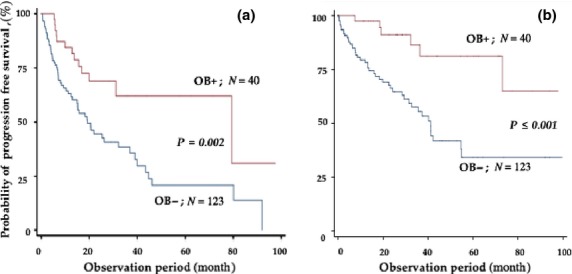
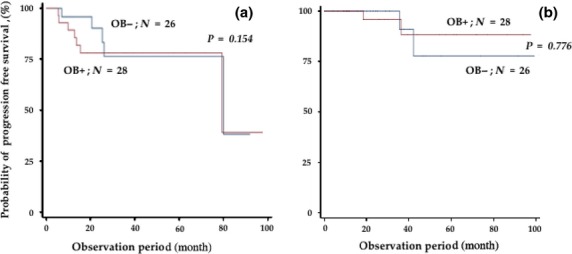
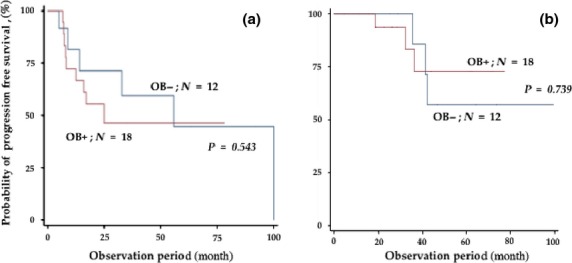
The emergence of oligoclonal bands (OB) has been reported in patients with multiple myeloma (MM) after stem cell transplantation (SCT) or successful chemotherapy. However, their clinical relevance remains unclear. We reviewed the clinical records of MM patients from January 2006 to May 2014. Treatment response was evaluated by International Working Group (IMWG) criteria. Serum immunofixation tests were performed at least every 3 months if the patient achieved more than very good partial response (VGPR). Free light chain (FLC) and minimal residual disease measurement by multicolor flow cytometry (MFC) were performed to evaluate the response to treatment. Among the 163 patients included in the study, 40 developed OB. Detection rates of OB in patients with complete response (CR), VGPR and partial response (PR) or less were 51.8, 36.3 and 0%, respectively. Patients with OB showed better progression-free survival (PFS) and overall survival (OS) rates than those without OB (P = 0.028 and P < 0.001, respectively). However, if the patients were limited to ≥VGPR or CR, development of OB did not affect PFS (P = 0.621 and P = 0.646, respectively) or OS (P = 0.189 and P = 0.766, respectively). OB was observed in 60% of patients after SCT, and in 36.6% of patients with more than VGPR without SCT (P < 0.001). Patients with OB tended to have less minimal residual disease than those without OB (P = 0.054) and its presence may affect the stringent CR criteria. In conclusion, the emergence of OB was seen exclusively in patients with favorable responses, but its emergence per se could not be translated to improved survival.
据报道,干细胞移植(SCT)后或化疗成功后的多发性骨髓瘤(MM)患者会出现寡克隆带(OB)。然而,它们的临床相关性仍不明确。我们回顾了2006年1月至2014年5月期间MM患者的临床记录。治疗反应根据国际工作组(IMWG)标准进行评估。如果患者达到非常好的部分缓解(VGPR)以上,则至少每3个月进行一次血清免疫固定试验。进行游离轻链(FLC)检测以及通过多色流式细胞术(MFC)测量微小残留病,以评估治疗反应。在纳入研究的163例患者中,40例出现了OB。完全缓解(CR)、VGPR以及部分缓解(PR)或更低缓解程度的患者中OB的检出率分别为51.8%、36.3%和0%。出现OB的患者无进展生存期(PFS)和总生存期(OS)率均高于未出现OB的患者(分别为P = 0.028和P < 0.001)。然而,如果将患者限制为≥VGPR或CR,OB的出现并不影响PFS(分别为P = 0.621和P = 0.646)或OS(分别为P = 0.189和P = 0.766)。SCT后60%的患者出现OB,在未进行SCT但达到VGPR以上的患者中这一比例为36.6%(P < 0.001)。出现OB的患者微小残留病往往比未出现OB的患者少(P = 0.054),其存在可能会影响严格的CR标准。总之,OB仅在反应良好的患者中出现,但其出现本身并不能转化为生存期的改善。