Chen Fei, Qi Xinyi, Qian Min, Dai Yue, Sun Yu
Institute of Health Sciences, Shanghai Institutes for Biological Sciences, Chinese Academy of Sciences, Shanghai, 200031, China.
Protein Cell. 2014 Nov;5(11):816-26. doi: 10.1007/s13238-014-0097-1. Epub 2014 Sep 5.
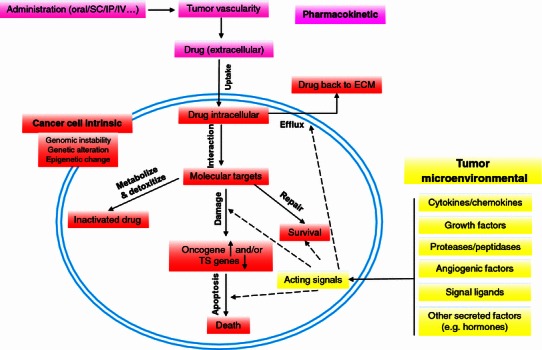
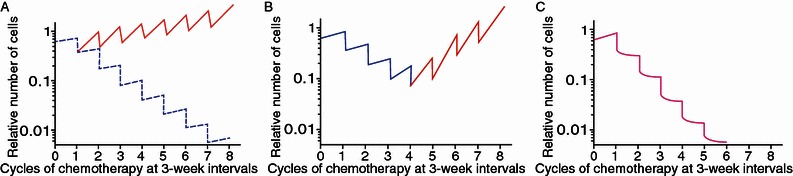
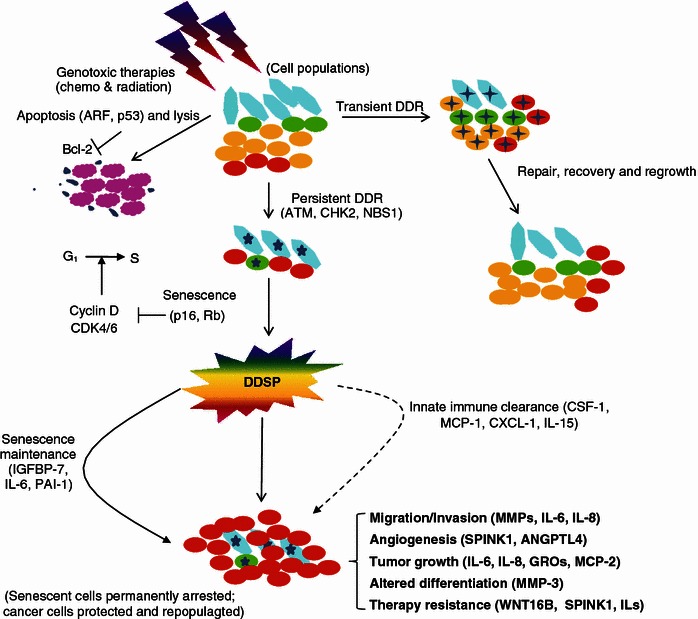
Cancer is a highly aggressive and devastating disease, and impediments to a cure arise not just from cancer itself. Targeted therapies are difficult to achieve since the majority of cancers are more intricate than ever imagined. Mainstream methodologies including chemotherapy and radiotherapy as routine clinical regimens frequently fail, eventually leading to pathologies that are refractory and incurable. One major cause is the gradual to rapid repopulation of surviving cancer cells during intervals of multiple-dose administration. Novel stress-responsive molecular pathways are increasingly unmasked and show promise as emerging targets for advanced strategies that aim at both de novo and acquired resistance. We highlight recent data reporting that treatments particularly those genotoxic can induce highly conserved damage responses in non-cancerous constituents of the tumor microenvironment (TMEN). Master regulators, including but not limited to NF-kB and C/EBP-β, are implicated and their signal cascades culminate in a robust, chronic and genome-wide secretory program, forming an activated TMEN that releases a myriad of soluble factors. The damage-elicited but essentially off target and cell non-autonomous secretory phenotype of host stroma causes adverse consequences, among which is acquired resistance of cancer cells. Harnessing signals arising from the TMEN, a pathophysiological niche frequently damaged by medical interventions, has the potential to promote overall efficacy and improve clinical outcomes provided that appropriate actions are ingeniously integrated into contemporary therapies. Thereby, anticancer regimens should be well tuned to establish an innovative clinical avenue, and such advancement will allow future oncological treatments to be more specific, accurate, thorough and personalized.
癌症是一种极具侵袭性和破坏性的疾病,治愈的障碍不仅源于癌症本身。由于大多数癌症比想象中更为复杂,因此难以实现靶向治疗。包括化疗和放疗在内的主流方法作为常规临床方案常常失败,最终导致难治和无法治愈的病症。一个主要原因是在多剂量给药间隔期间存活癌细胞会逐渐快速增殖。越来越多新发现的应激反应分子途径显示出有望成为针对原发性和获得性耐药的先进策略的新兴靶点。我们重点介绍了最近的数据,这些数据表明治疗尤其是那些具有基因毒性的治疗可在肿瘤微环境(TMEN)的非癌成分中诱导高度保守的损伤反应。包括但不限于NF-κB和C/EBP-β在内的主要调节因子参与其中,它们的信号级联最终形成一个强大、慢性且全基因组范围的分泌程序,形成一个激活的TMEN,释放出大量可溶性因子。宿主基质的损伤引发但本质上是脱靶且细胞非自主的分泌表型会导致不良后果,其中包括癌细胞获得性耐药。利用TMEN产生的信号(这是一个经常因医学干预而受损的病理生理生态位),如果将适当的措施巧妙地整合到当代疗法中,就有可能提高整体疗效并改善临床结果。因此,抗癌方案应进行良好调整以建立创新的临床途径,这种进展将使未来的肿瘤治疗更加特异、准确、彻底和个性化。