Cezar-de-Mello Paula F T, Toledo-Pinto Thiago G, Marques Carolinne S, Arnez Lucia E A, Cardoso Cynthia C, Guerreiro Luana T A, Antunes Sérgio L G, Jardim Márcia M, Covas Claudia de J F, Illaramendi Ximena, Dias-Baptista Ida M, Rosa Patrícia S, Durães Sandra M B, Pacheco Antonio G, Ribeiro-Alves Marcelo, Sarno Euzenir N, Moraes Milton O
Laboratório de Hanseníase, Instituto Oswaldo Cruz, Fundação Oswaldo Cruz (FIOCRUZ), Rio de Janeiro, Brasil.
Instituto Lauro de Souza Lima, Bauru, São Paulo, Brasil.
PLoS Negl Trop Dis. 2014 Sep 4;8(9):e3099. doi: 10.1371/journal.pntd.0003099. eCollection 2014 Sep.
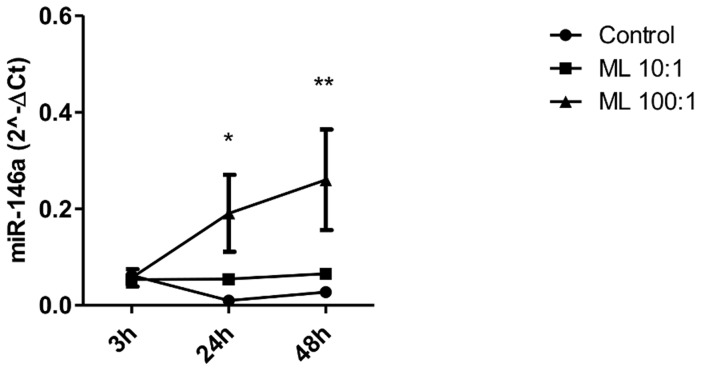
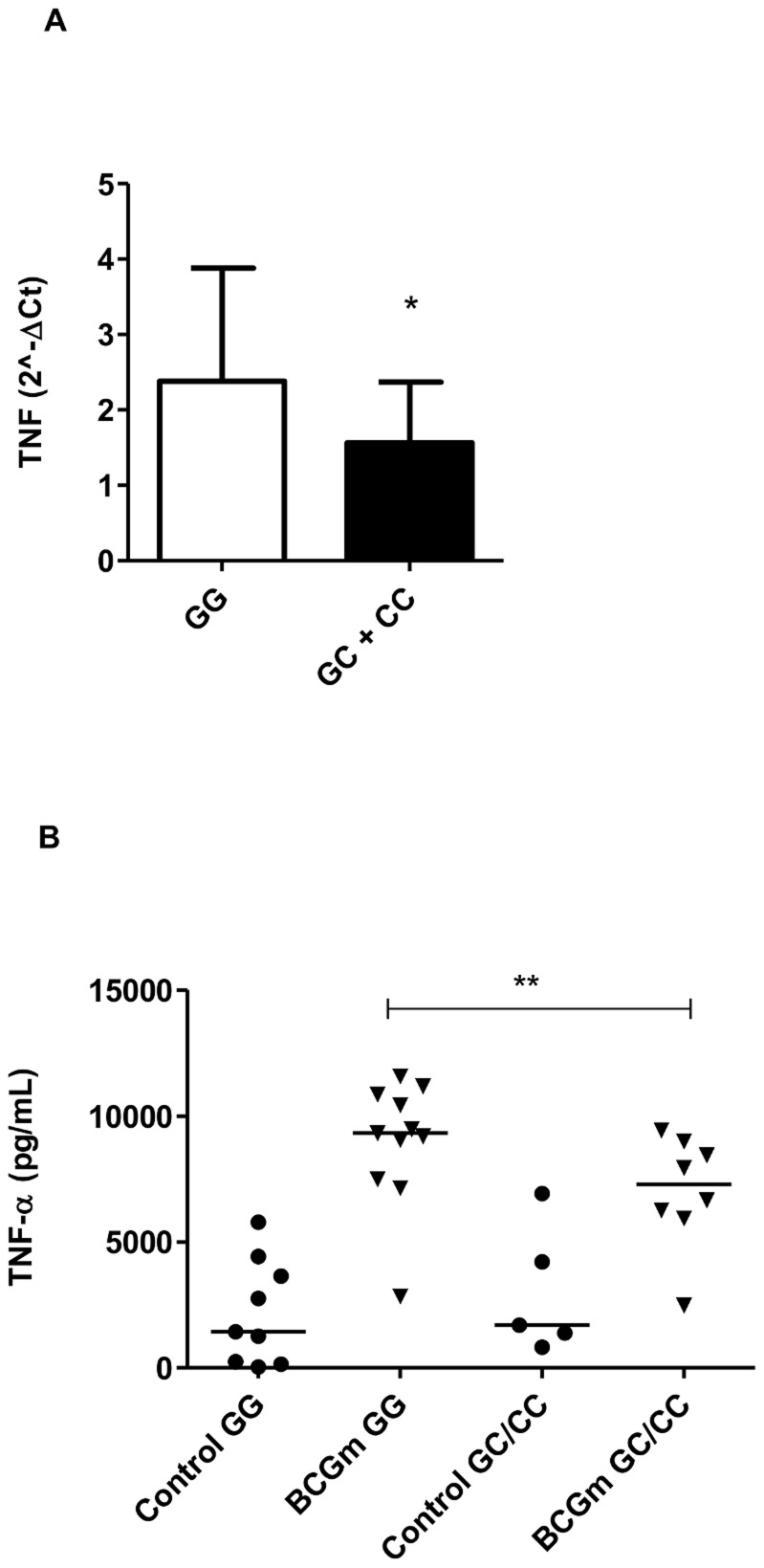
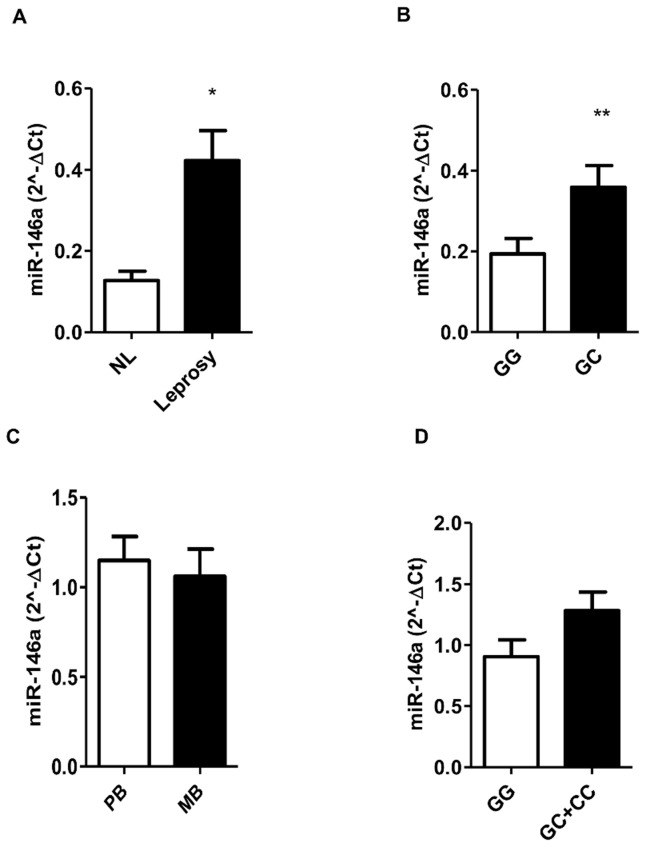
Mycobacterium leprae infects macrophages and Schwann cells inducing a gene expression program to facilitate its replication and progression to disease. MicroRNAs (miRNAs) are key regulators of gene expression and could be involved during the infection. To address the genetic influence of miRNAs in leprosy, we enrolled 1,098 individuals and conducted a case-control analysis in order to study four miRNAs genes containing single nucleotide polymorphism (miRSNP). We tested miRSNP-125a (rs12975333 G>T), miRSNP-223 (rs34952329 *>T), miRSNP-196a-2 (rs11614913 C>T) and miRSNP-146a (rs2910164 G>C). Amongst them, miRSNP-146a was the unique gene associated with risk to leprosy per se (GC OR = 1.44, p = 0.04; CC OR = 2.18, p = 0.0091). We replicated this finding showing that the C-allele was over-transmitted (p = 0.003) using a transmission-disequilibrium test. A functional analysis revealed that live M. leprae (MOI 100:1) was able to induce miR-146a expression in THP-1 (p<0.05). Furthermore, pure neural leprosy biopsies expressed augmented levels of that miRNA as compared to biopsy samples from neuropathies not related with leprosy (p = 0.001). Interestingly, carriers of the risk variant (C-allele) produce higher levels of mature miR-146a in nerves (p = 0.04). From skin biopsies, although we observed augmented levels of miR-146a, we were not able to correlate it with a particular clinical form or neither host genotype. MiR-146a is known to modulate TNF levels, thus we assessed TNF expression (nerve biopsies) and released by peripheral blood mononuclear cells infected with BCG Moreau. In both cases lower TNF levels correlates with subjects carrying the risk C-allele, (p = 0.0453 and p = 0.0352; respectively), which is consistent with an immunomodulatory role of this miRNA in leprosy.
麻风分枝杆菌感染巨噬细胞和施万细胞,诱导基因表达程序以促进其复制和疾病进展。微小RNA(miRNA)是基因表达的关键调节因子,可能参与感染过程。为了研究miRNA在麻风病中的遗传影响,我们招募了1098名个体并进行了病例对照分析,以研究四个含有单核苷酸多态性(miRSNP)的miRNA基因。我们检测了miRSNP-125a(rs12975333 G>T)、miRSNP-223(rs34952329 *>T)、miRSNP-196a-2(rs11614913 C>T)和miRSNP-146a(rs2910164 G>C)。其中,miRSNP-146a是唯一与麻风病本身风险相关的基因(GC基因型比值比=1.44,p=0.04;CC基因型比值比=2.18,p=0.0091)。我们通过传递不平衡检验重复了这一发现,表明C等位基因过度传递(p=0.003)。功能分析显示,活的麻风分枝杆菌(感染复数100:1)能够在THP-1细胞中诱导miR-146a表达(p<0.05)。此外,与非麻风性神经病的活检样本相比,纯神经麻风活检样本中该miRNA的表达水平升高(p=0.001)。有趣的是,风险变异体(C等位基因)携带者在神经中产生的成熟miR-146a水平更高(p=0.04)。从皮肤活检样本来看,尽管我们观察到miR-146a水平升高,但我们无法将其与特定的临床类型或宿主基因型相关联。已知miR-146a可调节TNF水平,因此我们评估了TNF的表达(神经活检)以及感染卡介苗莫罗的外周血单核细胞释放的TNF。在这两种情况下,较低的TNF水平都与携带风险C等位基因的受试者相关(分别为p=0.0453和p=0.0352),这与该miRNA在麻风病中的免疫调节作用一致。