den Hollander Wouter J, Holster I Lisanne, van Gilst Bianca, van Vuuren Anneke J, Jaddoe Vincent W V, Hofman Albert, Perez-Perez Guillermo I, Kuipers Ernst J, Moll Henriëtte A, Blaser Martin J
Departments of Gastroenterology and Hepatology, Erasmus University Medical Centre, Rotterdam, The Netherlands The Generation R Study Group, Erasmus University Medical Centre, Rotterdam, The Netherlands.
Departments of Gastroenterology and Hepatology, Erasmus University Medical Centre, Rotterdam, The Netherlands.
Gut. 2015 Aug;64(8):1200-8. doi: 10.1136/gutjnl-2014-307689. Epub 2014 Aug 28.
Helicobacter pylori colonisation rates in childhood have declined in Western populations, but it is unknown whether this trend is similar in children of non-Western ethnic backgrounds, born in a Western country. We aimed to identify H. pylori status in children, and determine mother-to-child transmission and risk factors for colonisation.
Antibodies against H. pylori and cytotoxin-associated gene A (CagA) were measured in children participating in a population-based prospective cohort study in Rotterdam, the Netherlands. Information on demographics and characteristics was collected using questionnaires.
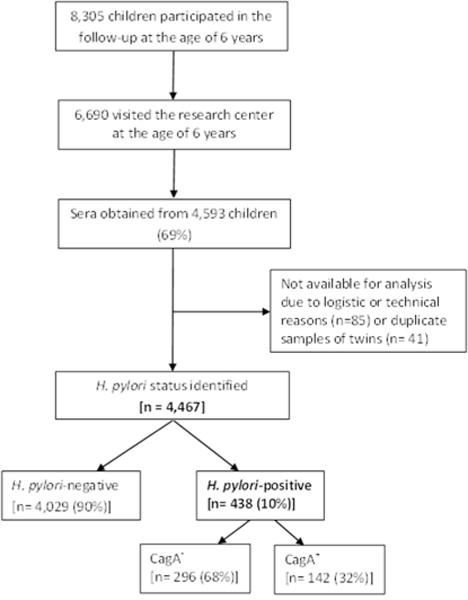
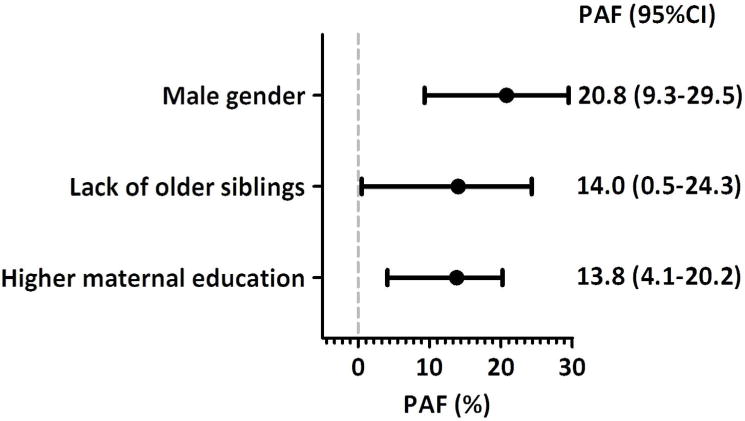
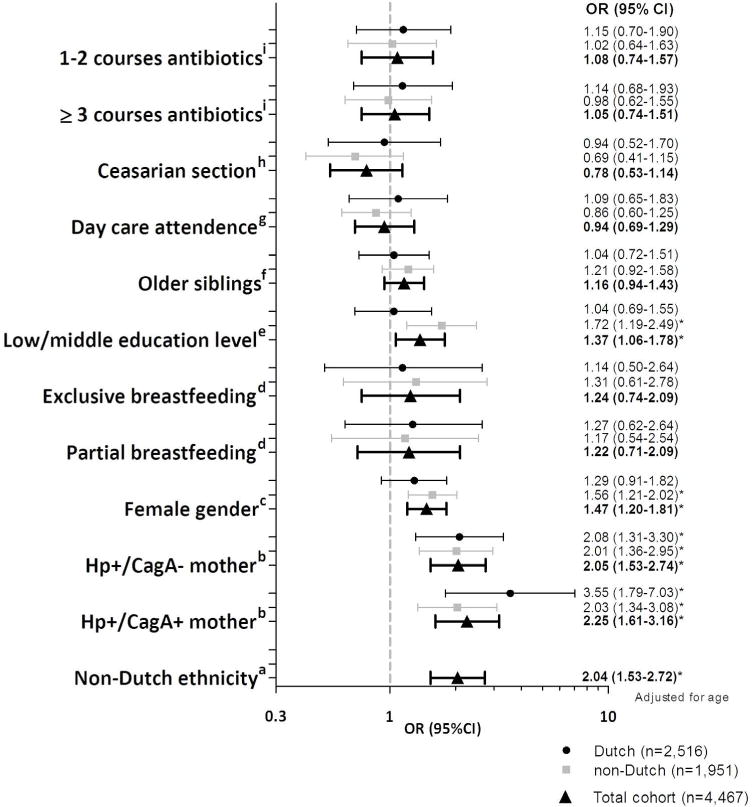
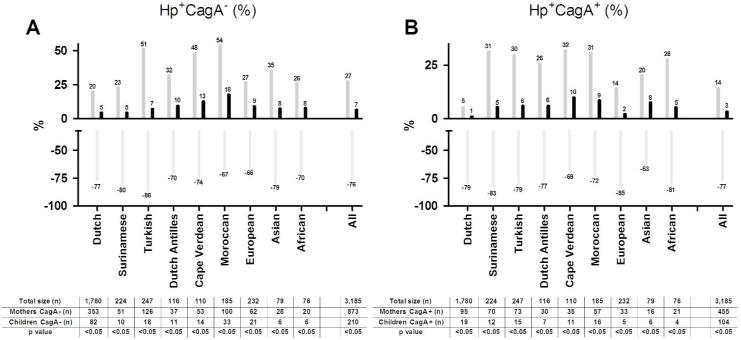
We analysed the serum of 4467 children (mean age 6.2 years±0.4 SD) and compared the results with the H. pylori status of their mothers (available for 3185 children). Overall, 438 (10%) children were H. pylori-positive, of whom 142 (32%) were CagA-positive. Independent risk factors for colonisation were: maternal H. pylori positivity (OR 2.12; 95% CI 1.62 to 2.77), non-Dutch ethnicity (OR 2.05; 95% CI 1.54 to 2.73), female gender (OR 1.47; 95% CI 1.20 to 1.80) and lower maternal education level (OR 1.38; 95% CI 1.06 to 1.79). Comparing mothers and children, we found an intergenerational decrease of 76% and 77% for Hp(+)CagA(-) and Hp(+)CagA(+)-strains, respectively, consistent across all nine ethnic groups studied. Male gender, higher maternal educational level and no older siblings, were independently associated with absence of H. pylori.
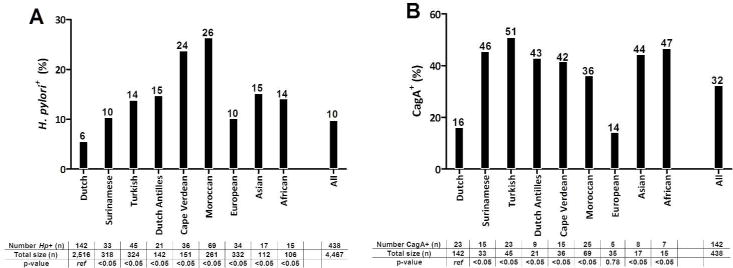
Although the highest H. pylori and CagA prevalence was found in children of non-Dutch ethnicities, the decreased colonisation rates were uniform across all ethnic groups, implying the importance of environmental factors in H. pylori transmission in modern cities, independent of ethnicity.
西方人群中儿童幽门螺杆菌的定植率有所下降,但尚不清楚在出生于西方国家的非西方族裔背景儿童中这一趋势是否相似。我们旨在确定儿童的幽门螺杆菌感染状况,并确定母婴传播及定植的危险因素。
在荷兰鹿特丹一项基于人群的前瞻性队列研究中,对参与研究的儿童检测了抗幽门螺杆菌抗体和细胞毒素相关基因A(CagA)。通过问卷调查收集人口统计学和特征信息。
我们分析了4467名儿童(平均年龄6.2岁±0.4标准差)的血清,并将结果与其母亲的幽门螺杆菌感染状况进行比较(3185名儿童可获取其母亲的感染状况)。总体而言,438名(10%)儿童幽门螺杆菌呈阳性,其中142名(32%)CagA呈阳性。定植的独立危险因素为:母亲幽门螺杆菌阳性(比值比2.12;95%置信区间1.62至2.77)、非荷兰族裔(比值比2.05;95%置信区间1.54至2.73)、女性(比值比1.47;95%置信区间1.20至1.80)以及母亲教育水平较低(比值比1.38;95%置信区间1.06至1.79)。比较母亲和儿童,我们发现Hp(+)CagA(-)和Hp(+)CagA(+)菌株的代际下降分别为76%和77%,在所研究的所有九个族裔群体中均一致。男性、母亲教育水平较高以及没有哥哥姐姐与未感染幽门螺杆菌独立相关。
尽管在非荷兰族裔儿童中幽门螺杆菌和CagA的患病率最高,但所有族裔群体的定植率下降情况均一致,这意味着在现代城市中环境因素在幽门螺杆菌传播中具有重要作用,与族裔无关。