Burroughs Lauri M, Nemecek Eneida R, Torgerson Troy R, Storer Barry E, Talano Julie-An, Domm Jennifer, Giller Roger H, Shimamura Akiko, Delaney Colleen, Skoda-Smith Suzanne, Thakar Monica S, Baker K Scott, Rawlings David J, Englund Janet A, Flowers Mary E D, Deeg H Joachim, Storb Rainer, Woolfrey Ann E
Fred Hutchinson Cancer Research Center, Seattle, Washington; University of Washington School of Medicine, Seattle, Washington; Seattle Children's Hospital, Seattle, Washington.
Oregon Health & Science University, Portland, Oregon.
Biol Blood Marrow Transplant. 2014 Dec;20(12):1996-2003. doi: 10.1016/j.bbmt.2014.08.020. Epub 2014 Sep 6.
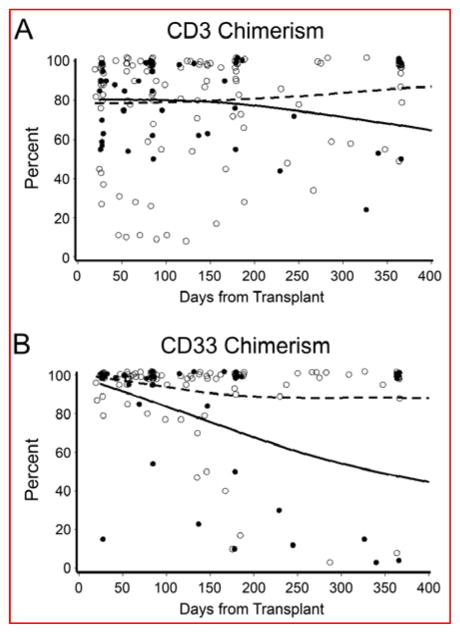
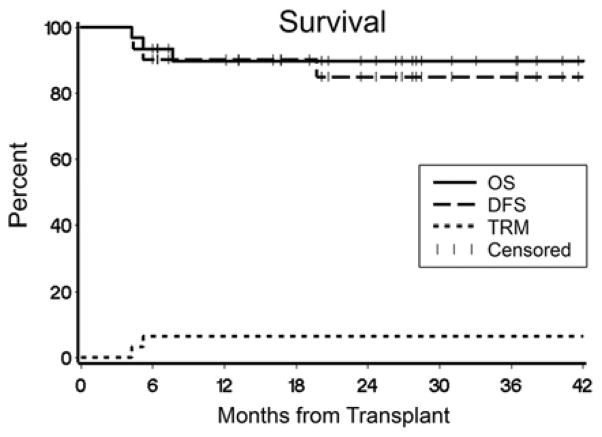
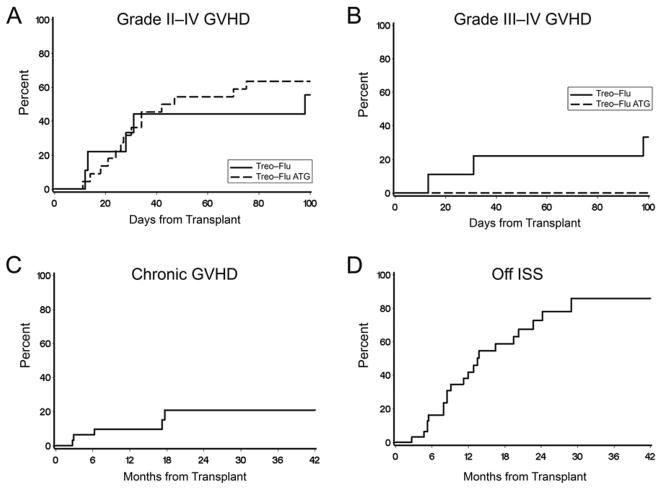
Hematopoietic cell transplantation is an effective treatment for patients with nonmalignant diseases and for many is the only known cure. Conventional myeloablative regimens have been associated with unacceptably high early transplant-related mortality (TRM), particularly in patients with comorbid conditions. This prospective multicenter trial was designed to determine the safety and engraftment efficacy of treosulfan-based conditioning in patients with nonmalignant diseases. Thirty-one patients received HLA-matched related (n = 4) or unrelated (n = 27) grafts after conditioning with treosulfan (total dose, 42 g/m(2)), fludarabine (total dose, 150 mg/m(2)), ± thymoglobulin (6 mg/kg; n = 22). Graft-versus-host disease (GVHD) prophylaxis consisted of tacrolimus and methotrexate. All patients engrafted. Day-100 TRM was 0%. With a median follow-up of 2 years, the 2-year survival was 90%. Three patients died of GVHD, recurrent hemophagocytic lymphohistiocytosis, and a surgical complication, respectively. The cumulative incidences of grades II to IV and III to IV acute GVHD at day 100 and chronic GVHD at 2 years were 62%, 10%, and 21%, respectively. Patients who received thymoglobulin had a significantly lower incidence of grades III to IV acute GVHD (0% versus 33%; P = .005). These results indicate that the combination of treosulfan, fludarabine, and thymoglobulin is effective at establishing donor engraftment with low toxicity and improved survival in patients with nonmalignant diseases and support the need for future disease-specific clinical trials.
造血细胞移植是治疗非恶性疾病患者的有效方法,对许多患者而言是唯一已知的治愈手段。传统的清髓方案与早期移植相关死亡率(TRM)高得令人难以接受有关,尤其是在合并症患者中。这项前瞻性多中心试验旨在确定以曲奥舒凡为基础的预处理方案在非恶性疾病患者中的安全性和植入效果。31例患者在接受曲奥舒凡(总剂量42 g/m²)、氟达拉滨(总剂量150 mg/m²)、±抗胸腺细胞球蛋白(6 mg/kg;n = 22)预处理后,接受了人类白细胞抗原(HLA)匹配的相关供体移植(n = 4)或无关供体移植(n = 27)。移植物抗宿主病(GVHD)预防措施包括他克莫司和甲氨蝶呤。所有患者均实现植入。100天的TRM为0%。中位随访2年,2年生存率为90%。3例患者分别死于GVHD、复发性噬血细胞性淋巴组织细胞增生症和手术并发症。100天时II至IV级和III至IV级急性GVHD以及2年时慢性GVHD的累积发生率分别为62%、10%和21%。接受抗胸腺细胞球蛋白的患者III至IV级急性GVHD的发生率显著较低(0%对33%;P = 0.005)。这些结果表明,曲奥舒凡、氟达拉滨和抗胸腺细胞球蛋白的联合应用在非恶性疾病患者中能有效实现供体植入,且毒性低、生存率提高,支持未来开展针对特定疾病的临床试验的必要性。