Göker Markus, Lu Megan, Fiebig Anne, Nolan Matt, Lapidus Alla, Tice Hope, Del Rio Tijana Glavina, Cheng Jan-Fang, Han Cliff, Tapia Roxanne, Goodwin Lynne A, Pitluck Sam, Liolios Konstantinos, Mavromatis Konstantinos, Pagani Ioanna, Ivanova Natalia, Mikhailova Natalia, Pati Amrita, Chen Amy, Palaniappan Krishna, Land Miriam, Mayilraj Shanmugam, Rohde Manfred, Detter John C, Bunk Boyke, Spring Stefan, Wirth Reinhard, Woyke Tanja, Bristow James, Eisen Jonathan A, Markowitz Victor, Hugenholtz Philip, Kyrpides Nikos C, Klenk Hans-Peter
Leibniz Institute DSMZ - German Collection of Microorganisms and Cell Cultures, Braunschweig, Germany.
DOE Joint Genome Institute, Walnut Creek, California, USA ; Los Alamos National Laboratory, Bioscience Division, Los Alamos, New Mexico, USA.
Stand Genomic Sci. 2014 Mar 15;9(3):1076-88. doi: 10.4056/sigs.5138968. eCollection 2014 Jun 15.
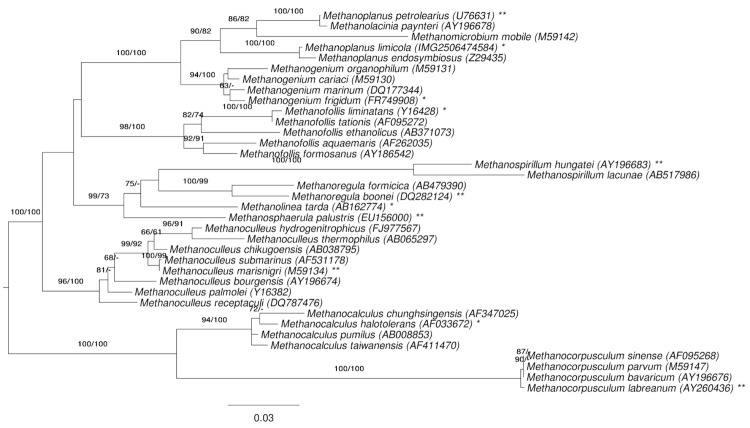
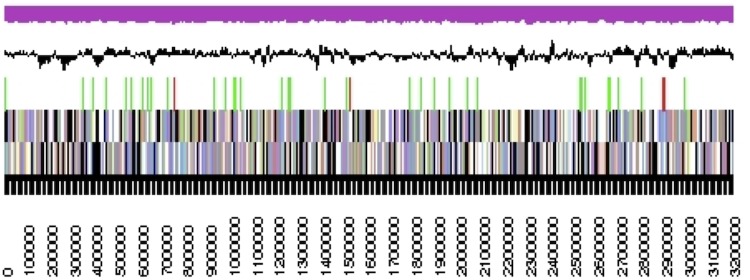
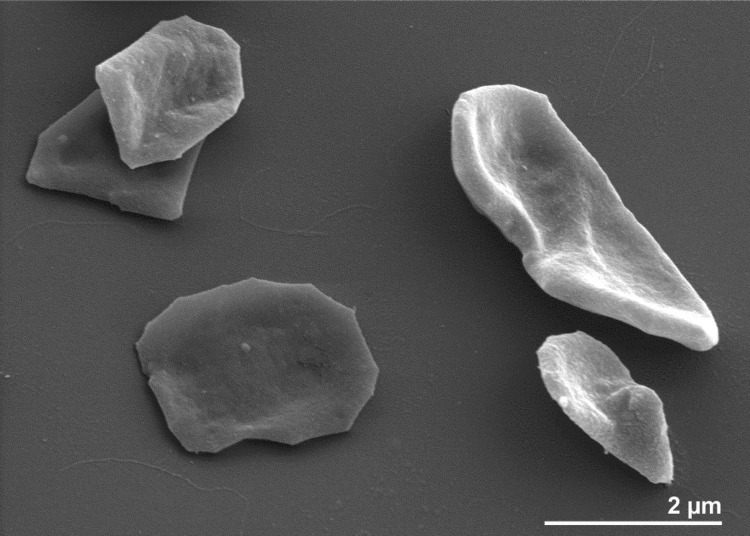
Methanoplanus limicola Wildgruber et al. 1984 is a mesophilic methanogen that was isolated from a swamp composed of drilling waste near Naples, Italy, shortly after the Archaea were recognized as a separate domain of life. Methanoplanus is the type genus in the family Methanoplanaceae, a taxon that felt into disuse since modern 16S rRNA gene sequences-based taxonomy was established. Methanoplanus is now placed within the Methanomicrobiaceae, a family that is so far poorly characterized at the genome level. The only other type strain of the genus with a sequenced genome, Methanoplanus petrolearius SEBR 4847(T), turned out to be misclassified and required reclassification to Methanolacinia. Both, Methanoplanus and Methanolacinia, needed taxonomic emendations due to a significant deviation of the G+C content of their genomes from previously published (pre-genome-sequence era) values. Until now genome sequences were published for only four of the 33 species with validly published names in the Methanomicrobiaceae. Here we describe the features of M. limicola, together with the improved-high-quality draft genome sequence and annotation of the type strain, M3(T). The 3,200,946 bp long chromosome (permanent draft sequence) with its 3,064 protein-coding and 65 RNA genes is a part of the G enomic E ncyclopedia of B acteria and Archaea project.
嗜泥甲烷平面菌(Methanoplanus limicola)由威尔德格鲁伯等人于1984年发现,是一种嗜温产甲烷菌,在古菌被确认为一个独立的生命域后不久,从意大利那不勒斯附近由钻井废料组成的沼泽中分离得到。甲烷平面菌属是甲烷平面菌科的模式属,自基于现代16S rRNA基因序列的分类法建立以来,该分类单元已不再使用。甲烷平面菌现在被归入甲烷微菌科,到目前为止,该科在基因组水平上的特征还很不清楚。该属另一个具有测序基因组的模式菌株,石油甲烷平面菌(Methanoplanus petrolearius)SEBR 4847(T),结果被错误分类,需要重新分类为甲醇嗜甲基菌属(Methanolacinia)。由于甲烷平面菌属和甲醇嗜甲基菌属的基因组G+C含量与之前发表的(基因组序列时代之前)值有显著偏差,两者都需要进行分类学修订。到目前为止,甲烷微菌科33个有效发表名称的物种中,只有4个物种的基因组序列被公布。在这里,我们描述了嗜泥甲烷平面菌的特征,以及模式菌株M3(T)的高质量改进草图基因组序列和注释。这个3200946 bp长的染色体(永久草图序列),含有3064个蛋白质编码基因和65个RNA基因,是细菌和古菌基因组百科全书项目的一部分。