Ramirez Oscar, Motta-Mena Laura B, Cordova Amanda, Estrada Abril, Li Qingyi, Martinez Luis, Garza Kristine M
Dept. of Biological Sciences, University of Texas at El Paso, El Paso, Texas, United States of America; Border Biomedical Research Center, University of Texas at El Paso, El Paso, Texas, United States of America.
Dept. of Biological Sciences, University of Texas at El Paso, El Paso, Texas, United States of America.
PLoS One. 2014 Sep 8;9(9):e106828. doi: 10.1371/journal.pone.0106828. eCollection 2014.
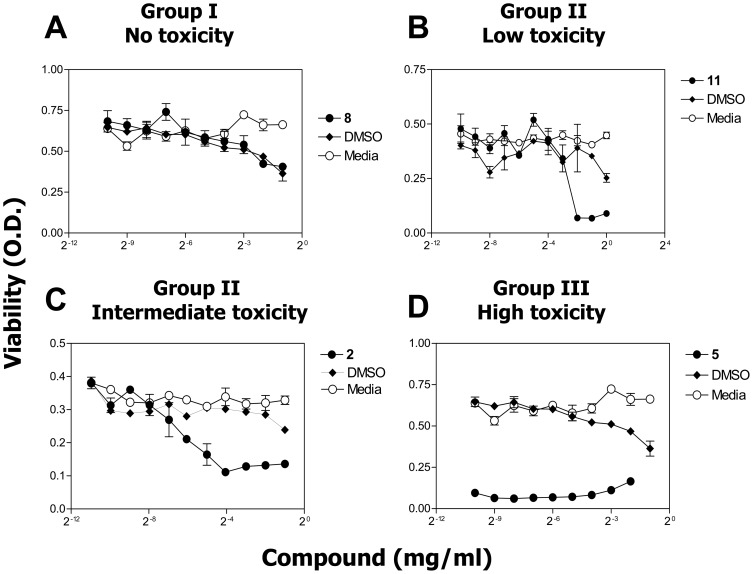
Synthesis of compound libraries and their concurrent assessment as selective reagents for probing and modulating biological function continues to be an active area of chemical biology. Microwave-assisted solid-phase Dötz benzannulation reactions have been used to inexpensively synthesize 2, 3-disubstituted-1, 4-naphthoquinone derivatives. Herein, we report the biological testing of a small library of such compounds using a murine fibroblast cell line (L929). Assessment of cellular viability identified three categories of cytotoxic compounds: no toxicity, low/intermediate toxicity and high toxicity. Increased levels of Annexin-V-positive staining and of caspase 3 activity confirmed that low, intermediate, and highly toxic compounds promote cell death. The compounds varied in their ability to induce mitochondrial depolarization and formation of reactive oxygen species (ROS). Both cytotoxic and non-cytotoxic compounds triggered mitochondrial depolarization, while one highly cytotoxic compound did not. In addition, all cytotoxic compounds promoted increased intracellular ROS but the cells were only partially protected from compound-induced apoptosis when in the presence of superoxide dismutase, catalase, or ascorbic acid suggesting utilization of additional pro-death mechanisms. In summary, nine of twelve (75%) 1, 4-naphthoquinone synthetic compounds were cytotoxic. Although the mitochondria did not appear to be a central target for induction of cell death, all of the cytotoxic compounds induced ROS formation. Thus, the data demonstrate that the synthesis regime effectively created cytotoxic compounds highlighting the potential use of the regime and its products for the identification of biologically relevant reagents.
化合物库的合成及其作为探测和调节生物功能的选择性试剂的同步评估仍然是化学生物学的一个活跃领域。微波辅助的固相Dötz苯并环化反应已被用于廉价地合成2,3-二取代-1,4-萘醌衍生物。在此,我们报告了使用小鼠成纤维细胞系(L929)对这类化合物的一个小型文库进行的生物学测试。细胞活力评估确定了三类细胞毒性化合物:无毒性、低/中度毒性和高毒性。膜联蛋白-V阳性染色水平和半胱天冬酶3活性的增加证实了低、中、高毒性化合物均能促进细胞死亡。这些化合物在诱导线粒体去极化和活性氧(ROS)形成的能力上有所不同。细胞毒性和非细胞毒性化合物均能引发线粒体去极化,而一种高细胞毒性化合物则不能。此外,所有细胞毒性化合物均能促进细胞内ROS增加,但当存在超氧化物歧化酶、过氧化氢酶或抗坏血酸时,细胞仅部分免受化合物诱导的凋亡,这表明还利用了其他促死亡机制。总之,十二种1,4-萘醌合成化合物中有九种(75%)具有细胞毒性。虽然线粒体似乎不是诱导细胞死亡的核心靶点,但所有细胞毒性化合物均能诱导ROS形成。因此,数据表明该合成方法有效地产生了细胞毒性化合物,突出了该方法及其产物在鉴定生物学相关试剂方面的潜在用途。