Ahluwalia Puja, Cameron Debra, Cockburn Lynn, Ellwood Lynn, Mori Brenda, Nixon Stephanie A
160-500 University Avenue, Toronto, ON M5G 1 V7, Canada.
BMC Med Educ. 2014 Sep 9;14:187. doi: 10.1186/1472-6920-14-187.
Clinical training in low-income countries has become increasingly popular among pre-licensure trainees from high-income countries. The Working Group on Ethics Guidelines for Global Health Training ("WEIGHT Guidelines") were designed to identify and inform the complex and contentious field of international clinical education. The purpose of this study was to use the WEIGHT Guidelines to evaluate an international clinical internship programme for Master's-level rehabilitation students at a Canadian university.
In-depth, semi-structured interviews were conducted with eight Canadian rehabilitation researchers, educations and/or clinicians responsible for administering international internships across three clinical training programmes. Interview questions were informed by the WEIGHT Guidelines. Directed content analysis was used to identify priorities for policy, practice and research.
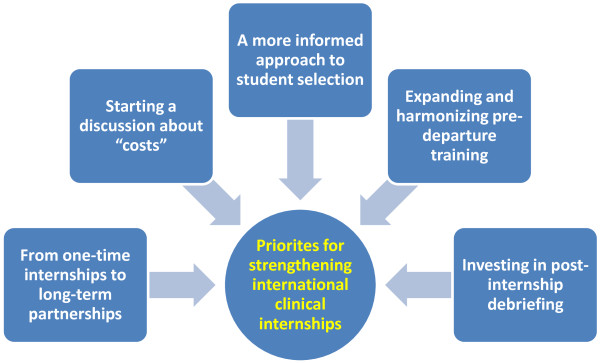
Five themes relating to strengthening international clinical education were identified: (1) from one-time internships to long-term partnerships, (2) starting a discussion about "costs", (3) a more informed approach to student selection, (4) expanding and harmonizing pre-departure training across disciplines, and (5) investing in post-internship debriefing.
International clinical education is fraught with ethical, pedagogical and logistical issues that require recognition and ongoing management. This is the first study to use the WEIGHT Guidelines as a qualitative research tool for assessing an existing global health education programme. Results highlight new priorities for action at the Canadian "sending institution", including more explicit attention to the costs (broadly defined) borne by all parties. A crucial next step is deepened engagement with educational partners at the "receiving organizations" based in low-income countries to nurture dialogue regarding reciprocity, trust and sustainability of the partnership. Education research is also needed that evaluates models of pre-departure training and post-internship debriefing for trainees.
低收入国家的临床培训在高收入国家的执照前学员中越来越受欢迎。全球健康培训伦理准则工作组(“WEIGHT准则”)旨在识别并为国际临床教育这一复杂且有争议的领域提供信息。本研究的目的是使用WEIGHT准则评估加拿大一所大学针对硕士水平康复专业学生的国际临床实习项目。
对八名加拿大康复研究人员、教育工作者和/或临床医生进行了深入的半结构化访谈,他们负责管理三个临床培训项目中的国际实习。访谈问题参考了WEIGHT准则。采用定向内容分析法确定政策、实践和研究的重点。
确定了与加强国际临床教育相关的五个主题:(1)从一次性实习到长期伙伴关系;(2)开始讨论“成本”;(3)采用更明智的学生选拔方法;(4)跨学科扩展并统一出发前培训;(5)投入实习后汇报工作。
国际临床教育充满了伦理、教学和后勤问题,需要得到认识并持续加以管理。这是第一项将WEIGHT准则用作定性研究工具来评估现有全球健康教育项目的研究。结果突出了加拿大“派遣机构”新的行动重点,包括更明确地关注各方承担的(广义定义的)成本。关键的下一步是与低收入国家“接收机构”的教育伙伴加深合作,以促进关于伙伴关系的互惠、信任和可持续性的对话。还需要开展教育研究,评估实习生出发前培训和实习后汇报工作的模式。