Xie Meng, Zhang Xuyin, Jia Zhan, Ren Yunyun, Wang Wenping
Department of Ultrasound, Obstetrics and Gynecology Hospital, Fudan University, Shanghai 200090, P.R. China.
Department of Obstetrics and Gynecology, Obstetrics and Gynecology Hospital, Fudan University, Shanghai 200090, P.R. China.
Oncol Lett. 2014 Oct;8(4):1652-1656. doi: 10.3892/ol.2014.2346. Epub 2014 Jul 11.
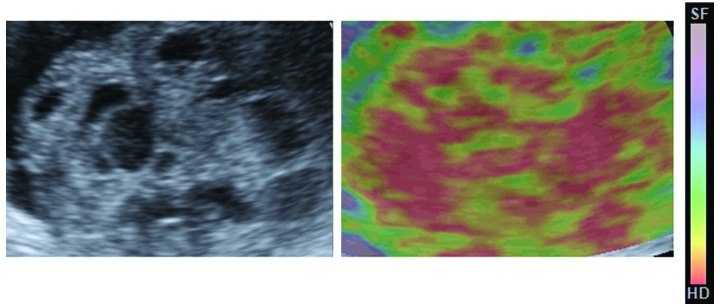
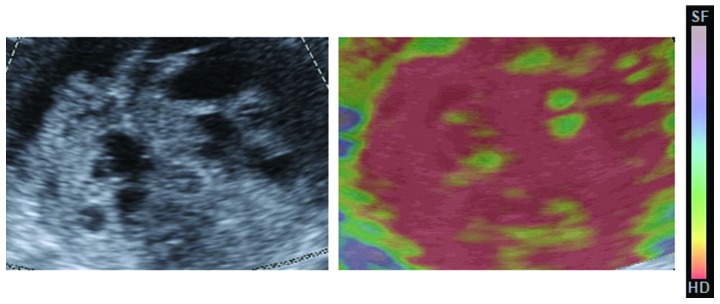
The aim of the present study was to evaluate tumor stiffness by ultrasound elastography, which has the potential to provide additional information that is useful in predicting the response to neoadjuvant chemotherapy (NACT) in high-grade serous ovarian carcinoma (HGSC) patients. In total, 32 patients with International Federation of Gynecology and Obstetrics stage III and IV epithelial ovarian cancer treated with NACT underwent transvaginal and transabdominal sonography, followed by elastography and finally, by interval cytoreductive surgery. Histopathological analysis revealed 24 (75%) HGSCs. The mean elasticity score was statistically higher for the post-NACT lesions than for the pre-NACT lesions (3.13±0.57 vs. 2.04±0.51, respectively; P<0.001). The median elasticity score for the pre-NACT lesions on the four-point scale was 2, and the score for the post-NACT lesions was 4. Cases of post-NACT with scores of 3 and 4 had a higher optimal cytoreduction rate than cases with scores of 1 and 2 (93.8 vs. 25.0%, respectively; P<0.001). When the post-NACT elasticity scores of 3 and 4 were used for the prediction of optimal cytoreduction, elastography exhibited 88.2% sensitivity, 85.7% specificity, a 93.8% positive predictive value, a 75.0% negative predictive value and 87.5% accuracy. The results of the current study suggested that elastography is a sensitive tool for the evaluation of NACT in patients with HGSC and that it may aid gynecologists in choosing the optimal cytoreduction.
本研究的目的是通过超声弹性成像评估肿瘤硬度,超声弹性成像有可能提供额外信息,有助于预测高级别浆液性卵巢癌(HGSC)患者对新辅助化疗(NACT)的反应。共有32例接受NACT治疗的国际妇产科联盟III期和IV期上皮性卵巢癌患者接受了经阴道和经腹超声检查,随后进行弹性成像检查,最后进行间歇性细胞减灭术。组织病理学分析显示24例(75%)为HGSC。NACT后病变的平均弹性评分在统计学上高于NACT前病变(分别为3.13±0.57和2.04±0.51;P<0.001)。在四点量表上,NACT前病变的中位弹性评分为2分,NACT后病变的评分为4分。NACT后评分为3分和4分的病例比评分为1分和2分的病例具有更高的最佳细胞减灭率(分别为93.8%和25.0%;P<0.001)。当使用NACT后弹性评分3分和4分来预测最佳细胞减灭时,弹性成像显示出88.2%的敏感性、85.7%的特异性、93.8%的阳性预测值、75.0%的阴性预测值和87.5%的准确性。本研究结果表明,弹性成像是评估HGSC患者NACT的一种敏感工具,它可能有助于妇科医生选择最佳的细胞减灭方案。