
用于检测粪便DNA中结直肠癌的SFRP2、GATA4/5、NDRG4和波形蛋白的DNA甲基化分析
DNA methylation analysis of SFRP2, GATA4/5, NDRG4 and VIM for the detection of colorectal cancer in fecal DNA.
作者信息
Lu Hongna, Huang Shiliang, Zhang Xie, Wang Danping, Zhang Xuesong, Yuan Xiaogang, Zhang Qiubo, Huang Zhigang
机构信息
Ningbo Medical Center, Li Huili Hospital, Ningbo, Zhejiang 315040, P.R. China ; Medical School of Ningbo University, Ningbo, Zhejiang 315211, P.R. China.
Ningbo Medical Center, Li Huili Hospital, Ningbo, Zhejiang 315040, P.R. China.
出版信息
Oncol Lett. 2014 Oct;8(4):1751-1756. doi: 10.3892/ol.2014.2413. Epub 2014 Aug 4.
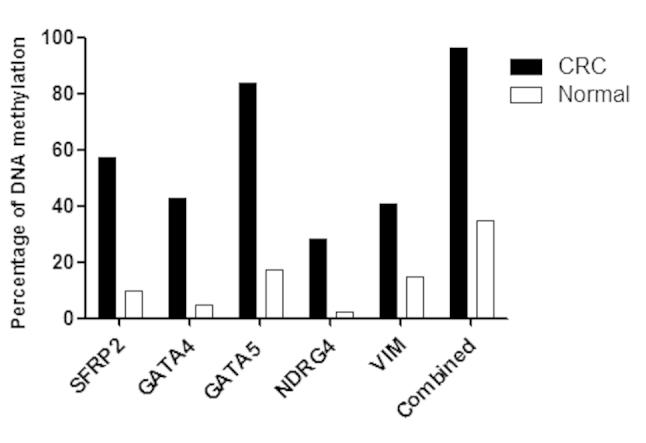
Aberrantly methylated genes are increasingly being established as biomarkers for the detection of colorectal cancer (CRC). In the present study, the methylation levels of the secreted frizzled-related protein gene 2 (, GATA binding protein 4/5 (/), N-Myc downstream-regulated gene 4 () and vimentin () promoters were evaluated for their use as markers in the noninvasive detection of CRC. Methylation-specific polymerase chain reaction was performed to analyze promoter CpG methylation of , /, and in the fecal DNA of 56 patients with CRC and 40 individuals exhibiting normal colonoscopy results. Promoter methylation levels of , /, and in CRC patients were 57.1% (32/56), 42.9% (24/56), 83.9% (47/56), 28.6% (16/56) and 41.1% (23/56), respectively. Furthermore, the specificity of the genes were 90.0% (4/40), 95.0% (2/40), 82.5% (7/40), 97.5% (4/40) and 85.0% (6/40), respectively. The overall sensitivity of detection for fecal DNA with at least one methylated gene was 96.4% (54/56) in CRC patients. By contrast, only 14 of the 40 normal individuals exhibited methylated DNA in the aforementioned promoter regions. Methylation of the , /, and promoters in fecal DNA is associated with the presence of colorectal tumors. Therefore, the detection of aberrantly methylated DNA in fecal samples may present a promising, noninvasive screening method for CRC.
异常甲基化基因越来越多地被确立为检测结直肠癌(CRC)的生物标志物。在本研究中,评估了分泌型卷曲相关蛋白基因2()、GATA结合蛋白4/5(/)、N-Myc下游调节基因4()和波形蛋白()启动子的甲基化水平,以确定其在CRC无创检测中的应用价值。采用甲基化特异性聚合酶链反应分析56例CRC患者和40例结肠镜检查结果正常个体粪便DNA中、/、和的启动子CpG甲基化情况。CRC患者中、/、和的启动子甲基化水平分别为57.1%(32/56)、42.9%(24/56)、83.9%(47/56)、28.6%(16/56)和41.1%(23/56)。此外,这些基因的特异性分别为90.0%(4/40)、95.0%(2/40)、82.5%(7/40)、97.5%(4/40)和85.0%(6/40)。CRC患者中至少有一个甲基化基因的粪便DNA检测总体灵敏度为96.4%(54/56)。相比之下,40例正常个体中只有14例在上述启动子区域出现DNA甲基化。粪便DNA中、/、和启动子的甲基化与结直肠肿瘤的存在相关。因此,检测粪便样本中异常甲基化的DNA可能是一种有前景的CRC无创筛查方法。

 Zotero 插件