Wright Kyle T, Giardina Charles, Vella Anthony T
Department of Immunology, University of Connecticut Health Center, University of Connecticut Heath Center, MC3710 263 Farmington Avenue, Farmington, CT 06030, USA.
Department of Molecular & Cell Biology, University of Connecticut, 91 North Eagleville Road, Unit 3125, Storrs, CT 06269-3125, USA.
Biochem Pharmacol. 2014 Nov 15;92(2):184-91. doi: 10.1016/j.bcp.2014.08.027. Epub 2014 Sep 6.
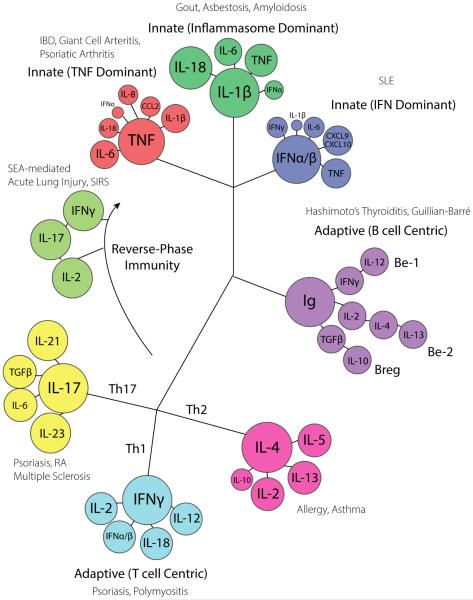
Inflammatory responses can vary depending on a myriad of factors including: (1) the initiating stimulus or trigger, (2) the cell types involved in the response, and (3) the specific effector cytokine-chemokine milieus produced. The compilation of these and other factors in a given mechanistic context is sometimes referred to as the "inflammome". Humans and other higher-order mammals have evolved (over time) several discrete inflammomes to counter the effects of pathogens. However, when these inflammomes are induced inappropriately, they drive the development of chronic inflammatory diseases. The vast majority of biological anti-inflammatory treatments currently being developed are focused on the post hoc inhibition of downstream effectors by anti-cytokine monoclonal antibodies and receptor antagonists. This prevailing "end-point treatment" has even directed a new disease classification paradigm, namely a cytokine-based disease classification, as opposed to a traditional diagnosis based on a particular tissue or organ system dysfunction. Although this approach has a number of advantages, it omits the processes that led to the generation of the inflammatory effectors in the first place. In this review, we will expand the cytokine-based disease taxonomy into an inflammome-based taxonomy that includes interventions that subvert a priori cytokine development and can complement post hoc inhibition.
炎症反应会因众多因素而有所不同,这些因素包括:(1)起始刺激或触发因素;(2)参与反应的细胞类型;以及(3)所产生的特定效应细胞因子 - 趋化因子环境。在特定机制背景下,这些因素与其他因素的综合有时被称为“炎症小体”。人类和其他高等哺乳动物(随着时间推移)已经进化出几种不同的炎症小体来对抗病原体的影响。然而,当这些炎症小体被不恰当地诱导时,它们会推动慢性炎症性疾病的发展。目前正在研发的绝大多数生物抗炎治疗方法都集中在通过抗细胞因子单克隆抗体和受体拮抗剂对下游效应器进行事后抑制。这种普遍的“终点治疗”甚至引导了一种新的疾病分类范式,即基于细胞因子的疾病分类,这与基于特定组织或器官系统功能障碍的传统诊断方法不同。尽管这种方法有许多优点,但它首先忽略了导致炎症效应器产生的过程。在本综述中,我们将基于细胞因子的疾病分类法扩展为基于炎症小体的分类法,其中包括颠覆先验细胞因子发展并可补充事后抑制的干预措施。