Joaquim Andrei F, Ghizoni Enrico, Giacomini Leonardo A, Tedeschi Helder, Patel Alpesh A
Department of Neurology, Neurosurgery Division, State University of Campinas (UNICAMP), Campinas, SP, Brazil.
Department of Orthopaedics, Northwestern University, Chicago, IL, USA.
J Craniovertebr Junction Spine. 2014 Apr;5(2):78-84. doi: 10.4103/0974-8237.139202.
Basilar invagination (BI) is a congenital craniocervical junction (CCJ) anomaly represented by a prolapsed spine into the skull-base that can result in severe neurological impairment.
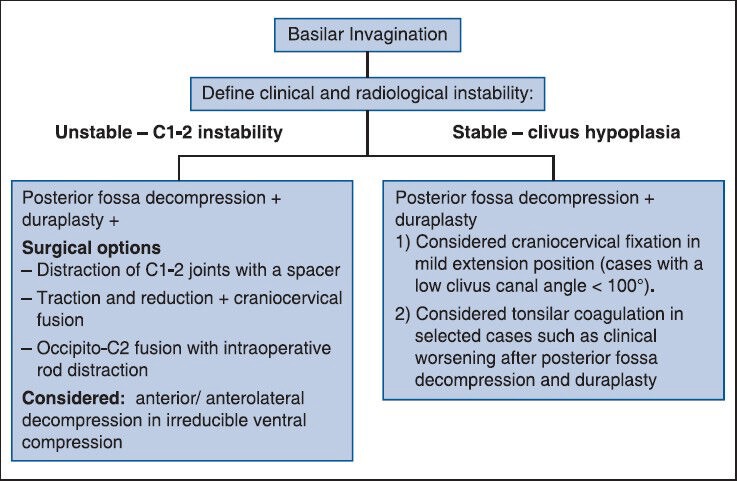
In this paper, we retrospective evaluate the surgical treatment of 26 patients surgically treated for symptomatic BI. BI was classified according to instability and neural abnormalities findings. Clinical outcome was evaluated using the Nürick grade system.
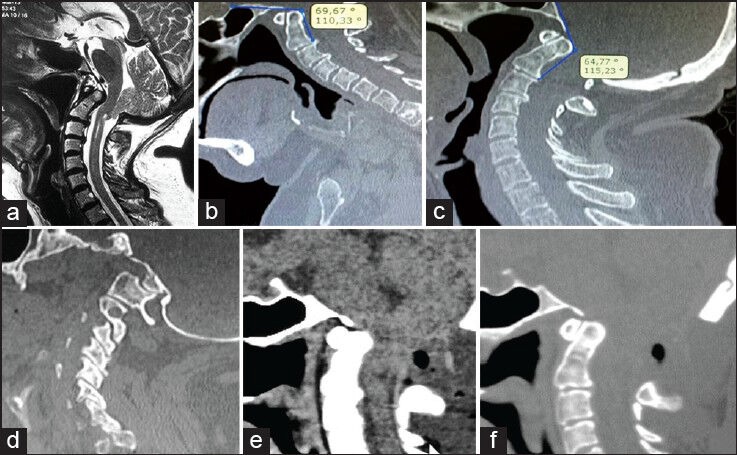
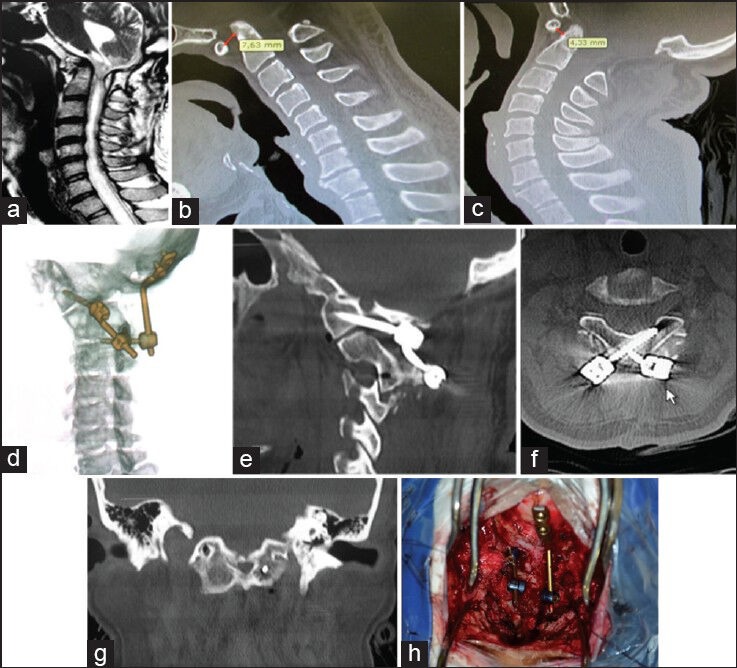
A total of 26 patients were included in this paper. Their age ranged from 15 to 67 years old (mean 38). Of which, 10 patients were male (38%) and 16 (62%) were female. All patients had some degree of tonsillar herniation, with 25 patients treated with foramen magnum decompression. Nine patients required a craniocervical fixation. Six patients had undergone prior surgery and required a new surgical procedure for progression of neurological symptoms associated with new compression or instability. Most of patients with neurological symptoms secondary to brainstem compression had some improvement during the follow-up. There was mortality in this series, 1 month after surgery, associated with a late removal of the tracheal cannula.
Management of BI requires can provide improvements in neurological outcomes, but requires analysis of the neural and bony anatomy of the CCJ, as well as occult instability. The complexity and heterogeneous presentation requires attention to occult instability on examination and attention to airway problems secondary to concomitant facial malformations.
颅底陷入症(BI)是一种先天性颅颈交界区(CCJ)异常,表现为脊柱向颅底脱垂,可导致严重的神经功能障碍。
在本文中,我们回顾性评估了26例因症状性BI接受手术治疗的患者。根据不稳定和神经异常表现对BI进行分类。使用Nürick分级系统评估临床结果。
本文共纳入26例患者。他们的年龄在15至67岁之间(平均38岁)。其中,10例为男性(38%),16例为女性(62%)。所有患者均有一定程度的扁桃体疝,25例患者接受了枕骨大孔减压术。9例患者需要进行颅颈固定。6例患者曾接受过手术,因与新的压迫或不稳定相关的神经症状进展而需要再次手术。大多数继发于脑干压迫的神经症状患者在随访期间有所改善。本系列中有1例患者在术后1个月死亡,与气管插管延迟拔除有关。
BI的治疗需要分析CCJ的神经和骨骼解剖结构以及隐匿性不稳定,这样才能改善神经功能结局。其复杂性和异质性表现要求在检查时关注隐匿性不稳定,并注意伴随面部畸形引起的气道问题。